

6.9 Exercise 18: The Wind-Driven Circulation
147
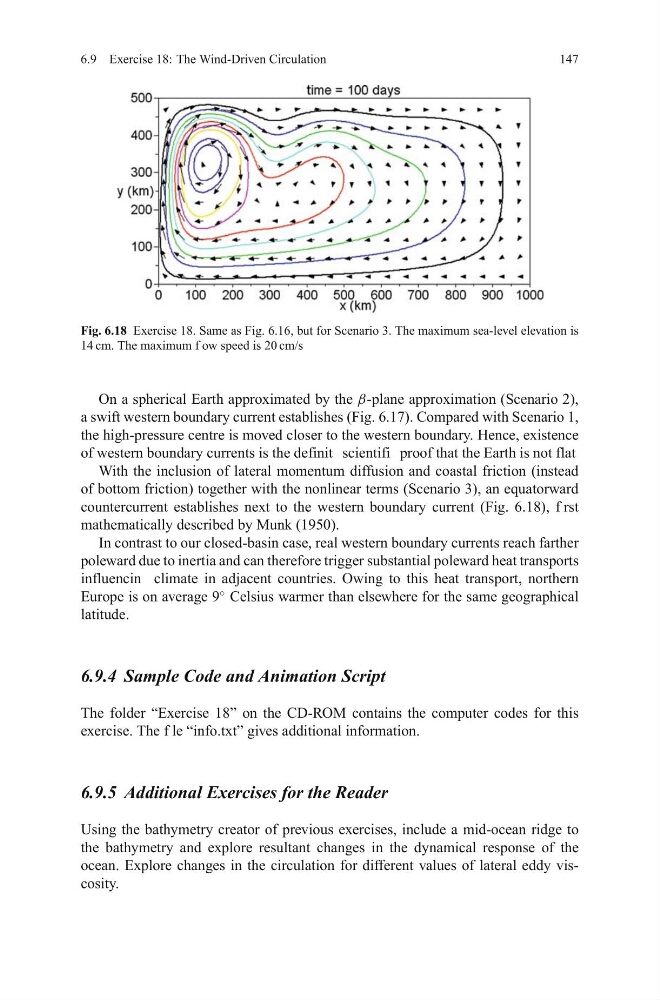
Fig. 6.18 Exercise 18. Same as Fig. 6.16, but for Scenario 3. The maximum sea-level elevation is
14 cm. The maximum f ow speed is 20 cm/s
On a spherical Earth approximated by the β-plane approximation (Scenario 2),
a swift western boundary current establishes (Fig. 6.17). Compared with Scenario 1,
the high-pressure centre is moved closer to the western boundary. Hence, existence
of western boundary currents is the definit scientifi proof that the Earth is not flat
With the inclusion of lateral momentum diffusion and coastal friction (instead
of bottom friction) together with the nonlinear terms (Scenario 3), an equatorward
countercurrent establishes next to the western boundary current (Fig. 6.18), f rst
mathematically described by Munk (1950).
In contrast to our closed-basin case, real western boundary currents reach farther
poleward due to inertia and can therefore trigger substantial poleward heat transports
influencin climate in adjacent countries. Owing to this heat transport, northern
Europe is on average 9
◦
Celsius warmer than elsewhere for the same geographical
latitude.
6.9.4 Sample Code and Animation Script
The folder “Exercise 18” on the CD-ROM contains the computer codes for this
exercise. The f le “info.txt” gives additional information.
6.9.5 Additional Exercises for the Reader
Using the bathymetry creator of previous exercises, include a mid-ocean ridge to
the bathymetry and explore resultant changes in the dynamical response of the
ocean. Explore changes in the circulation for different values of lateral eddy viscosity.
147
Fig. 6.18 Exercise 18. Same as Fig. 6.16, but for Scenario 3. The maximum sea-level elevation is
14 cm. The maximum f ow speed is 20 cm/s
On a spherical Earth approximated by the β-plane approximation (Scenario 2),
a swift western boundary current establishes (Fig. 6.17). Compared with Scenario 1,
the high-pressure centre is moved closer to the western boundary. Hence, existence
of western boundary currents is the definit scientifi proof that the Earth is not flat
With the inclusion of lateral momentum diffusion and coastal friction (instead
of bottom friction) together with the nonlinear terms (Scenario 3), an equatorward
countercurrent establishes next to the western boundary current (Fig. 6.18), f rst
mathematically described by Munk (1950).
In contrast to our closed-basin case, real western boundary currents reach farther
poleward due to inertia and can therefore trigger substantial poleward heat transports
influencin climate in adjacent countries. Owing to this heat transport, northern
Europe is on average 9
◦
Celsius warmer than elsewhere for the same geographical
latitude.
6.9.4 Sample Code and Animation Script
The folder “Exercise 18” on the CD-ROM contains the computer codes for this
exercise. The f le “info.txt” gives additional information.
6.9.5 Additional Exercises for the Reader
Using the bathymetry creator of previous exercises, include a mid-ocean ridge to
the bathymetry and explore resultant changes in the dynamical response of the
ocean. Explore changes in the circulation for different values of lateral eddy viscosity.