

142
6 Rotational Effects
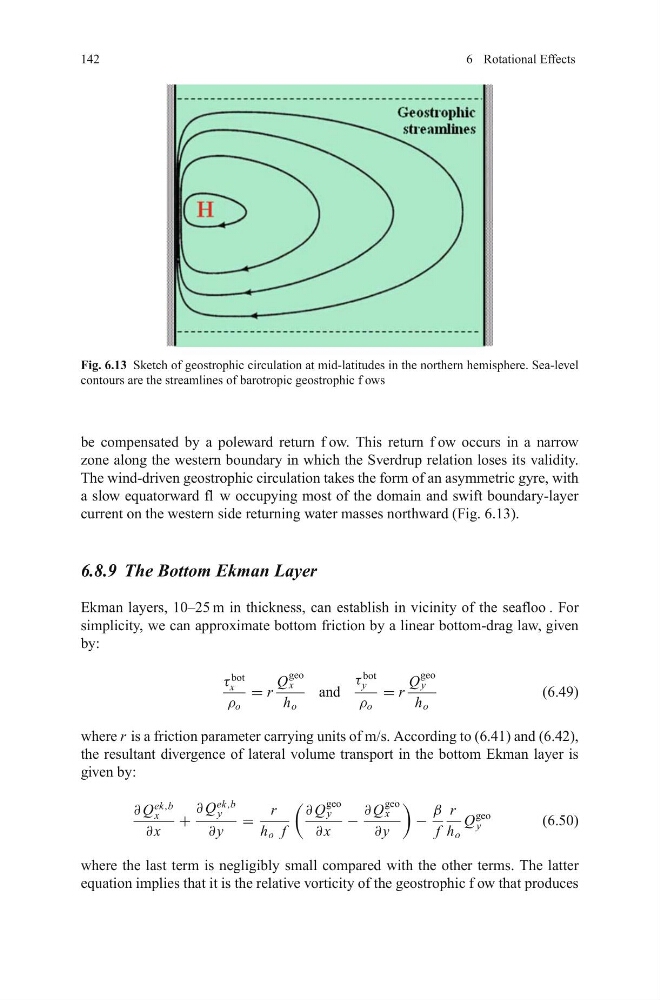
Fig. 6.13 Sketch of geostrophic circulation at mid-latitudes in the northern hemisphere. Sea-level
contours are the streamlines of barotropic geostrophic f ows
be compensated by a poleward return f ow. This return f ow occurs in a narrow
zone along the western boundary in which the Sverdrup relation loses its validity.
The wind-driven geostrophic circulation takes the form of an asymmetric gyre, with
a slow equatorward fl w occupying most of the domain and swift boundary-layer
current on the western side returning water masses northward (Fig. 6.13).
6.8.9 The Bottom Ekman Layer
Ekman layers, 10–25 m in thickness, can establish in vicinity of the seafloo . For
simplicity, we can approximate bottom friction by a linear bottom-drag law, given
by:
τ
bot
x
ρ o
= r
Q
geo
x
h o
and
τ
bot
y
ρ o
= r
Q
geo
y
h o
(6.49)
where r is a friction parameter carrying units of m/s. According to (6.41) and (6.42),
the resultant divergence of lateral volume transport in the bottom Ekman layer is
given by:
∂ Q
ek,b
x
∂ x
+
∂ Q
ek,b
y
∂ y
=
r
h o f
∂ Q
geo
y
∂ x
−
∂ Q
geo
x
∂ y
−
β
f
r
h o
Q
geo
y
(6.50)
where the last term is negligibly small compared with the other terms. The latter
equation implies that it is the relative vorticity of the geostrophic f ow that produces
6 Rotational Effects
Fig. 6.13 Sketch of geostrophic circulation at mid-latitudes in the northern hemisphere. Sea-level
contours are the streamlines of barotropic geostrophic f ows
be compensated by a poleward return f ow. This return f ow occurs in a narrow
zone along the western boundary in which the Sverdrup relation loses its validity.
The wind-driven geostrophic circulation takes the form of an asymmetric gyre, with
a slow equatorward fl w occupying most of the domain and swift boundary-layer
current on the western side returning water masses northward (Fig. 6.13).
6.8.9 The Bottom Ekman Layer
Ekman layers, 10–25 m in thickness, can establish in vicinity of the seafloo . For
simplicity, we can approximate bottom friction by a linear bottom-drag law, given
by:
τ
bot
x
ρ o
= r
Q
geo
x
h o
and
τ
bot
y
ρ o
= r
Q
geo
y
h o
(6.49)
where r is a friction parameter carrying units of m/s. According to (6.41) and (6.42),
the resultant divergence of lateral volume transport in the bottom Ekman layer is
given by:
∂ Q
ek,b
x
∂ x
+
∂ Q
ek,b
y
∂ y
=
r
h o f
∂ Q
geo
y
∂ x
−
∂ Q
geo
x
∂ y
−
β
f
r
h o
Q
geo
y
(6.50)
where the last term is negligibly small compared with the other terms. The latter
equation implies that it is the relative vorticity of the geostrophic f ow that produces