

Chapter 6
Rotational Effects
Abstract This chapter applies the shallow-water equations to study a variety of
hydrodynamic processes being influence or even controlled by the Coriolis force.
The reader is introduced to quasi-geostrophic f ows and the concept of vorticity.
Exercises address a rich variety of processes including coastal Kelvin waves, topographic steering of barotropic quasi-geostrophic f ows, topographic Rossby waves,
the general wind-driven circulation of the ocean, western boundary currents, baroclinic compensation, geostrophic adjustment of density fronts, the baroclinic instability mechanism, and reduced-gravity plumes.
6.1 The Complete Shallow-Water Equations
6.1.1 Description
Exercises in this chapter employ the single-layer shallow-water equations in their
complete form including nonlinear terms, wind-stress forcing, the Coriolis force,
the pressure-gradient force, bottom friction and lateral diffusion of momentum. The
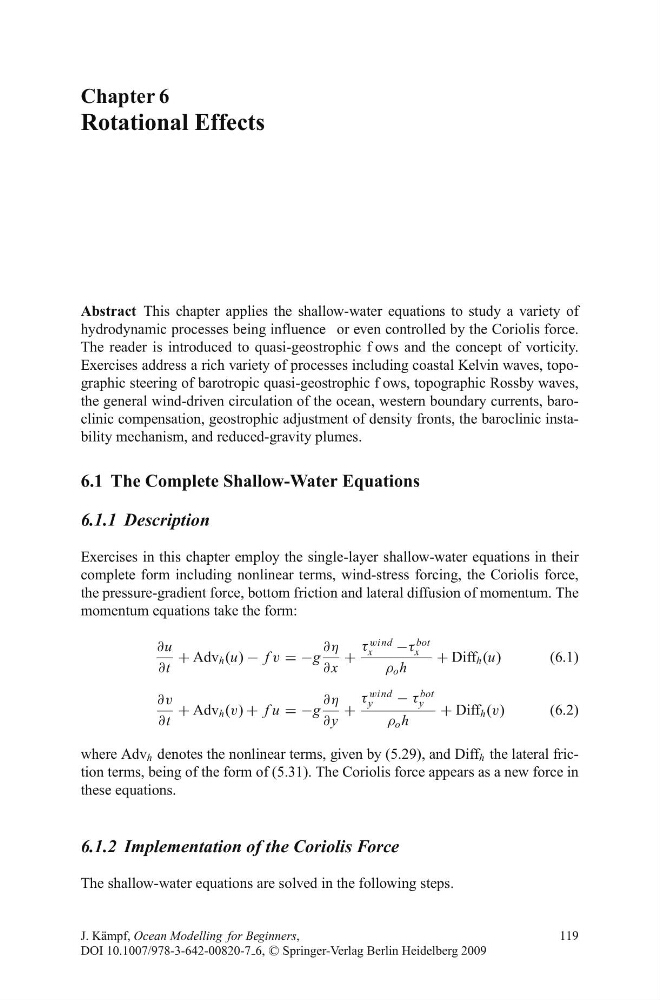
momentum equations take the form:
∂u
∂t
+ Adv h (u) − f v = −g
∂η
∂ x
+
τ wind
x
−τ
bot
x
ρ o h
+ Diff h (u)
(6.1)
∂v
∂t
+ Adv h (v) + f u = −g
∂η
∂ y
+
τ
wind
y
− τ
bot
y
ρ o h
+ Diff h (v)
(6.2)
where Adv h denotes the nonlinear terms, given by (5.29), and Diff h the lateral friction terms, being of the form of (5.31). The Coriolis force appears as a new force in
these equations.
6.1.2 Implementation of the Coriolis Force
The shallow-water equations are solved in the following steps.
J. K¨ ampf, Ocean Modelling for Beginners,
DOI 10.1007/978-3-642-00820-7 6, C
Springer-Verlag Berlin Heidelberg 2009
119
Rotational Effects
Abstract This chapter applies the shallow-water equations to study a variety of
hydrodynamic processes being influence or even controlled by the Coriolis force.
The reader is introduced to quasi-geostrophic f ows and the concept of vorticity.
Exercises address a rich variety of processes including coastal Kelvin waves, topographic steering of barotropic quasi-geostrophic f ows, topographic Rossby waves,
the general wind-driven circulation of the ocean, western boundary currents, baroclinic compensation, geostrophic adjustment of density fronts, the baroclinic instability mechanism, and reduced-gravity plumes.
6.1 The Complete Shallow-Water Equations
6.1.1 Description
Exercises in this chapter employ the single-layer shallow-water equations in their
complete form including nonlinear terms, wind-stress forcing, the Coriolis force,
the pressure-gradient force, bottom friction and lateral diffusion of momentum. The
momentum equations take the form:
∂u
∂t
+ Adv h (u) − f v = −g
∂η
∂ x
+
τ wind
x
−τ
bot
x
ρ o h
+ Diff h (u)
(6.1)
∂v
∂t
+ Adv h (v) + f u = −g
∂η
∂ y
+
τ
wind
y
− τ
bot
y
ρ o h
+ Diff h (v)
(6.2)
where Adv h denotes the nonlinear terms, given by (5.29), and Diff h the lateral friction terms, being of the form of (5.31). The Coriolis force appears as a new force in
these equations.
6.1.2 Implementation of the Coriolis Force
The shallow-water equations are solved in the following steps.
J. K¨ ampf, Ocean Modelling for Beginners,
DOI 10.1007/978-3-642-00820-7 6, C
Springer-Verlag Berlin Heidelberg 2009
119