

5.10 Exercise 14: Island Wakes
117
5.10.7 Sample Code
The folder “Exercise 14” contains the computer code including implementations
of lateral momentum diffusion and lateral friction with coastlines. Different slip
conditions can be selected by means of a switch called “slip”.
5.10.8 Results
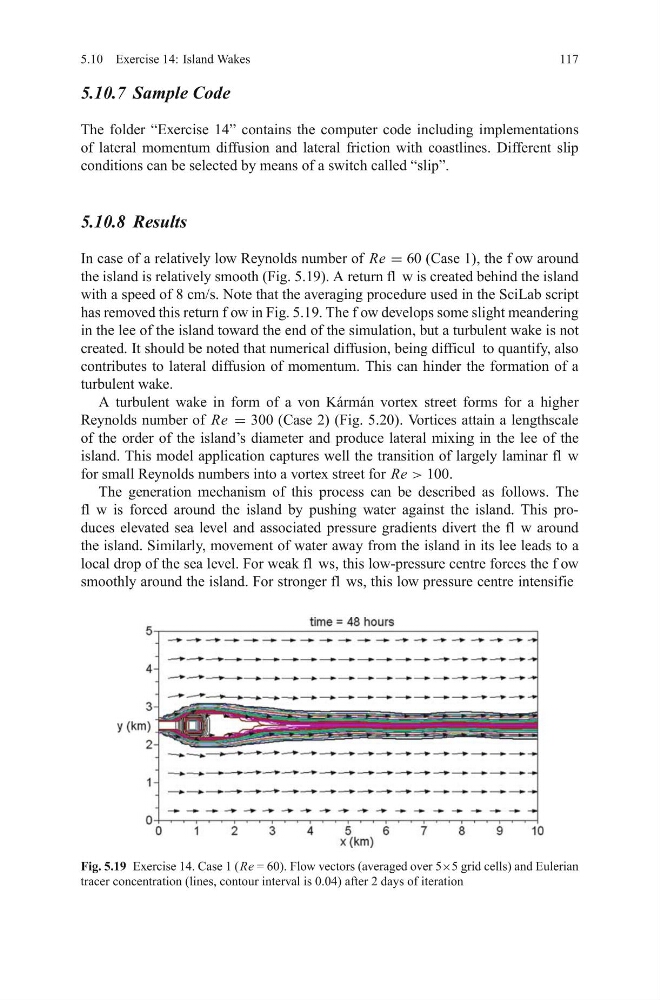
In case of a relatively low Reynolds number of Re = 60 (Case 1), the f ow around
the island is relatively smooth (Fig. 5.19). A return fl w is created behind the island
with a speed of 8 cm/s. Note that the averaging procedure used in the SciLab script
has removed this return f ow in Fig. 5.19. The f ow develops some slight meandering
in the lee of the island toward the end of the simulation, but a turbulent wake is not
created. It should be noted that numerical diffusion, being difficul to quantify, also
contributes to lateral diffusion of momentum. This can hinder the formation of a
turbulent wake.
A turbulent wake in form of a von K´ arm´ an vortex street forms for a higher
Reynolds number of Re = 300 (Case 2) (Fig. 5.20). Vortices attain a lengthscale
of the order of the island’s diameter and produce lateral mixing in the lee of the
island. This model application captures well the transition of largely laminar fl w
for small Reynolds numbers into a vortex street for Re > 100.
The generation mechanism of this process can be described as follows. The
fl w is forced around the island by pushing water against the island. This produces elevated sea level and associated pressure gradients divert the fl w around
the island. Similarly, movement of water away from the island in its lee leads to a
local drop of the sea level. For weak fl ws, this low-pressure centre forces the f ow
smoothly around the island. For stronger fl ws, this low pressure centre intensifie
Fig. 5.19 Exercise 14. Case 1 (Re = 60). Flow vectors (averaged over 5×5 grid cells) and Eulerian
tracer concentration (lines, contour interval is 0.04) after 2 days of iteration
117
5.10.7 Sample Code
The folder “Exercise 14” contains the computer code including implementations
of lateral momentum diffusion and lateral friction with coastlines. Different slip
conditions can be selected by means of a switch called “slip”.
5.10.8 Results
In case of a relatively low Reynolds number of Re = 60 (Case 1), the f ow around
the island is relatively smooth (Fig. 5.19). A return fl w is created behind the island
with a speed of 8 cm/s. Note that the averaging procedure used in the SciLab script
has removed this return f ow in Fig. 5.19. The f ow develops some slight meandering
in the lee of the island toward the end of the simulation, but a turbulent wake is not
created. It should be noted that numerical diffusion, being difficul to quantify, also
contributes to lateral diffusion of momentum. This can hinder the formation of a
turbulent wake.
A turbulent wake in form of a von K´ arm´ an vortex street forms for a higher
Reynolds number of Re = 300 (Case 2) (Fig. 5.20). Vortices attain a lengthscale
of the order of the island’s diameter and produce lateral mixing in the lee of the
island. This model application captures well the transition of largely laminar fl w
for small Reynolds numbers into a vortex street for Re > 100.
The generation mechanism of this process can be described as follows. The
fl w is forced around the island by pushing water against the island. This produces elevated sea level and associated pressure gradients divert the fl w around
the island. Similarly, movement of water away from the island in its lee leads to a
local drop of the sea level. For weak fl ws, this low-pressure centre forces the f ow
smoothly around the island. For stronger fl ws, this low pressure centre intensifie
Fig. 5.19 Exercise 14. Case 1 (Re = 60). Flow vectors (averaged over 5×5 grid cells) and Eulerian
tracer concentration (lines, contour interval is 0.04) after 2 days of iteration