

5.10 Exercise 14: Island Wakes
115
5.10.4 Stability Criterion for Diffusion Terms
The one-dimensional diffusion equation for a variable ψ can be written as:
∂ψ
∂t
= A h
∂
2
ψ
∂x 2
(5.36)
where A h is a diffusivity assumed constant. Using an explicit finite-di ference formulation of diffusion term leads to the stability criterion:
Δt ≤
(Δx)
2
A h
(5.37)
Although the diffusion terms (5.31) and (5.31) in the momentum equations are
slightly more complex than assumed here, the latter condition gives a useful upper
bound for permitted time steps. If problems persist, the time step should be further
reduced.
5.10.5 Full-Slip, Semi-Slip and No-Slip Conditions
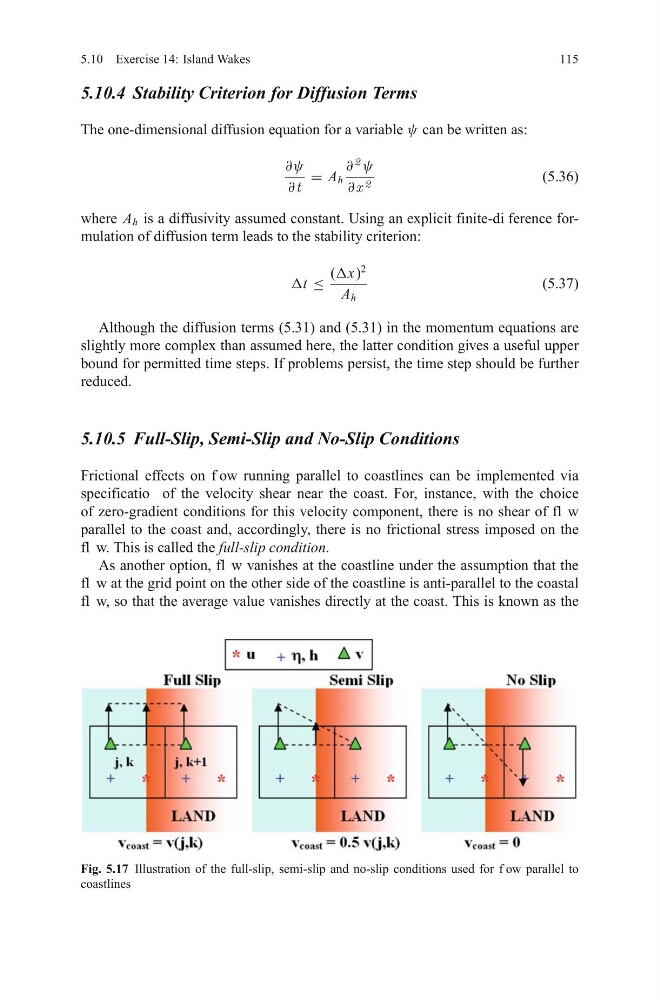
Frictional effects on f ow running parallel to coastlines can be implemented via
specificatio of the velocity shear near the coast. For, instance, with the choice
of zero-gradient conditions for this velocity component, there is no shear of fl w
parallel to the coast and, accordingly, there is no frictional stress imposed on the
fl w. This is called the full-slip condition.
As another option, fl w vanishes at the coastline under the assumption that the
fl w at the grid point on the other side of the coastline is anti-parallel to the coastal
fl w, so that the average value vanishes directly at the coast. This is known as the
Fig. 5.17 Illustration of the full-slip, semi-slip and no-slip conditions used for f ow parallel to
coastlines
115
5.10.4 Stability Criterion for Diffusion Terms
The one-dimensional diffusion equation for a variable ψ can be written as:
∂ψ
∂t
= A h
∂
2
ψ
∂x 2
(5.36)
where A h is a diffusivity assumed constant. Using an explicit finite-di ference formulation of diffusion term leads to the stability criterion:
Δt ≤
(Δx)
2
A h
(5.37)
Although the diffusion terms (5.31) and (5.31) in the momentum equations are
slightly more complex than assumed here, the latter condition gives a useful upper
bound for permitted time steps. If problems persist, the time step should be further
reduced.
5.10.5 Full-Slip, Semi-Slip and No-Slip Conditions
Frictional effects on f ow running parallel to coastlines can be implemented via
specificatio of the velocity shear near the coast. For, instance, with the choice
of zero-gradient conditions for this velocity component, there is no shear of fl w
parallel to the coast and, accordingly, there is no frictional stress imposed on the
fl w. This is called the full-slip condition.
As another option, fl w vanishes at the coastline under the assumption that the
fl w at the grid point on the other side of the coastline is anti-parallel to the coastal
fl w, so that the average value vanishes directly at the coast. This is known as the
Fig. 5.17 Illustration of the full-slip, semi-slip and no-slip conditions used for f ow parallel to
coastlines