

Earth’s surface, or from interpreting seismic wave propagation within rocks. Also,
we have learned about our Earth’s interior due to laboratory experimental work on
the stability of mineral phases at different pressure and temperatures. Thus, laboratory experiments exerting high pressure and high temperatures on minerals in
order to change their stability have permitted us to determine the density distribution at the interior of the planet (Green and Ringwood 1970). Another way of
determining the composition of the Earth’s interior is by measuring the density
differences of the material encountered and then comparing this information to that
obtained from laboratory experiments. The density differences can be gathered
during earthquakes and/or any extensive man-made explosive activity (bomb
testing) where the release of energy at a known source produces waves, which
radiate in all directions and are identified on seismographs (from the Greek words
seismic meaning earthquake and graphos meaning writing). The seismograph
measures time and the ground motion of the Earth’s interior. The ground motion is
transmitted into the Earth by ‘‘wave propagation’’, similar to what is observed on
the sea’s surface when dropping a stone. A seismograph will measure the propagation of certain seismic waves called P-waves (Primary waves), which are
compression waves, as well as expansion waves, like sound and other S-waves,
which vibrate at right angles to the direction of travel, as do light waves. The P
waves travel through both solids and liquids while the S-waves only travel through
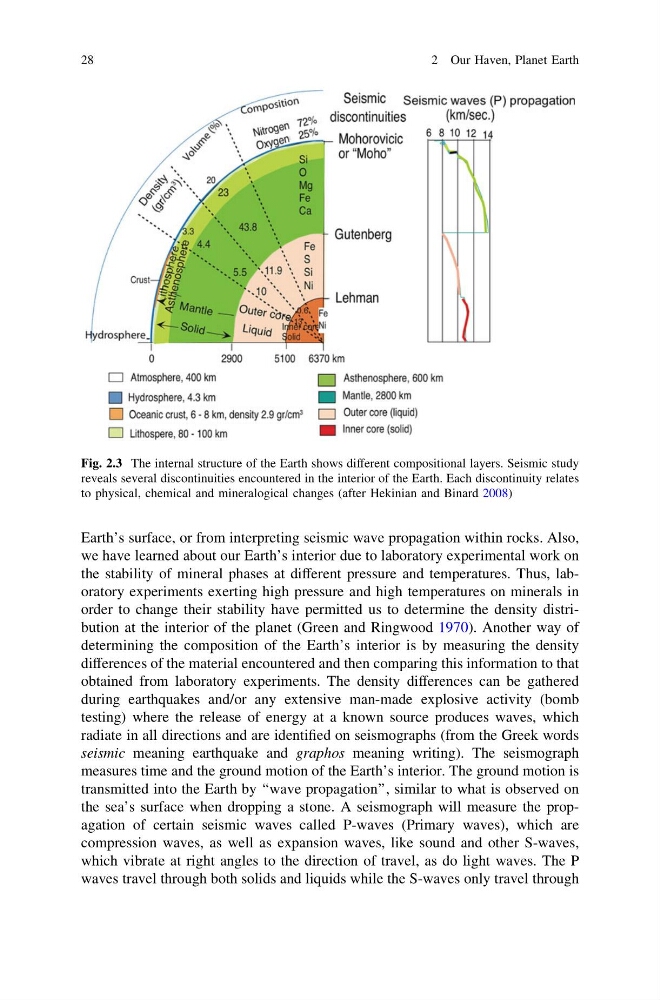
Fig. 2.3 The internal structure of the Earth shows different compositional layers. Seismic study
reveals several discontinuities encountered in the interior of the Earth. Each discontinuity relates
to physical, chemical and mineralogical changes (after Hekinian and Binard 2008)
28
2 Our Haven, Planet Earth
we have learned about our Earth’s interior due to laboratory experimental work on
the stability of mineral phases at different pressure and temperatures. Thus, laboratory experiments exerting high pressure and high temperatures on minerals in
order to change their stability have permitted us to determine the density distribution at the interior of the planet (Green and Ringwood 1970). Another way of
determining the composition of the Earth’s interior is by measuring the density
differences of the material encountered and then comparing this information to that
obtained from laboratory experiments. The density differences can be gathered
during earthquakes and/or any extensive man-made explosive activity (bomb
testing) where the release of energy at a known source produces waves, which
radiate in all directions and are identified on seismographs (from the Greek words
seismic meaning earthquake and graphos meaning writing). The seismograph
measures time and the ground motion of the Earth’s interior. The ground motion is
transmitted into the Earth by ‘‘wave propagation’’, similar to what is observed on
the sea’s surface when dropping a stone. A seismograph will measure the propagation of certain seismic waves called P-waves (Primary waves), which are
compression waves, as well as expansion waves, like sound and other S-waves,
which vibrate at right angles to the direction of travel, as do light waves. The P
waves travel through both solids and liquids while the S-waves only travel through
Fig. 2.3 The internal structure of the Earth shows different compositional layers. Seismic study
reveals several discontinuities encountered in the interior of the Earth. Each discontinuity relates
to physical, chemical and mineralogical changes (after Hekinian and Binard 2008)
28
2 Our Haven, Planet Earth