

place on Earth. Based on isotopic element ratios measured on primitive meteorites
and compared to present terrestrial samples, it was found that the Earth’s mantle
was a deep ocean magma during its first 30 million years (Boyet and Carlson 2005)
(Figs. 2.2 and 2.3).
The early molten Earth most probably crystallized from the base of the mantle
upward and Earth’s surface was the residue of molten liquid sitting under a
primordial crust. Similar to the other solid planets, the early dense iron contained
in the molten magma settled at the center forming the metallic core overlaid by a
peridotite (silica, aluminum, iron, magnesium and calcium) enriched mantle.
As the mantle continued to solidify, convection currents were generated and
they were able to mix the upper and lower mantle material (Boyet and Carlson
2005). Reservoirs of enriched elements such as potassium, sodium, uranium,
thorium and rare gases such as He (helium), Ne (neon), Ar (argon) and Xe (xenon)
and their isotopes now mostly reside in a region found at the mantle-core
boundary, at 2900 km depth. The heat generated by these radioactive elements and
the heat within the molten core are responsible for creating the mantle’s convection currents and for supplying energy and matter to hot magma plumes
upwelling towards Earth’s surface. Also, the early differentiation of the Earth’s
mantle interior must have been the result of at least two different sources to
produce the most common volcanic rocks, which are mid-ocean ridge basalts
(MORBs), and ocean island basalts (IOB) (Mukhopadhyay 2012).
Our present knowledge of the Earth’s interior suggests that it is roughly like an
onion made of successive concentrically arranged layers with increasing density
towards its interior (Fig. 2.3). The deep Earth’s interior is beyond our visual
observation; the only evidence of its composition comes from meteorites falling on
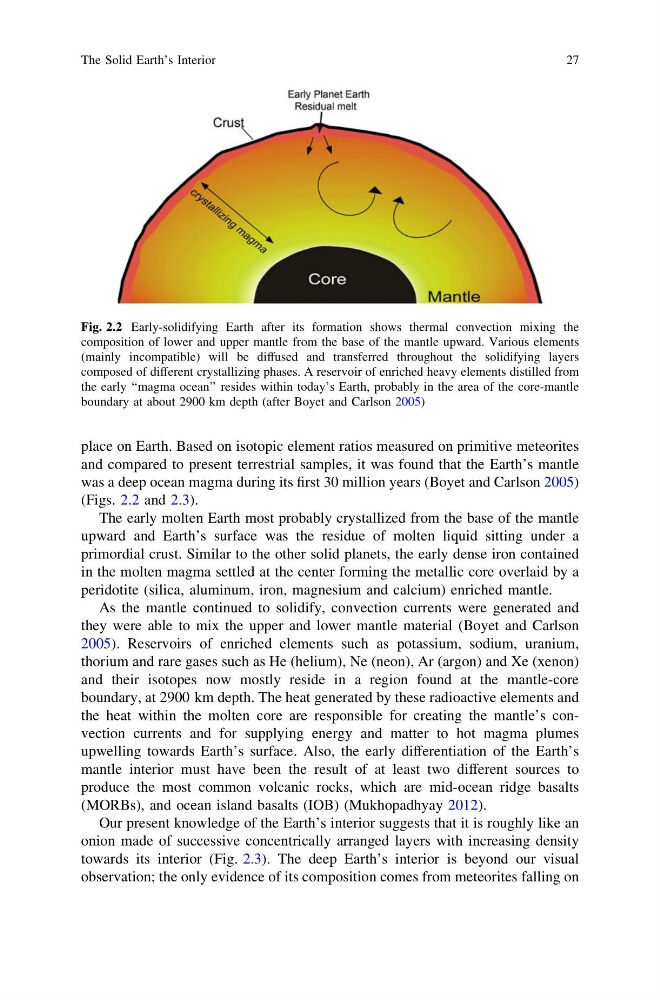
Fig. 2.2 Early-solidifying Earth after its formation shows thermal convection mixing the
composition of lower and upper mantle from the base of the mantle upward. Various elements
(mainly incompatible) will be diffused and transferred throughout the solidifying layers
composed of different crystallizing phases. A reservoir of enriched heavy elements distilled from
the early ‘‘magma ocean’’ resides within today’s Earth, probably in the area of the core-mantle
boundary at about 2900 km depth (after Boyet and Carlson 2005)
The Solid Earth’s Interior
27
and compared to present terrestrial samples, it was found that the Earth’s mantle
was a deep ocean magma during its first 30 million years (Boyet and Carlson 2005)
(Figs. 2.2 and 2.3).
The early molten Earth most probably crystallized from the base of the mantle
upward and Earth’s surface was the residue of molten liquid sitting under a
primordial crust. Similar to the other solid planets, the early dense iron contained
in the molten magma settled at the center forming the metallic core overlaid by a
peridotite (silica, aluminum, iron, magnesium and calcium) enriched mantle.
As the mantle continued to solidify, convection currents were generated and
they were able to mix the upper and lower mantle material (Boyet and Carlson
2005). Reservoirs of enriched elements such as potassium, sodium, uranium,
thorium and rare gases such as He (helium), Ne (neon), Ar (argon) and Xe (xenon)
and their isotopes now mostly reside in a region found at the mantle-core
boundary, at 2900 km depth. The heat generated by these radioactive elements and
the heat within the molten core are responsible for creating the mantle’s convection currents and for supplying energy and matter to hot magma plumes
upwelling towards Earth’s surface. Also, the early differentiation of the Earth’s
mantle interior must have been the result of at least two different sources to
produce the most common volcanic rocks, which are mid-ocean ridge basalts
(MORBs), and ocean island basalts (IOB) (Mukhopadhyay 2012).
Our present knowledge of the Earth’s interior suggests that it is roughly like an
onion made of successive concentrically arranged layers with increasing density
towards its interior (Fig. 2.3). The deep Earth’s interior is beyond our visual
observation; the only evidence of its composition comes from meteorites falling on
Fig. 2.2 Early-solidifying Earth after its formation shows thermal convection mixing the
composition of lower and upper mantle from the base of the mantle upward. Various elements
(mainly incompatible) will be diffused and transferred throughout the solidifying layers
composed of different crystallizing phases. A reservoir of enriched heavy elements distilled from
the early ‘‘magma ocean’’ resides within today’s Earth, probably in the area of the core-mantle
boundary at about 2900 km depth (after Boyet and Carlson 2005)
The Solid Earth’s Interior
27