

The Pitcairn region includes two large edifices, which are located in the
southeastern prolongation at about 90–110 km from Pitcairn Island. These large
seamounts were named ‘‘Adams’’, after John Adams, a seaman who stayed loyal to
Fletcher Christian, and ‘‘Bounty’’, after the ship HMS Bounty. They are approximately 3500 m in height, rising respectively to 55 m and to 450 m below sea
level, and they have erupted a volume of at least 525 km
3 and 275 km
3 of lava
respectively. It is not excluded that these edifices could have been found above sea
level at one time. Age determination (K/Ar) on the volcanics from ‘‘Bounty’’ gave
an age of about 344,000 ± 32,000 years (Guillou et al. 1997).
From earthquake indications and field observations, it is thought that the most
eastern limit of the hot spot is now located near the Bounty and Adams volcanoes,
at approximately 110 km east of Pitcairn Island, and that the spreading rate for the
oceanic plate’s motion is about 80–100 mm per year. Calculated on the basis of
these two assumptions, the earliest volcanism forming the Pitcairn Island hotspot
probably occurred 1.1 million years ago. The 5907 km
3 volume of volcanic
construction over 1.1 million years gives a volcanic accumulation rate of about
0.0054 km
3 /yr. This value is about 20–33 times less than that of the Kilauea
volcano in Hawaii (0.1–0.18 km
3 /yr) (Clague et al. 2000; Cayol et al 2000). The
construction of large edifices such as the Adams and Bounty volcanoes (3,500 m
high) with 310 km
3 of lava could have taken place in about 58,000 years.
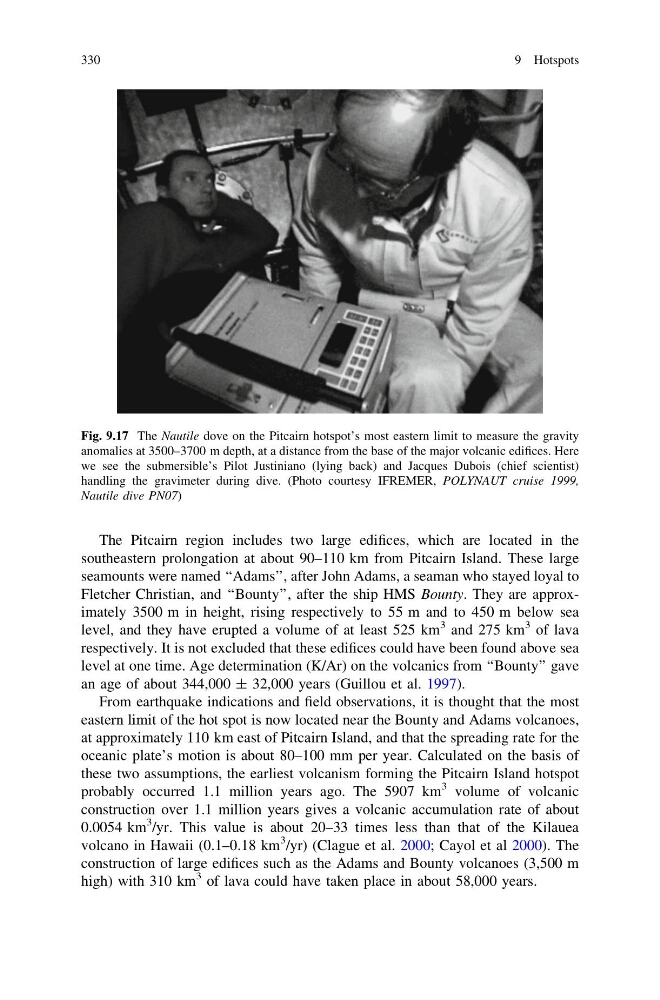
Fig. 9.17 The Nautile dove on the Pitcairn hotspot’s most eastern limit to measure the gravity
anomalies at 3500–3700 m depth, at a distance from the base of the major volcanic edifices. Here
we see the submersible’s Pilot Justiniano (lying back) and Jacques Dubois (chief scientist)
handling the gravimeter during dive. (Photo courtesy IFREMER, POLYNAUT cruise 1999,
Nautile dive PN07)
330
9 Hotspots
southeastern prolongation at about 90–110 km from Pitcairn Island. These large
seamounts were named ‘‘Adams’’, after John Adams, a seaman who stayed loyal to
Fletcher Christian, and ‘‘Bounty’’, after the ship HMS Bounty. They are approximately 3500 m in height, rising respectively to 55 m and to 450 m below sea
level, and they have erupted a volume of at least 525 km
3 and 275 km
3 of lava
respectively. It is not excluded that these edifices could have been found above sea
level at one time. Age determination (K/Ar) on the volcanics from ‘‘Bounty’’ gave
an age of about 344,000 ± 32,000 years (Guillou et al. 1997).
From earthquake indications and field observations, it is thought that the most
eastern limit of the hot spot is now located near the Bounty and Adams volcanoes,
at approximately 110 km east of Pitcairn Island, and that the spreading rate for the
oceanic plate’s motion is about 80–100 mm per year. Calculated on the basis of
these two assumptions, the earliest volcanism forming the Pitcairn Island hotspot
probably occurred 1.1 million years ago. The 5907 km
3 volume of volcanic
construction over 1.1 million years gives a volcanic accumulation rate of about
0.0054 km
3 /yr. This value is about 20–33 times less than that of the Kilauea
volcano in Hawaii (0.1–0.18 km
3 /yr) (Clague et al. 2000; Cayol et al 2000). The
construction of large edifices such as the Adams and Bounty volcanoes (3,500 m
high) with 310 km
3 of lava could have taken place in about 58,000 years.
Fig. 9.17 The Nautile dove on the Pitcairn hotspot’s most eastern limit to measure the gravity
anomalies at 3500–3700 m depth, at a distance from the base of the major volcanic edifices. Here
we see the submersible’s Pilot Justiniano (lying back) and Jacques Dubois (chief scientist)
handling the gravimeter during dive. (Photo courtesy IFREMER, POLYNAUT cruise 1999,
Nautile dive PN07)
330
9 Hotspots