

home video, run tape players and radios. However the best entertainment is still
the community’s social get-togethers.
Visit to Pitcairn Island
My first visit near the island was made during the F.S. SONNE cruise of leg 65,
and took place in November 1989. Captain Andresen was the master on board. The
people from the Island wanted to come on board the SONNE to show us their
products, mainly T-Shirts, postcards, carvings and stamps. They put all their
material on the back deck of the ship for the crew to see, so we could buy things, or
exchange them for other products on board such as paint or cans of food.
The physical appearance of the Pitcairn Islanders is quite variable. They could
have Polynesian features and dark hair as well as typical Anglo-Saxon oval-shaped
long faces, blue eyes and blond hair. It was at this time that six persons from the
scientific party (Dietrich Ackerman, a mineralogist from Kiel University, Nicolas
Binard, volcanologist, Silvain Pasqua, a camera man from France, Colin Devey, a
geochemist from Kiel, Woodhead, a geochemist from Australia, and Jean-Paul
Décriaud, a geophysicist at IFREMER) were invited to go and stay on the island
for a couple days. In compensation, Captain Andresen invited three islanders to
stay on board the SONNE. We planned to pick up the scientists after doing our
survey prior to leaving the site. Meanwhile, the scientists were to spend their time
getting acquainted with the inhabitants and looking at the geology of the island.
They also collected rock samples to be compared to the data obtained from the
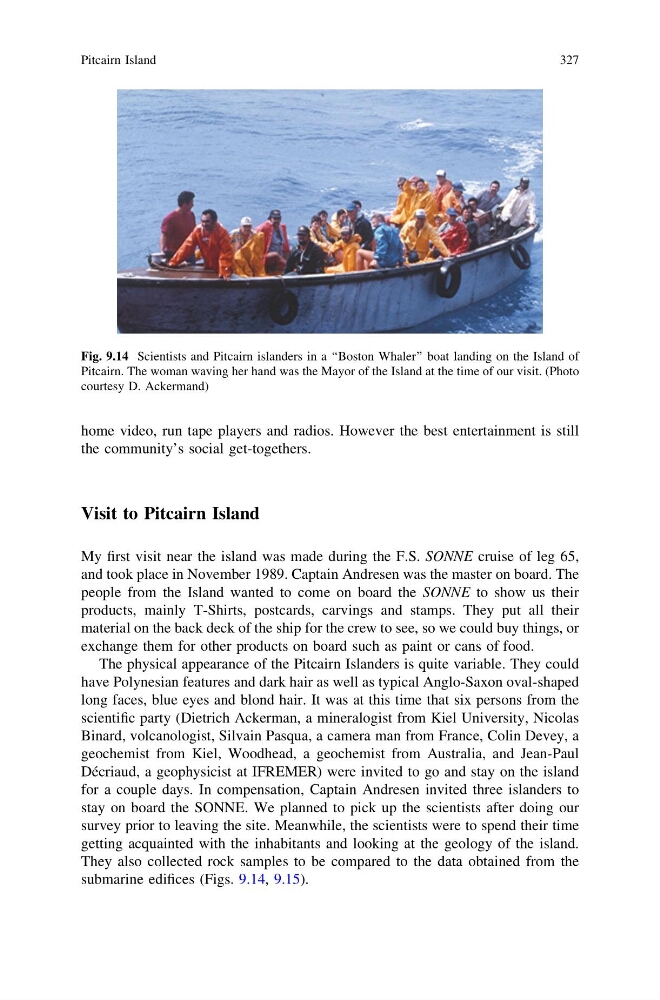
submarine edifices (Figs. 9.14, 9.15).
Fig. 9.14 Scientists and Pitcairn islanders in a ‘‘Boston Whaler’’ boat landing on the Island of
Pitcairn. The woman waving her hand was the Mayor of the Island at the time of our visit. (Photo
courtesy D. Ackermand)
Pitcairn Island
327
the community’s social get-togethers.
Visit to Pitcairn Island
My first visit near the island was made during the F.S. SONNE cruise of leg 65,
and took place in November 1989. Captain Andresen was the master on board. The
people from the Island wanted to come on board the SONNE to show us their
products, mainly T-Shirts, postcards, carvings and stamps. They put all their
material on the back deck of the ship for the crew to see, so we could buy things, or
exchange them for other products on board such as paint or cans of food.
The physical appearance of the Pitcairn Islanders is quite variable. They could
have Polynesian features and dark hair as well as typical Anglo-Saxon oval-shaped
long faces, blue eyes and blond hair. It was at this time that six persons from the
scientific party (Dietrich Ackerman, a mineralogist from Kiel University, Nicolas
Binard, volcanologist, Silvain Pasqua, a camera man from France, Colin Devey, a
geochemist from Kiel, Woodhead, a geochemist from Australia, and Jean-Paul
Décriaud, a geophysicist at IFREMER) were invited to go and stay on the island
for a couple days. In compensation, Captain Andresen invited three islanders to
stay on board the SONNE. We planned to pick up the scientists after doing our
survey prior to leaving the site. Meanwhile, the scientists were to spend their time
getting acquainted with the inhabitants and looking at the geology of the island.
They also collected rock samples to be compared to the data obtained from the
submarine edifices (Figs. 9.14, 9.15).
Fig. 9.14 Scientists and Pitcairn islanders in a ‘‘Boston Whaler’’ boat landing on the Island of
Pitcairn. The woman waving her hand was the Mayor of the Island at the time of our visit. (Photo
courtesy D. Ackermand)
Pitcairn Island
327