

just when the submersible and the support ship N.O. Le SUROIT arrived on the
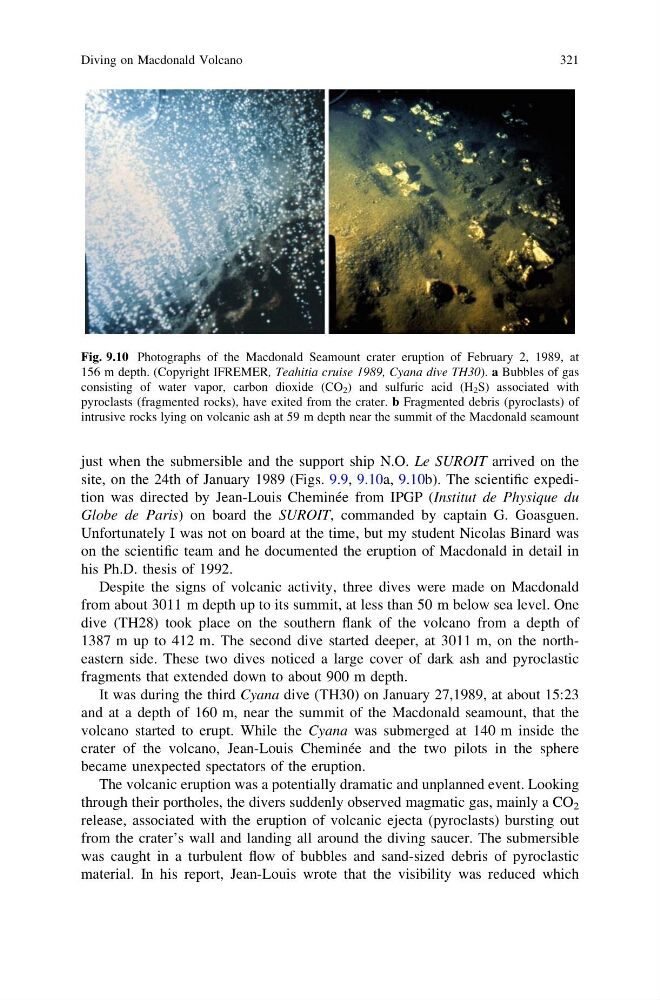
site, on the 24th of January 1989 (Figs. 9.9, 9.10a, 9.10b). The scientific expedition was directed by Jean-Louis Cheminée from IPGP (Institut de Physique du
Globe de Paris) on board the SUROIT, commanded by captain G. Goasguen.
Unfortunately I was not on board at the time, but my student Nicolas Binard was
on the scientific team and he documented the eruption of Macdonald in detail in
his Ph.D. thesis of 1992.
Despite the signs of volcanic activity, three dives were made on Macdonald
from about 3011 m depth up to its summit, at less than 50 m below sea level. One
dive (TH28) took place on the southern flank of the volcano from a depth of
1387 m up to 412 m. The second dive started deeper, at 3011 m, on the northeastern side. These two dives noticed a large cover of dark ash and pyroclastic
fragments that extended down to about 900 m depth.
It was during the third Cyana dive (TH30) on January 27,1989, at about 15:23
and at a depth of 160 m, near the summit of the Macdonald seamount, that the
volcano started to erupt. While the Cyana was submerged at 140 m inside the
crater of the volcano, Jean-Louis Cheminée and the two pilots in the sphere
became unexpected spectators of the eruption.
The volcanic eruption was a potentially dramatic and unplanned event. Looking
through their portholes, the divers suddenly observed magmatic gas, mainly a CO 2
release, associated with the eruption of volcanic ejecta (pyroclasts) bursting out
from the crater’s wall and landing all around the diving saucer. The submersible
was caught in a turbulent flow of bubbles and sand-sized debris of pyroclastic
material. In his report, Jean-Louis wrote that the visibility was reduced which
Fig. 9.10 Photographs of the Macdonald Seamount crater eruption of February 2, 1989, at
156 m depth. (Copyright IFREMER, Teahitia cruise 1989, Cyana dive TH30). a Bubbles of gas
consisting of water vapor, carbon dioxide (CO 2 ) and sulfuric acid (H 2 S) associated with
pyroclasts (fragmented rocks), have exited from the crater. b Fragmented debris (pyroclasts) of
intrusive rocks lying on volcanic ash at 59 m depth near the summit of the Macdonald seamount
Diving on Macdonald Volcano
321
site, on the 24th of January 1989 (Figs. 9.9, 9.10a, 9.10b). The scientific expedition was directed by Jean-Louis Cheminée from IPGP (Institut de Physique du
Globe de Paris) on board the SUROIT, commanded by captain G. Goasguen.
Unfortunately I was not on board at the time, but my student Nicolas Binard was
on the scientific team and he documented the eruption of Macdonald in detail in
his Ph.D. thesis of 1992.
Despite the signs of volcanic activity, three dives were made on Macdonald
from about 3011 m depth up to its summit, at less than 50 m below sea level. One
dive (TH28) took place on the southern flank of the volcano from a depth of
1387 m up to 412 m. The second dive started deeper, at 3011 m, on the northeastern side. These two dives noticed a large cover of dark ash and pyroclastic
fragments that extended down to about 900 m depth.
It was during the third Cyana dive (TH30) on January 27,1989, at about 15:23
and at a depth of 160 m, near the summit of the Macdonald seamount, that the
volcano started to erupt. While the Cyana was submerged at 140 m inside the
crater of the volcano, Jean-Louis Cheminée and the two pilots in the sphere
became unexpected spectators of the eruption.
The volcanic eruption was a potentially dramatic and unplanned event. Looking
through their portholes, the divers suddenly observed magmatic gas, mainly a CO 2
release, associated with the eruption of volcanic ejecta (pyroclasts) bursting out
from the crater’s wall and landing all around the diving saucer. The submersible
was caught in a turbulent flow of bubbles and sand-sized debris of pyroclastic
material. In his report, Jean-Louis wrote that the visibility was reduced which
Fig. 9.10 Photographs of the Macdonald Seamount crater eruption of February 2, 1989, at
156 m depth. (Copyright IFREMER, Teahitia cruise 1989, Cyana dive TH30). a Bubbles of gas
consisting of water vapor, carbon dioxide (CO 2 ) and sulfuric acid (H 2 S) associated with
pyroclasts (fragmented rocks), have exited from the crater. b Fragmented debris (pyroclasts) of
intrusive rocks lying on volcanic ash at 59 m depth near the summit of the Macdonald seamount
Diving on Macdonald Volcano
321