

point, the slope became gentle (\10°) and was abundantly sedimented. This
marked a drastic change in the geology as well as in the biology. Indeed, there was
a sharp decrease in organic life and only occasional rocky outcrops were seen. At
16:03, a sample of dolerite was collected from a rare, partially buried rocky
outcrop. The first basalt sample PI 17-11 (PI = Pito, 17 = dive # and
11 = sample #) was taken at 16:18 at 3035 m depth. Also, basaltic breccias and
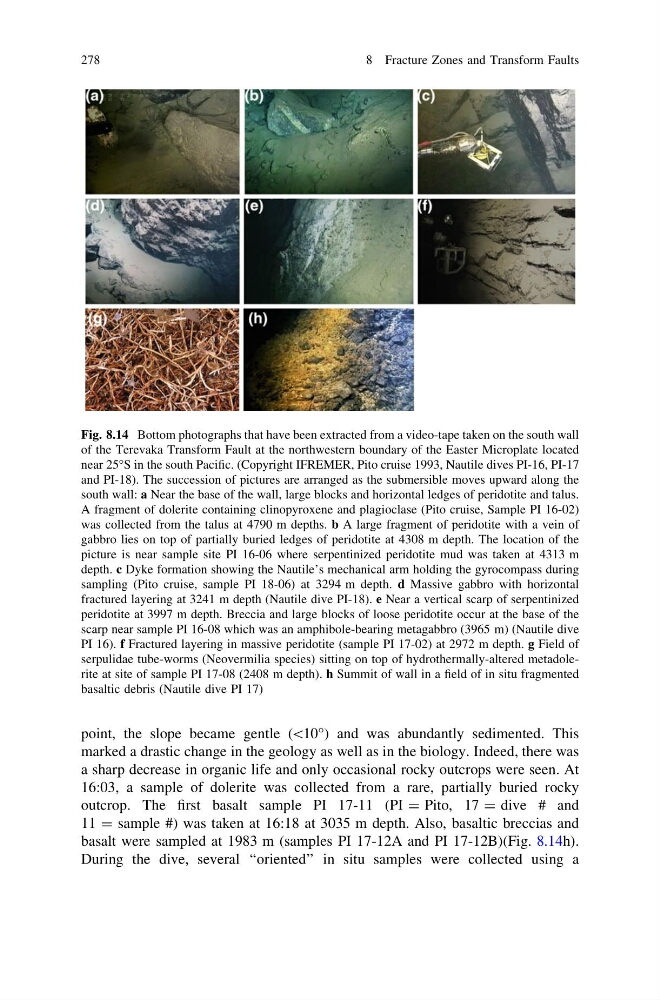
basalt were sampled at 1983 m (samples PI 17-12A and PI 17-12B)(Fig. 8.14h).
During the dive, several ‘‘oriented’’ in situ samples were collected using a
Fig. 8.14 Bottom photographs that have been extracted from a video-tape taken on the south wall
of the Terevaka Transform Fault at the northwestern boundary of the Easter Microplate located
near 25°S in the south Pacific. (Copyright IFREMER, Pito cruise 1993, Nautile dives PI-16, PI-17
and PI-18). The succession of pictures are arranged as the submersible moves upward along the
south wall: a Near the base of the wall, large blocks and horizontal ledges of peridotite and talus.
A fragment of dolerite containing clinopyroxene and plagioclase (Pito cruise, Sample PI 16-02)
was collected from the talus at 4790 m depths. b A large fragment of peridotite with a vein of
gabbro lies on top of partially buried ledges of peridotite at 4308 m depth. The location of the
picture is near sample site PI 16-06 where serpentinized peridotite mud was taken at 4313 m
depth. c Dyke formation showing the Nautile’s mechanical arm holding the gyrocompass during
sampling (Pito cruise, sample PI 18-06) at 3294 m depth. d Massive gabbro with horizontal
fractured layering at 3241 m depth (Nautile dive PI-18). e Near a vertical scarp of serpentinized
peridotite at 3997 m depth. Breccia and large blocks of loose peridotite occur at the base of the
scarp near sample PI 16-08 which was an amphibole-bearing metagabbro (3965 m) (Nautile dive
PI 16). f Fractured layering in massive peridotite (sample PI 17-02) at 2972 m depth. g Field of
serpulidae tube-worms (Neovermilia species) sitting on top of hydrothermally-altered metadolerite at site of sample PI 17-08 (2408 m depth). h Summit of wall in a field of in situ fragmented
basaltic debris (Nautile dive PI 17)
278
8 Fracture Zones and Transform Faults
marked a drastic change in the geology as well as in the biology. Indeed, there was
a sharp decrease in organic life and only occasional rocky outcrops were seen. At
16:03, a sample of dolerite was collected from a rare, partially buried rocky
outcrop. The first basalt sample PI 17-11 (PI = Pito, 17 = dive # and
11 = sample #) was taken at 16:18 at 3035 m depth. Also, basaltic breccias and
basalt were sampled at 1983 m (samples PI 17-12A and PI 17-12B)(Fig. 8.14h).
During the dive, several ‘‘oriented’’ in situ samples were collected using a
Fig. 8.14 Bottom photographs that have been extracted from a video-tape taken on the south wall
of the Terevaka Transform Fault at the northwestern boundary of the Easter Microplate located
near 25°S in the south Pacific. (Copyright IFREMER, Pito cruise 1993, Nautile dives PI-16, PI-17
and PI-18). The succession of pictures are arranged as the submersible moves upward along the
south wall: a Near the base of the wall, large blocks and horizontal ledges of peridotite and talus.
A fragment of dolerite containing clinopyroxene and plagioclase (Pito cruise, Sample PI 16-02)
was collected from the talus at 4790 m depths. b A large fragment of peridotite with a vein of
gabbro lies on top of partially buried ledges of peridotite at 4308 m depth. The location of the
picture is near sample site PI 16-06 where serpentinized peridotite mud was taken at 4313 m
depth. c Dyke formation showing the Nautile’s mechanical arm holding the gyrocompass during
sampling (Pito cruise, sample PI 18-06) at 3294 m depth. d Massive gabbro with horizontal
fractured layering at 3241 m depth (Nautile dive PI-18). e Near a vertical scarp of serpentinized
peridotite at 3997 m depth. Breccia and large blocks of loose peridotite occur at the base of the
scarp near sample PI 16-08 which was an amphibole-bearing metagabbro (3965 m) (Nautile dive
PI 16). f Fractured layering in massive peridotite (sample PI 17-02) at 2972 m depth. g Field of
serpulidae tube-worms (Neovermilia species) sitting on top of hydrothermally-altered metadolerite at site of sample PI 17-08 (2408 m depth). h Summit of wall in a field of in situ fragmented
basaltic debris (Nautile dive PI 17)
278
8 Fracture Zones and Transform Faults