

‘‘Was that an avalanche?!?’’ Max asked. ‘‘Yes,’’ I said. ‘‘I do not know far it
extended but in any case we’d better move away from the scarp!’’
Max moved us back to a safe distance from the scarp’s wall.
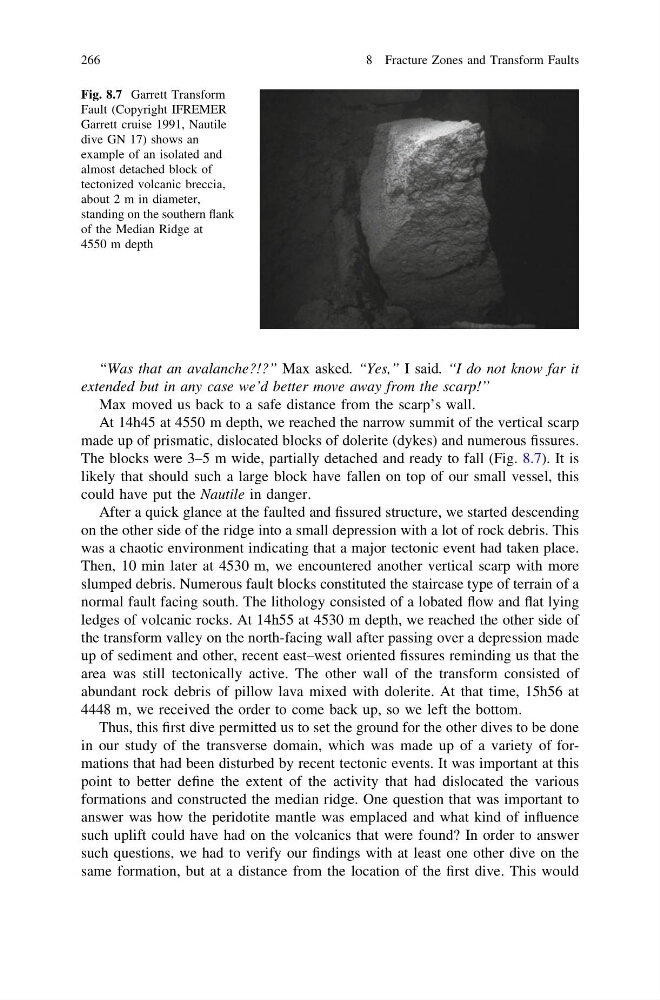
At 14h45 at 4550 m depth, we reached the narrow summit of the vertical scarp
made up of prismatic, dislocated blocks of dolerite (dykes) and numerous fissures.
The blocks were 3–5 m wide, partially detached and ready to fall (Fig. 8.7). It is
likely that should such a large block have fallen on top of our small vessel, this
could have put the Nautile in danger.
After a quick glance at the faulted and fissured structure, we started descending
on the other side of the ridge into a small depression with a lot of rock debris. This
was a chaotic environment indicating that a major tectonic event had taken place.
Then, 10 min later at 4530 m, we encountered another vertical scarp with more
slumped debris. Numerous fault blocks constituted the staircase type of terrain of a
normal fault facing south. The lithology consisted of a lobated flow and flat lying
ledges of volcanic rocks. At 14h55 at 4530 m depth, we reached the other side of
the transform valley on the north-facing wall after passing over a depression made
up of sediment and other, recent east–west oriented fissures reminding us that the
area was still tectonically active. The other wall of the transform consisted of
abundant rock debris of pillow lava mixed with dolerite. At that time, 15h56 at
4448 m, we received the order to come back up, so we left the bottom.
Thus, this first dive permitted us to set the ground for the other dives to be done
in our study of the transverse domain, which was made up of a variety of formations that had been disturbed by recent tectonic events. It was important at this
point to better define the extent of the activity that had dislocated the various
formations and constructed the median ridge. One question that was important to
answer was how the peridotite mantle was emplaced and what kind of influence
such uplift could have had on the volcanics that were found? In order to answer
such questions, we had to verify our findings with at least one other dive on the
same formation, but at a distance from the location of the first dive. This would
Fig. 8.7 Garrett Transform
Fault (Copyright IFREMER
Garrett cruise 1991, Nautile
dive GN 17) shows an
example of an isolated and
almost detached block of
tectonized volcanic breccia,
about 2 m in diameter,
standing on the southern flank
of the Median Ridge at
4550 m depth
266
8 Fracture Zones and Transform Faults
extended but in any case we’d better move away from the scarp!’’
Max moved us back to a safe distance from the scarp’s wall.
At 14h45 at 4550 m depth, we reached the narrow summit of the vertical scarp
made up of prismatic, dislocated blocks of dolerite (dykes) and numerous fissures.
The blocks were 3–5 m wide, partially detached and ready to fall (Fig. 8.7). It is
likely that should such a large block have fallen on top of our small vessel, this
could have put the Nautile in danger.
After a quick glance at the faulted and fissured structure, we started descending
on the other side of the ridge into a small depression with a lot of rock debris. This
was a chaotic environment indicating that a major tectonic event had taken place.
Then, 10 min later at 4530 m, we encountered another vertical scarp with more
slumped debris. Numerous fault blocks constituted the staircase type of terrain of a
normal fault facing south. The lithology consisted of a lobated flow and flat lying
ledges of volcanic rocks. At 14h55 at 4530 m depth, we reached the other side of
the transform valley on the north-facing wall after passing over a depression made
up of sediment and other, recent east–west oriented fissures reminding us that the
area was still tectonically active. The other wall of the transform consisted of
abundant rock debris of pillow lava mixed with dolerite. At that time, 15h56 at
4448 m, we received the order to come back up, so we left the bottom.
Thus, this first dive permitted us to set the ground for the other dives to be done
in our study of the transverse domain, which was made up of a variety of formations that had been disturbed by recent tectonic events. It was important at this
point to better define the extent of the activity that had dislocated the various
formations and constructed the median ridge. One question that was important to
answer was how the peridotite mantle was emplaced and what kind of influence
such uplift could have had on the volcanics that were found? In order to answer
such questions, we had to verify our findings with at least one other dive on the
same formation, but at a distance from the location of the first dive. This would
Fig. 8.7 Garrett Transform
Fault (Copyright IFREMER
Garrett cruise 1991, Nautile
dive GN 17) shows an
example of an isolated and
almost detached block of
tectonized volcanic breccia,
about 2 m in diameter,
standing on the southern flank
of the Median Ridge at
4550 m depth
266
8 Fracture Zones and Transform Faults