

goal of SONNE’s 157th Leg, which was also organized by the University of Kiel in
Germany, was to investigate magmatic and hydrothermal processes at a spreading
ridge axis influenced by the hotspot-controlled Foundation Volcanic Chain that
reaches the PAR.
For evaluating the influence of the hotspot on the ridge axis, it was planned to
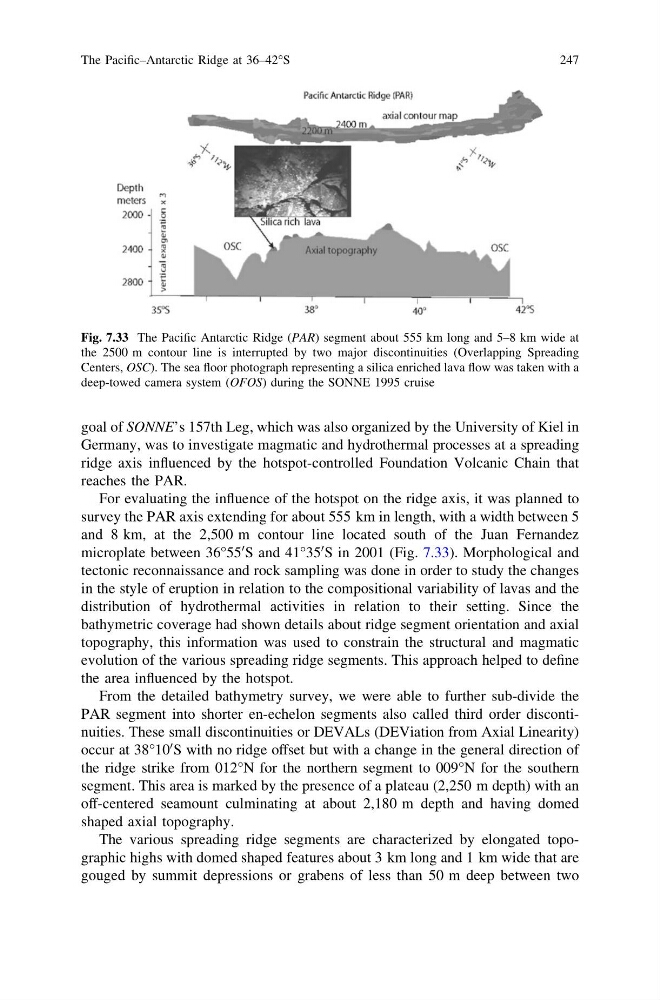
survey the PAR axis extending for about 555 km in length, with a width between 5
and 8 km, at the 2,500 m contour line located south of the Juan Fernandez
microplate between 36°55
0 S and 41°35
0 S in 2001 (Fig. 7.33). Morphological and
tectonic reconnaissance and rock sampling was done in order to study the changes
in the style of eruption in relation to the compositional variability of lavas and the
distribution of hydrothermal activities in relation to their setting. Since the
bathymetric coverage had shown details about ridge segment orientation and axial
topography, this information was used to constrain the structural and magmatic
evolution of the various spreading ridge segments. This approach helped to define
the area influenced by the hotspot.
From the detailed bathymetry survey, we were able to further sub-divide the
PAR segment into shorter en-echelon segments also called third order discontinuities. These small discontinuities or DEVALs (DEViation from Axial Linearity)
occur at 38°10
0 S with no ridge offset but with a change in the general direction of
the ridge strike from 012°N for the northern segment to 009°N for the southern
segment. This area is marked by the presence of a plateau (2,250 m depth) with an
off-centered seamount culminating at about 2,180 m depth and having domed
shaped axial topography.
The various spreading ridge segments are characterized by elongated topographic highs with domed shaped features about 3 km long and 1 km wide that are
gouged by summit depressions or grabens of less than 50 m deep between two
Fig. 7.33 The Pacific Antarctic Ridge (PAR) segment about 555 km long and 5–8 km wide at
the 2500 m contour line is interrupted by two major discontinuities (Overlapping Spreading
Centers, OSC). The sea floor photograph representing a silica enriched lava flow was taken with a
deep-towed camera system (OFOS) during the SONNE 1995 cruise
The Pacific–Antarctic Ridge at 36–42°S
247
Germany, was to investigate magmatic and hydrothermal processes at a spreading
ridge axis influenced by the hotspot-controlled Foundation Volcanic Chain that
reaches the PAR.
For evaluating the influence of the hotspot on the ridge axis, it was planned to
survey the PAR axis extending for about 555 km in length, with a width between 5
and 8 km, at the 2,500 m contour line located south of the Juan Fernandez
microplate between 36°55
0 S and 41°35
0 S in 2001 (Fig. 7.33). Morphological and
tectonic reconnaissance and rock sampling was done in order to study the changes
in the style of eruption in relation to the compositional variability of lavas and the
distribution of hydrothermal activities in relation to their setting. Since the
bathymetric coverage had shown details about ridge segment orientation and axial
topography, this information was used to constrain the structural and magmatic
evolution of the various spreading ridge segments. This approach helped to define
the area influenced by the hotspot.
From the detailed bathymetry survey, we were able to further sub-divide the
PAR segment into shorter en-echelon segments also called third order discontinuities. These small discontinuities or DEVALs (DEViation from Axial Linearity)
occur at 38°10
0 S with no ridge offset but with a change in the general direction of
the ridge strike from 012°N for the northern segment to 009°N for the southern
segment. This area is marked by the presence of a plateau (2,250 m depth) with an
off-centered seamount culminating at about 2,180 m depth and having domed
shaped axial topography.
The various spreading ridge segments are characterized by elongated topographic highs with domed shaped features about 3 km long and 1 km wide that are
gouged by summit depressions or grabens of less than 50 m deep between two
Fig. 7.33 The Pacific Antarctic Ridge (PAR) segment about 555 km long and 5–8 km wide at
the 2500 m contour line is interrupted by two major discontinuities (Overlapping Spreading
Centers, OSC). The sea floor photograph representing a silica enriched lava flow was taken with a
deep-towed camera system (OFOS) during the SONNE 1995 cruise
The Pacific–Antarctic Ridge at 36–42°S
247