

Cyana and having had the traditional ‘‘initiation ceremony’’ that all new divers
received with the water hose prior to a cocktail party. Finally, Jim was able to talk
about the dive and he said he was surprised by the type of massive sulfides, which
reminded him of some land-based deposits in Canada. Also, he was certain that
these sulfides were deposited along a faulted elongated terrain on the southern
flank of the seamount, just as he had often observed on land. So our discovery was
an important landmark for the future exploration of massive and extensive deposits
that had been formed underwater.
Thus, after four dives (Cy 82-14, Cy 84-25, Cy 84-23, Cy 84-31) and one deeptowed camera station (RAIE 3), we were able to have a much better idea about the
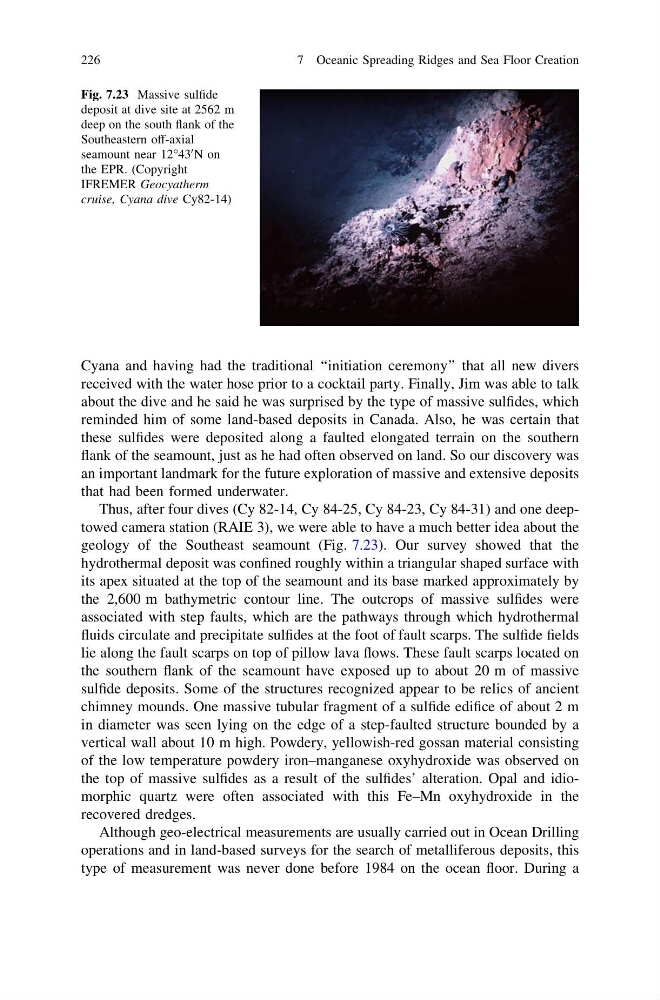
geology of the Southeast seamount (Fig. 7.23). Our survey showed that the
hydrothermal deposit was confined roughly within a triangular shaped surface with
its apex situated at the top of the seamount and its base marked approximately by
the 2,600 m bathymetric contour line. The outcrops of massive sulfides were
associated with step faults, which are the pathways through which hydrothermal
fluids circulate and precipitate sulfides at the foot of fault scarps. The sulfide fields
lie along the fault scarps on top of pillow lava flows. These fault scarps located on
the southern flank of the seamount have exposed up to about 20 m of massive
sulfide deposits. Some of the structures recognized appear to be relics of ancient
chimney mounds. One massive tubular fragment of a sulfide edifice of about 2 m
in diameter was seen lying on the edge of a step-faulted structure bounded by a
vertical wall about 10 m high. Powdery, yellowish-red gossan material consisting
of the low temperature powdery iron–manganese oxyhydroxide was observed on
the top of massive sulfides as a result of the sulfides’ alteration. Opal and idiomorphic quartz were often associated with this Fe–Mn oxyhydroxide in the
recovered dredges.
Although geo-electrical measurements are usually carried out in Ocean Drilling
operations and in land-based surveys for the search of metalliferous deposits, this
type of measurement was never done before 1984 on the ocean floor. During a
Fig. 7.23 Massive sulfide
deposit at dive site at 2562 m
deep on the south flank of the
Southeastern off-axial
seamount near 12°43
0 N on
the EPR. (Copyright
IFREMER Geocyatherm
cruise, Cyana dive Cy82-14)
226
7 Oceanic Spreading Ridges and Sea Floor Creation
received with the water hose prior to a cocktail party. Finally, Jim was able to talk
about the dive and he said he was surprised by the type of massive sulfides, which
reminded him of some land-based deposits in Canada. Also, he was certain that
these sulfides were deposited along a faulted elongated terrain on the southern
flank of the seamount, just as he had often observed on land. So our discovery was
an important landmark for the future exploration of massive and extensive deposits
that had been formed underwater.
Thus, after four dives (Cy 82-14, Cy 84-25, Cy 84-23, Cy 84-31) and one deeptowed camera station (RAIE 3), we were able to have a much better idea about the
geology of the Southeast seamount (Fig. 7.23). Our survey showed that the
hydrothermal deposit was confined roughly within a triangular shaped surface with
its apex situated at the top of the seamount and its base marked approximately by
the 2,600 m bathymetric contour line. The outcrops of massive sulfides were
associated with step faults, which are the pathways through which hydrothermal
fluids circulate and precipitate sulfides at the foot of fault scarps. The sulfide fields
lie along the fault scarps on top of pillow lava flows. These fault scarps located on
the southern flank of the seamount have exposed up to about 20 m of massive
sulfide deposits. Some of the structures recognized appear to be relics of ancient
chimney mounds. One massive tubular fragment of a sulfide edifice of about 2 m
in diameter was seen lying on the edge of a step-faulted structure bounded by a
vertical wall about 10 m high. Powdery, yellowish-red gossan material consisting
of the low temperature powdery iron–manganese oxyhydroxide was observed on
the top of massive sulfides as a result of the sulfides’ alteration. Opal and idiomorphic quartz were often associated with this Fe–Mn oxyhydroxide in the
recovered dredges.
Although geo-electrical measurements are usually carried out in Ocean Drilling
operations and in land-based surveys for the search of metalliferous deposits, this
type of measurement was never done before 1984 on the ocean floor. During a
Fig. 7.23 Massive sulfide
deposit at dive site at 2562 m
deep on the south flank of the
Southeastern off-axial
seamount near 12°43
0 N on
the EPR. (Copyright
IFREMER Geocyatherm
cruise, Cyana dive Cy82-14)
226
7 Oceanic Spreading Ridges and Sea Floor Creation