

Such a type of discontinuity encountered within the crust is called a Low
Velocity Zone (LVZ). It indicates the presence of melt that is magma and/or a
mushy mixture of magma and partially solidified melt. Later on, in 1986, another
such experiment with more sophisticated and efficient seismic instruments was
carried out along the strike of the various EPR segments essentially located
between 8°N and 14°N by U.S. scientists. This study also revealed similar results.
They also interpreted the presence of an LVZ, which was observed to be discontinuous along its extent (Detrick et al. 1987; Avedik and Geli 1987).
Unfortunately, Felix waited until 1987 for his data (from the 1981 cruise) to be
published, because some of his colleagues at IFREMER who had read the manuscript were skeptical about his results and did not believe that the small water-gun
he had used was reliable, and thus he was worried that his interpretations were
risky. Nowadays, it is well accepted that the types of sub-crustal discontinuities
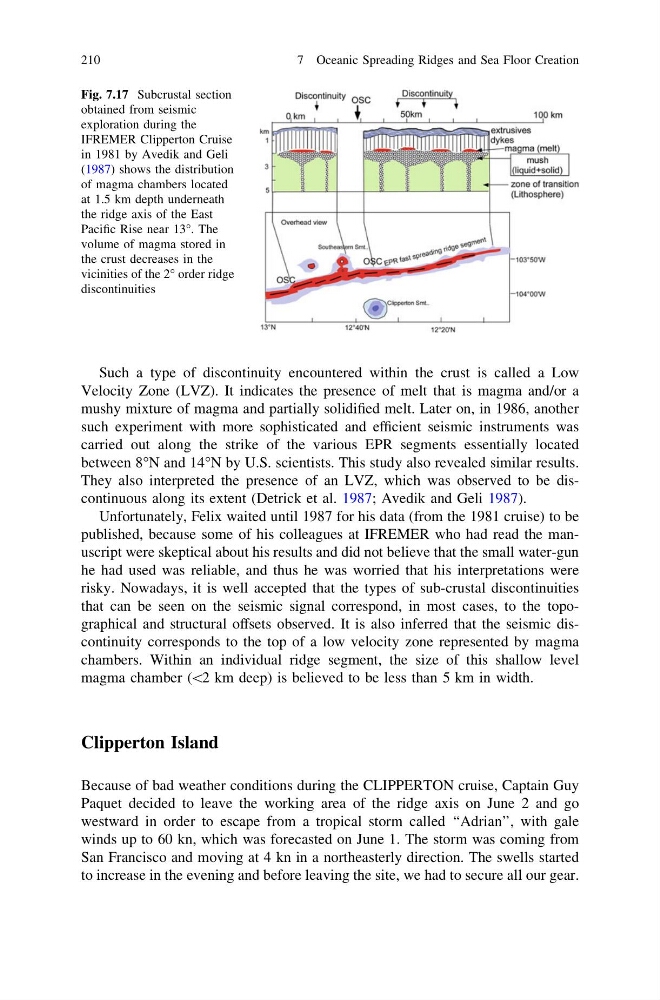
that can be seen on the seismic signal correspond, in most cases, to the topographical and structural offsets observed. It is also inferred that the seismic discontinuity corresponds to the top of a low velocity zone represented by magma
chambers. Within an individual ridge segment, the size of this shallow level
magma chamber (\2 km deep) is believed to be less than 5 km in width.
Clipperton Island
Because of bad weather conditions during the CLIPPERTON cruise, Captain Guy
Paquet decided to leave the working area of the ridge axis on June 2 and go
westward in order to escape from a tropical storm called ‘‘Adrian’’, with gale
winds up to 60 kn, which was forecasted on June 1. The storm was coming from
San Francisco and moving at 4 kn in a northeasterly direction. The swells started
to increase in the evening and before leaving the site, we had to secure all our gear.
Fig. 7.17 Subcrustal section
obtained from seismic
exploration during the
IFREMER Clipperton Cruise
in 1981 by Avedik and Geli
(1987) shows the distribution
of magma chambers located
at 1.5 km depth underneath
the ridge axis of the East
Pacific Rise near 13°. The
volume of magma stored in
the crust decreases in the
vicinities of the 2° order ridge
discontinuities
210
7 Oceanic Spreading Ridges and Sea Floor Creation
Velocity Zone (LVZ). It indicates the presence of melt that is magma and/or a
mushy mixture of magma and partially solidified melt. Later on, in 1986, another
such experiment with more sophisticated and efficient seismic instruments was
carried out along the strike of the various EPR segments essentially located
between 8°N and 14°N by U.S. scientists. This study also revealed similar results.
They also interpreted the presence of an LVZ, which was observed to be discontinuous along its extent (Detrick et al. 1987; Avedik and Geli 1987).
Unfortunately, Felix waited until 1987 for his data (from the 1981 cruise) to be
published, because some of his colleagues at IFREMER who had read the manuscript were skeptical about his results and did not believe that the small water-gun
he had used was reliable, and thus he was worried that his interpretations were
risky. Nowadays, it is well accepted that the types of sub-crustal discontinuities
that can be seen on the seismic signal correspond, in most cases, to the topographical and structural offsets observed. It is also inferred that the seismic discontinuity corresponds to the top of a low velocity zone represented by magma
chambers. Within an individual ridge segment, the size of this shallow level
magma chamber (\2 km deep) is believed to be less than 5 km in width.
Clipperton Island
Because of bad weather conditions during the CLIPPERTON cruise, Captain Guy
Paquet decided to leave the working area of the ridge axis on June 2 and go
westward in order to escape from a tropical storm called ‘‘Adrian’’, with gale
winds up to 60 kn, which was forecasted on June 1. The storm was coming from
San Francisco and moving at 4 kn in a northeasterly direction. The swells started
to increase in the evening and before leaving the site, we had to secure all our gear.
Fig. 7.17 Subcrustal section
obtained from seismic
exploration during the
IFREMER Clipperton Cruise
in 1981 by Avedik and Geli
(1987) shows the distribution
of magma chambers located
at 1.5 km depth underneath
the ridge axis of the East
Pacific Rise near 13°. The
volume of magma stored in
the crust decreases in the
vicinities of the 2° order ridge
discontinuities
210
7 Oceanic Spreading Ridges and Sea Floor Creation