

abundant slumped angular and prismatic rock debris, which I recognized as being
dyke fragments.
I thought that these intrusive dykes must be exposed further up slope. Pierre
slowed down and, without stopping the submarine, he very quickly collected our
fifth sample, which was a piece of loose debris (sample OT14-05). As the Nautile
continued its ascension along the slope, we could see green colored gravel-sized
fragments mixed with the larger dolerite blocks. This indicated that within the
avalanche’s debris, fragments of green colored peridotite and chunks of a darker,
massive dolerite dyke were mixed together and were most likely going to be
exposed higher up along the slope. However, it was not until we reached a depth of
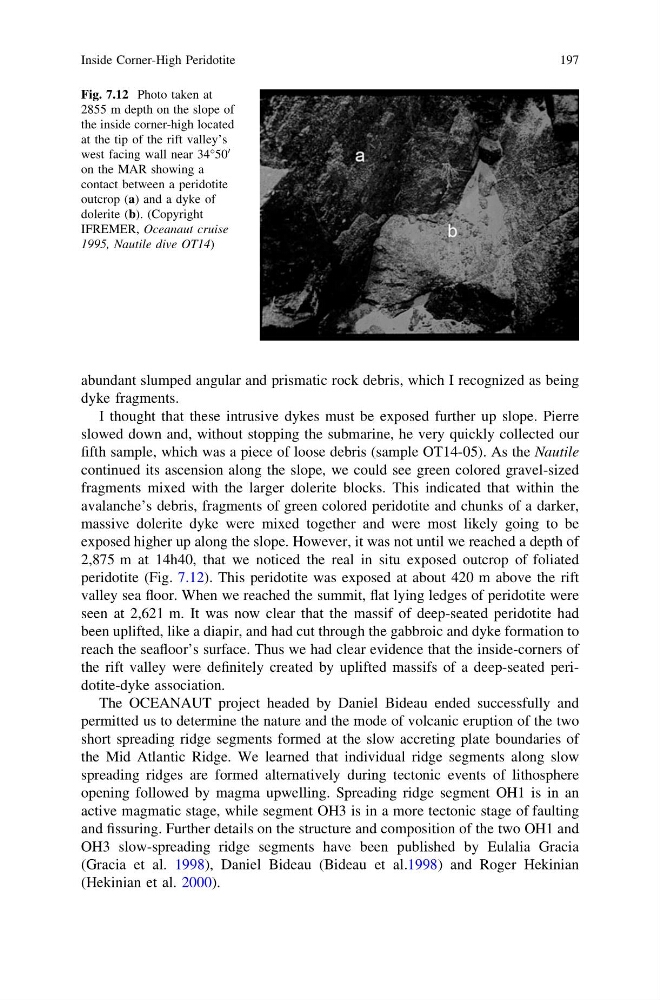
2,875 m at 14h40, that we noticed the real in situ exposed outcrop of foliated
peridotite (Fig. 7.12). This peridotite was exposed at about 420 m above the rift
valley sea floor. When we reached the summit, flat lying ledges of peridotite were
seen at 2,621 m. It was now clear that the massif of deep-seated peridotite had
been uplifted, like a diapir, and had cut through the gabbroic and dyke formation to
reach the seafloor’s surface. Thus we had clear evidence that the inside-corners of
the rift valley were definitely created by uplifted massifs of a deep-seated peridotite-dyke association.
The OCEANAUT project headed by Daniel Bideau ended successfully and
permitted us to determine the nature and the mode of volcanic eruption of the two
short spreading ridge segments formed at the slow accreting plate boundaries of
the Mid Atlantic Ridge. We learned that individual ridge segments along slow
spreading ridges are formed alternatively during tectonic events of lithosphere
opening followed by magma upwelling. Spreading ridge segment OH1 is in an
active magmatic stage, while segment OH3 is in a more tectonic stage of faulting
and fissuring. Further details on the structure and composition of the two OH1 and
OH3 slow-spreading ridge segments have been published by Eulalia Gracia
(Gracia et al. 1998), Daniel Bideau (Bideau et al.1998) and Roger Hekinian
(Hekinian et al. 2000).
Fig. 7.12 Photo taken at
2855 m depth on the slope of
the inside corner-high located
at the tip of the rift valley’s
west facing wall near 34°50
0
on the MAR showing a
contact between a peridotite
outcrop (a) and a dyke of
dolerite (b). (Copyright
IFREMER, Oceanaut cruise
1995, Nautile dive OT14)
Inside Corner-High Peridotite
197
dyke fragments.
I thought that these intrusive dykes must be exposed further up slope. Pierre
slowed down and, without stopping the submarine, he very quickly collected our
fifth sample, which was a piece of loose debris (sample OT14-05). As the Nautile
continued its ascension along the slope, we could see green colored gravel-sized
fragments mixed with the larger dolerite blocks. This indicated that within the
avalanche’s debris, fragments of green colored peridotite and chunks of a darker,
massive dolerite dyke were mixed together and were most likely going to be
exposed higher up along the slope. However, it was not until we reached a depth of
2,875 m at 14h40, that we noticed the real in situ exposed outcrop of foliated
peridotite (Fig. 7.12). This peridotite was exposed at about 420 m above the rift
valley sea floor. When we reached the summit, flat lying ledges of peridotite were
seen at 2,621 m. It was now clear that the massif of deep-seated peridotite had
been uplifted, like a diapir, and had cut through the gabbroic and dyke formation to
reach the seafloor’s surface. Thus we had clear evidence that the inside-corners of
the rift valley were definitely created by uplifted massifs of a deep-seated peridotite-dyke association.
The OCEANAUT project headed by Daniel Bideau ended successfully and
permitted us to determine the nature and the mode of volcanic eruption of the two
short spreading ridge segments formed at the slow accreting plate boundaries of
the Mid Atlantic Ridge. We learned that individual ridge segments along slow
spreading ridges are formed alternatively during tectonic events of lithosphere
opening followed by magma upwelling. Spreading ridge segment OH1 is in an
active magmatic stage, while segment OH3 is in a more tectonic stage of faulting
and fissuring. Further details on the structure and composition of the two OH1 and
OH3 slow-spreading ridge segments have been published by Eulalia Gracia
(Gracia et al. 1998), Daniel Bideau (Bideau et al.1998) and Roger Hekinian
(Hekinian et al. 2000).
Fig. 7.12 Photo taken at
2855 m depth on the slope of
the inside corner-high located
at the tip of the rift valley’s
west facing wall near 34°50
0
on the MAR showing a
contact between a peridotite
outcrop (a) and a dyke of
dolerite (b). (Copyright
IFREMER, Oceanaut cruise
1995, Nautile dive OT14)
Inside Corner-High Peridotite
197