

In the meantime on the bridge, the captain was concerned about a storm
warning that had been broadcast. Several tropical storms (Humberto, Luis, Iris and
Karen) with a radius of 125 nautical miles had formed near 12–15°N and were
forecast from August 28 to September 1st. On September 7, the storm called ‘Iris’
went up the coast of Brittany (France) with winds up to 140 km/h. Thus, on
August 30, our captain decided that we had to move from our diving site on
segment OH1, because another tropical storm called ‘‘Humberto’’ was heading
towards the Azores at a speed of 29 nautical miles. Thus, we were obliged to move
further south to 34°49
0 N to explore a second ridge segment.
The other ridge segment that was explored during the Oceanaut cruise was
called OH3 and is located about 100 km further south of OH1. The rift valley of
segment OH3 is shorter, about 50 km long, deeper ([3,000 m depth), and it has
abundant fissures and faults. From the dives we made, it was shown that the
volcanic activity has been limited, as indicated by the presence of small mounds
and haystack types of features suggesting localized events. This segment does not
have any median ridge construction but is a series of gentle rolling hills in the
middle of the rift valley. The most recent volcanism also occurs on the eastern side
of the rift valley over a width of about 1 km. The extremities of this ridge segment
are located at the intersection of non-transform discontinuities characterized by the
presence of two topographic elevations composed of uplifted peridotite.
By 1999 the submersible Nautile had already made more than 1500 dives.
However, in 1995, I had the opportunity to participate on its 1,000th dive during
the Oceanaut cruise. Indeed, to my surprise, the chief scientist, Daniel Bideau,
wanted me to be on board the submersible for this special event, even if it was not
supposed to be my turn to dive. That’s when I realized that I was getting older, but
at the same time, I was very happy to inaugurate another round of a thousand dives
for this superb engine, Nautile.
Dive OT-09 was the 1,000th dive of the Nautile on September 5, 1995. For this
occasion, the engineers of the diving group had prepared a plastic panel with the
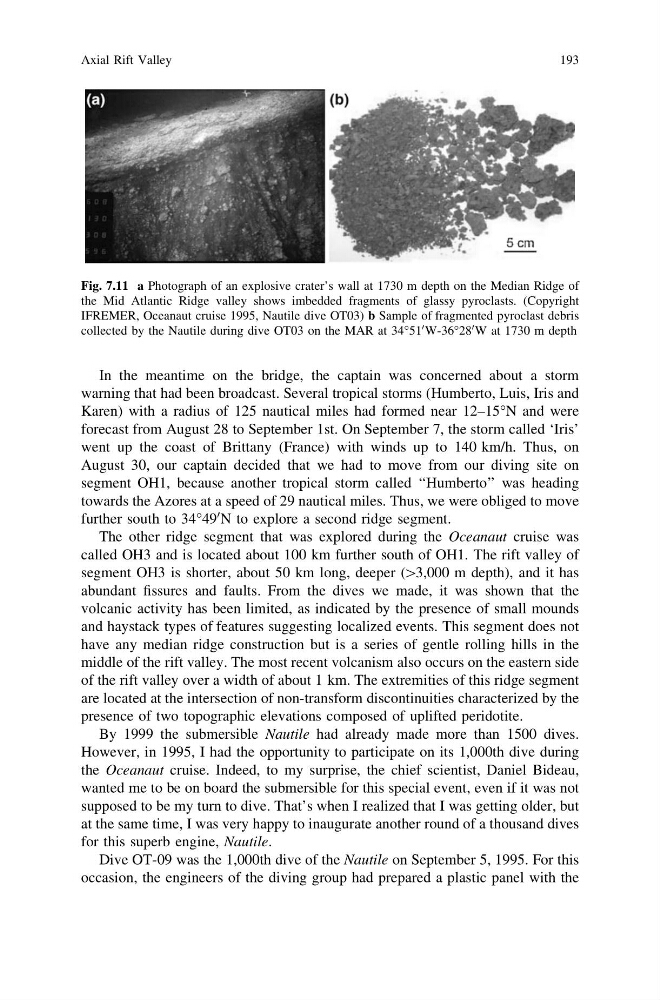
Fig. 7.11 a Photograph of an explosive crater’s wall at 1730 m depth on the Median Ridge of
the Mid Atlantic Ridge valley shows imbedded fragments of glassy pyroclasts. (Copyright
IFREMER, Oceanaut cruise 1995, Nautile dive OT03) b Sample of fragmented pyroclast debris
collected by the Nautile during dive OT03 on the MAR at 34°51
0 W-36°28
0 W at 1730 m depth
Axial Rift Valley
193
warning that had been broadcast. Several tropical storms (Humberto, Luis, Iris and
Karen) with a radius of 125 nautical miles had formed near 12–15°N and were
forecast from August 28 to September 1st. On September 7, the storm called ‘Iris’
went up the coast of Brittany (France) with winds up to 140 km/h. Thus, on
August 30, our captain decided that we had to move from our diving site on
segment OH1, because another tropical storm called ‘‘Humberto’’ was heading
towards the Azores at a speed of 29 nautical miles. Thus, we were obliged to move
further south to 34°49
0 N to explore a second ridge segment.
The other ridge segment that was explored during the Oceanaut cruise was
called OH3 and is located about 100 km further south of OH1. The rift valley of
segment OH3 is shorter, about 50 km long, deeper ([3,000 m depth), and it has
abundant fissures and faults. From the dives we made, it was shown that the
volcanic activity has been limited, as indicated by the presence of small mounds
and haystack types of features suggesting localized events. This segment does not
have any median ridge construction but is a series of gentle rolling hills in the
middle of the rift valley. The most recent volcanism also occurs on the eastern side
of the rift valley over a width of about 1 km. The extremities of this ridge segment
are located at the intersection of non-transform discontinuities characterized by the
presence of two topographic elevations composed of uplifted peridotite.
By 1999 the submersible Nautile had already made more than 1500 dives.
However, in 1995, I had the opportunity to participate on its 1,000th dive during
the Oceanaut cruise. Indeed, to my surprise, the chief scientist, Daniel Bideau,
wanted me to be on board the submersible for this special event, even if it was not
supposed to be my turn to dive. That’s when I realized that I was getting older, but
at the same time, I was very happy to inaugurate another round of a thousand dives
for this superb engine, Nautile.
Dive OT-09 was the 1,000th dive of the Nautile on September 5, 1995. For this
occasion, the engineers of the diving group had prepared a plastic panel with the
Fig. 7.11 a Photograph of an explosive crater’s wall at 1730 m depth on the Median Ridge of
the Mid Atlantic Ridge valley shows imbedded fragments of glassy pyroclasts. (Copyright
IFREMER, Oceanaut cruise 1995, Nautile dive OT03) b Sample of fragmented pyroclast debris
collected by the Nautile during dive OT03 on the MAR at 34°51
0 W-36°28
0 W at 1730 m depth
Axial Rift Valley
193