

For an on-site observer, the color of the hydrothermal exiting fluids varies
according to its composition, which reflects various types of element content in
metals and/or other elements. The black exiting fluids consist essentially of darkcolored metallic sulfides composed of Zn, Fe, and Cu and their exiting temperature
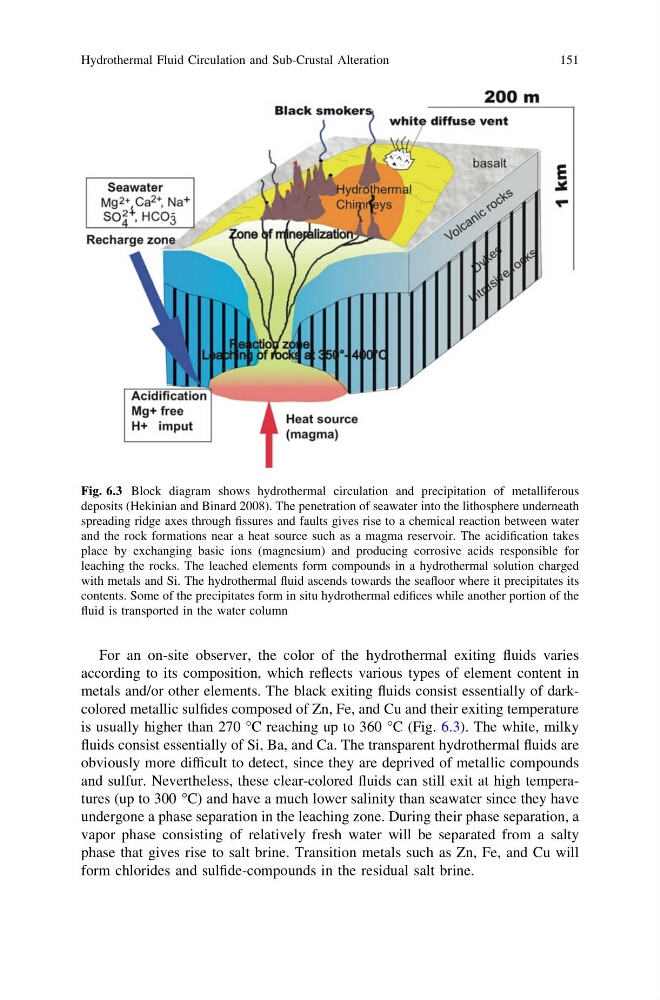
is usually higher than 270 °C reaching up to 360 °C (Fig. 6.3). The white, milky
fluids consist essentially of Si, Ba, and Ca. The transparent hydrothermal fluids are
obviously more difficult to detect, since they are deprived of metallic compounds
and sulfur. Nevertheless, these clear-colored fluids can still exit at high temperatures (up to 300 °C) and have a much lower salinity than seawater since they have
undergone a phase separation in the leaching zone. During their phase separation, a
vapor phase consisting of relatively fresh water will be separated from a salty
phase that gives rise to salt brine. Transition metals such as Zn, Fe, and Cu will
form chlorides and sulfide-compounds in the residual salt brine.
Fig. 6.3 Block diagram shows hydrothermal circulation and precipitation of metalliferous
deposits (Hekinian and Binard 2008). The penetration of seawater into the lithosphere underneath
spreading ridge axes through fissures and faults gives rise to a chemical reaction between water
and the rock formations near a heat source such as a magma reservoir. The acidification takes
place by exchanging basic ions (magnesium) and producing corrosive acids responsible for
leaching the rocks. The leached elements form compounds in a hydrothermal solution charged
with metals and Si. The hydrothermal fluid ascends towards the seafloor where it precipitates its
contents. Some of the precipitates form in situ hydrothermal edifices while another portion of the
fluid is transported in the water column
Hydrothermal Fluid Circulation and Sub-Crustal Alteration
151
according to its composition, which reflects various types of element content in
metals and/or other elements. The black exiting fluids consist essentially of darkcolored metallic sulfides composed of Zn, Fe, and Cu and their exiting temperature
is usually higher than 270 °C reaching up to 360 °C (Fig. 6.3). The white, milky
fluids consist essentially of Si, Ba, and Ca. The transparent hydrothermal fluids are
obviously more difficult to detect, since they are deprived of metallic compounds
and sulfur. Nevertheless, these clear-colored fluids can still exit at high temperatures (up to 300 °C) and have a much lower salinity than seawater since they have
undergone a phase separation in the leaching zone. During their phase separation, a
vapor phase consisting of relatively fresh water will be separated from a salty
phase that gives rise to salt brine. Transition metals such as Zn, Fe, and Cu will
form chlorides and sulfide-compounds in the residual salt brine.
Fig. 6.3 Block diagram shows hydrothermal circulation and precipitation of metalliferous
deposits (Hekinian and Binard 2008). The penetration of seawater into the lithosphere underneath
spreading ridge axes through fissures and faults gives rise to a chemical reaction between water
and the rock formations near a heat source such as a magma reservoir. The acidification takes
place by exchanging basic ions (magnesium) and producing corrosive acids responsible for
leaching the rocks. The leached elements form compounds in a hydrothermal solution charged
with metals and Si. The hydrothermal fluid ascends towards the seafloor where it precipitates its
contents. Some of the precipitates form in situ hydrothermal edifices while another portion of the
fluid is transported in the water column
Hydrothermal Fluid Circulation and Sub-Crustal Alteration
151