

(layered) units during magma’s accumulation in the confines of a reservoir. The
volume of melt underneath ridge axes could vary considerably and will depend on
the rate of partial melting of upwelling mantle diapirs, as well as on the rate of
spreading at the ridge axes.
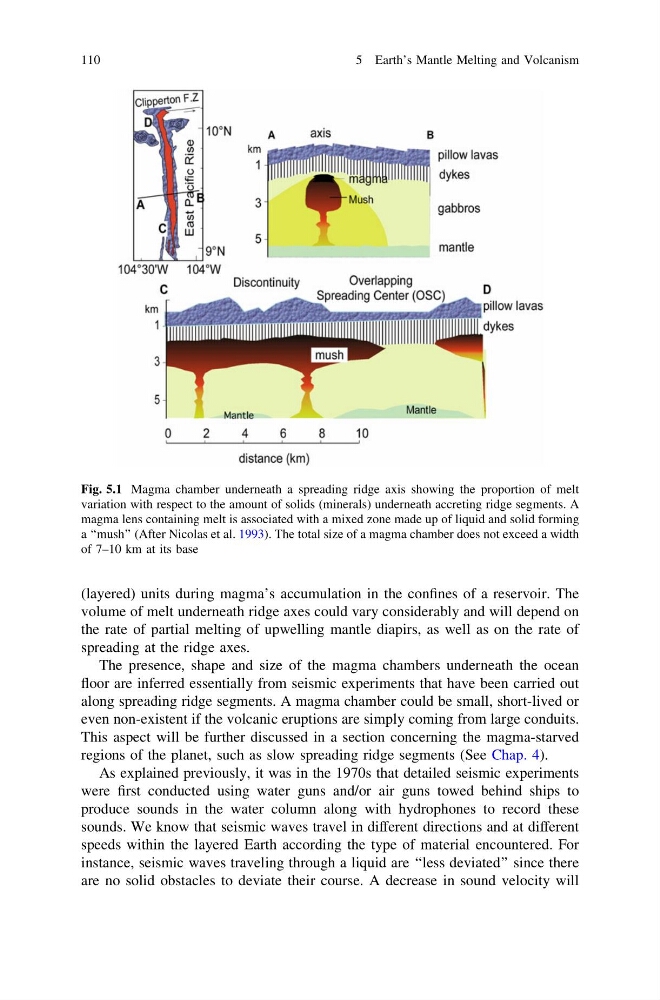
The presence, shape and size of the magma chambers underneath the ocean
floor are inferred essentially from seismic experiments that have been carried out
along spreading ridge segments. A magma chamber could be small, short-lived or
even non-existent if the volcanic eruptions are simply coming from large conduits.
This aspect will be further discussed in a section concerning the magma-starved
regions of the planet, such as slow spreading ridge segments (See Chap. 4).
As explained previously, it was in the 1970s that detailed seismic experiments
were first conducted using water guns and/or air guns towed behind ships to
produce sounds in the water column along with hydrophones to record these
sounds. We know that seismic waves travel in different directions and at different
speeds within the layered Earth according the type of material encountered. For
instance, seismic waves traveling through a liquid are ‘‘less deviated’’ since there
are no solid obstacles to deviate their course. A decrease in sound velocity will
Fig. 5.1 Magma chamber underneath a spreading ridge axis showing the proportion of melt
variation with respect to the amount of solids (minerals) underneath accreting ridge segments. A
magma lens containing melt is associated with a mixed zone made up of liquid and solid forming
a ‘‘mush’’ (After Nicolas et al. 1993). The total size of a magma chamber does not exceed a width
of 7–10 km at its base
110
5 Earth’s Mantle Melting and Volcanism
volume of melt underneath ridge axes could vary considerably and will depend on
the rate of partial melting of upwelling mantle diapirs, as well as on the rate of
spreading at the ridge axes.
The presence, shape and size of the magma chambers underneath the ocean
floor are inferred essentially from seismic experiments that have been carried out
along spreading ridge segments. A magma chamber could be small, short-lived or
even non-existent if the volcanic eruptions are simply coming from large conduits.
This aspect will be further discussed in a section concerning the magma-starved
regions of the planet, such as slow spreading ridge segments (See Chap. 4).
As explained previously, it was in the 1970s that detailed seismic experiments
were first conducted using water guns and/or air guns towed behind ships to
produce sounds in the water column along with hydrophones to record these
sounds. We know that seismic waves travel in different directions and at different
speeds within the layered Earth according the type of material encountered. For
instance, seismic waves traveling through a liquid are ‘‘less deviated’’ since there
are no solid obstacles to deviate their course. A decrease in sound velocity will
Fig. 5.1 Magma chamber underneath a spreading ridge axis showing the proportion of melt
variation with respect to the amount of solids (minerals) underneath accreting ridge segments. A
magma lens containing melt is associated with a mixed zone made up of liquid and solid forming
a ‘‘mush’’ (After Nicolas et al. 1993). The total size of a magma chamber does not exceed a width
of 7–10 km at its base
110
5 Earth’s Mantle Melting and Volcanism