

38
G. Lagerloef and J. Font
3.3 Basic Principles and Issue for Salinity Remote Sensing
Salinity remote sensing is possible because the microwave emission of the sea surface at a given radio frequency depends partly on the dielectric coefficient of sea
water, which in turn is partly related to salinity and temperature (Klein and Swift,
1977; Meissner and Wentz, 2003). The total power of the emission at horizontal
(H) and vertical (V) polarization is measured remotely with a microwave radiometer. The output is given in terms of a parameter called brightness temperature (T BH
and T BV ) at each polarization, which are respectively the products of the surface
emissivities (e H and e V ) and the absolute temperature of the sea surface (T):
T BH = e H T
T BV = e V T
(3.1)
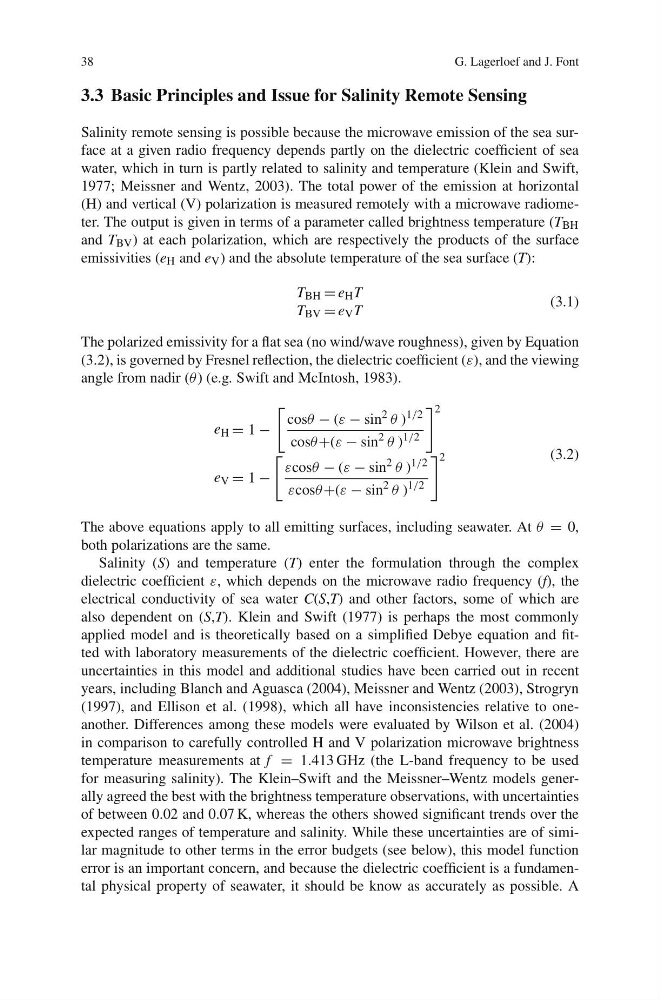
The polarized emissivity for a flat sea (no wind/wave roughness), given by Equation
(3.2), is governed by Fresnel reflection, the dielectric coefficient (ε), and the viewing
angle from nadir (θ) (e.g. Swift and McIntosh, 1983).
e H = 1 −
cosθ − (ε − sin
2
θ )
1/2
cosθ +(ε − sin
2
θ )
1/2
2
e V = 1 −
εcosθ − (ε − sin
2
θ )
1/2
εcosθ +(ε − sin
2
θ )
1/2
2
(3.2)
The above equations apply to all emitting surfaces, including seawater. At θ = 0,
both polarizations are the same.
Salinity (S) and temperature (T) enter the formulation through the complex
dielectric coefficient ε, which depends on the microwave radio frequency (f), the
electrical conductivity of sea water C(S,T) and other factors, some of which are
also dependent on (S,T). Klein and Swift (1977) is perhaps the most commonly
applied model and is theoretically based on a simplified Debye equation and fitted with laboratory measurements of the dielectric coefficient. However, there are
uncertainties in this model and additional studies have been carried out in recent
years, including Blanch and Aguasca (2004), Meissner and Wentz (2003), Strogryn
(1997), and Ellison et al. (1998), which all have inconsistencies relative to oneanother. Differences among these models were evaluated by Wilson et al. (2004)
in comparison to carefully controlled H and V polarization microwave brightness
temperature measurements at f = 1.413 GHz (the L-band frequency to be used
for measuring salinity). The Klein–Swift and the Meissner–Wentz models generally agreed the best with the brightness temperature observations, with uncertainties
of between 0.02 and 0.07 K, whereas the others showed significant trends over the
expected ranges of temperature and salinity. While these uncertainties are of similar magnitude to other terms in the error budgets (see below), this model function
error is an important concern, and because the dielectric coefficient is a fundamental physical property of seawater, it should be know as accurately as possible. A
G. Lagerloef and J. Font
3.3 Basic Principles and Issue for Salinity Remote Sensing
Salinity remote sensing is possible because the microwave emission of the sea surface at a given radio frequency depends partly on the dielectric coefficient of sea
water, which in turn is partly related to salinity and temperature (Klein and Swift,
1977; Meissner and Wentz, 2003). The total power of the emission at horizontal
(H) and vertical (V) polarization is measured remotely with a microwave radiometer. The output is given in terms of a parameter called brightness temperature (T BH
and T BV ) at each polarization, which are respectively the products of the surface
emissivities (e H and e V ) and the absolute temperature of the sea surface (T):
T BH = e H T
T BV = e V T
(3.1)
The polarized emissivity for a flat sea (no wind/wave roughness), given by Equation
(3.2), is governed by Fresnel reflection, the dielectric coefficient (ε), and the viewing
angle from nadir (θ) (e.g. Swift and McIntosh, 1983).
e H = 1 −
cosθ − (ε − sin
2
θ )
1/2
cosθ +(ε − sin
2
θ )
1/2
2
e V = 1 −
εcosθ − (ε − sin
2
θ )
1/2
εcosθ +(ε − sin
2
θ )
1/2
2
(3.2)
The above equations apply to all emitting surfaces, including seawater. At θ = 0,
both polarizations are the same.
Salinity (S) and temperature (T) enter the formulation through the complex
dielectric coefficient ε, which depends on the microwave radio frequency (f), the
electrical conductivity of sea water C(S,T) and other factors, some of which are
also dependent on (S,T). Klein and Swift (1977) is perhaps the most commonly
applied model and is theoretically based on a simplified Debye equation and fitted with laboratory measurements of the dielectric coefficient. However, there are
uncertainties in this model and additional studies have been carried out in recent
years, including Blanch and Aguasca (2004), Meissner and Wentz (2003), Strogryn
(1997), and Ellison et al. (1998), which all have inconsistencies relative to oneanother. Differences among these models were evaluated by Wilson et al. (2004)
in comparison to carefully controlled H and V polarization microwave brightness
temperature measurements at f = 1.413 GHz (the L-band frequency to be used
for measuring salinity). The Klein–Swift and the Meissner–Wentz models generally agreed the best with the brightness temperature observations, with uncertainties
of between 0.02 and 0.07 K, whereas the others showed significant trends over the
expected ranges of temperature and salinity. While these uncertainties are of similar magnitude to other terms in the error budgets (see below), this model function
error is an important concern, and because the dielectric coefficient is a fundamental physical property of seawater, it should be know as accurately as possible. A