

3 SMOS and Aquarius/SAC-D Missions
37
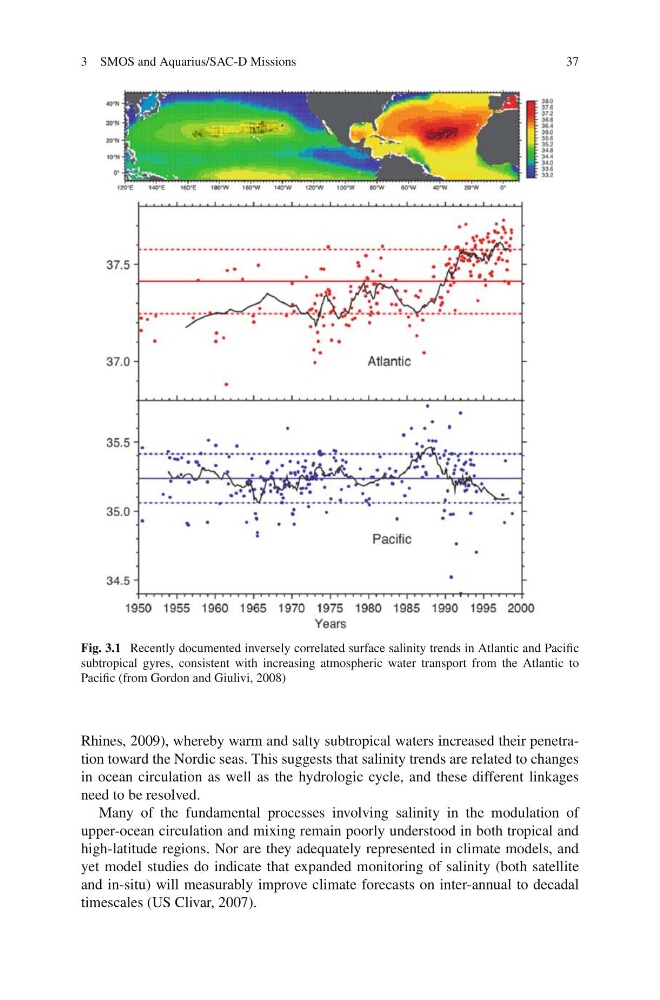
Fig. 3.1 Recently documented inversely correlated surface salinity trends in Atlantic and Pacific
subtropical gyres, consistent with increasing atmospheric water transport from the Atlantic to
Pacific (from Gordon and Giulivi, 2008)
Rhines, 2009), whereby warm and salty subtropical waters increased their penetration toward the Nordic seas. This suggests that salinity trends are related to changes
in ocean circulation as well as the hydrologic cycle, and these different linkages
need to be resolved.
Many of the fundamental processes involving salinity in the modulation of
upper-ocean circulation and mixing remain poorly understood in both tropical and
high-latitude regions. Nor are they adequately represented in climate models, and
yet model studies do indicate that expanded monitoring of salinity (both satellite
and in-situ) will measurably improve climate forecasts on inter-annual to decadal
timescales (US Clivar, 2007).
37
Fig. 3.1 Recently documented inversely correlated surface salinity trends in Atlantic and Pacific
subtropical gyres, consistent with increasing atmospheric water transport from the Atlantic to
Pacific (from Gordon and Giulivi, 2008)
Rhines, 2009), whereby warm and salty subtropical waters increased their penetration toward the Nordic seas. This suggests that salinity trends are related to changes
in ocean circulation as well as the hydrologic cycle, and these different linkages
need to be resolved.
Many of the fundamental processes involving salinity in the modulation of
upper-ocean circulation and mixing remain poorly understood in both tropical and
high-latitude regions. Nor are they adequately represented in climate models, and
yet model studies do indicate that expanded monitoring of salinity (both satellite
and in-situ) will measurably improve climate forecasts on inter-annual to decadal
timescales (US Clivar, 2007).