

20 Ocean-Colour Radiometry
355
Table 20.1 Pelagic indicators and remote sensing potential
(a) Ideal characteristics of pelagic indicators
Represent a well-understood and widely-accepted ecosystem property
Quantifiable unambiguously in standard units
Measurable rapidly at low incremental cost
Repeat frequency compatible with intrinsic time scale of properties
Measurable at a variety of scales
Possibility to create long (multi-decadal) time series
(b) Remote sensing for operational metrics
Requisites of speed, resolution, repeat frequency, cost-effectiveness are easily met
Autotrophic biomass important ecosystem property
Primary production fields can also be generated
SST and chlorophyll obtainable at same resolution
Time series possible: seasonal dynamics can be quantified objectively
Allows interannual comparisons
Table 20.2 List of some useful indicators amenable to remote sensing
Indicator
Label
Dimensions
Initiation of spring bloom
b i
[T]
Timing of spring maximum
b t
[T]
Amplitude of spring bloom
b a
[ML −3 ]
Duration of spring bloom
b d
[T]
Total production in spring bloom
b p
[ML −2 ]
Annual phytoplankton production
P Y
[ML −2 ]
Annual new production
P N
[ML −2 ]
Initial slope of light-saturation curve
α B
[L 2 ]
Assimilation number
P B m
[T −1 ]
Particulate organic carbon
C T
[ML −3 ]
Phytoplankton carbon
C p
[ML −3 ]
Carbon-to-chlorophyll ratio
χ
Dimensionless
Phytoplankton growth rate
μ
[T −1 ]
Generalised phytoplankton loss rate
L
[ML −3 /T]
Integrated phytoplankton loss
L T
[ML −3 ]
Spatial variance in biomass field
σ B
2
[M 2 /L 6 ]
Spatial variance in production field
σ P
2
[M 2 /L 4 ]
Phytoplankton functional types
NA
NA
Phytoplankton size
d
[L]
Delineation of biogeochemical provinces
NA
NA
generally accepted (subject of a Declaration of the United Nations), but difficult to
put in practice.
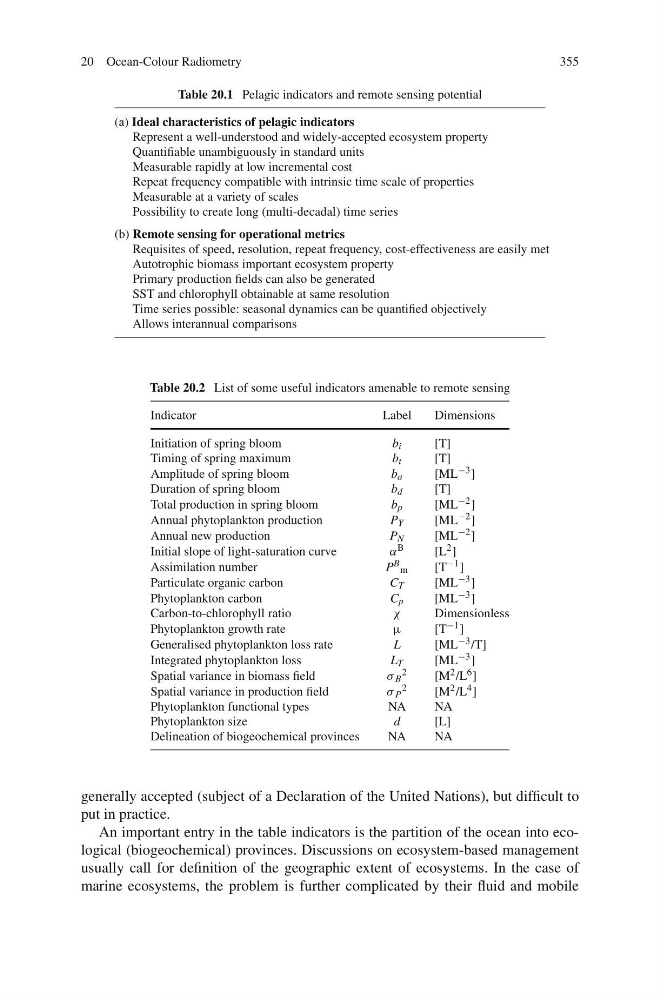
An important entry in the table indicators is the partition of the ocean into ecological (biogeochemical) provinces. Discussions on ecosystem-based management
usually call for definition of the geographic extent of ecosystems. In the case of
marine ecosystems, the problem is further complicated by their fluid and mobile
355
Table 20.1 Pelagic indicators and remote sensing potential
(a) Ideal characteristics of pelagic indicators
Represent a well-understood and widely-accepted ecosystem property
Quantifiable unambiguously in standard units
Measurable rapidly at low incremental cost
Repeat frequency compatible with intrinsic time scale of properties
Measurable at a variety of scales
Possibility to create long (multi-decadal) time series
(b) Remote sensing for operational metrics
Requisites of speed, resolution, repeat frequency, cost-effectiveness are easily met
Autotrophic biomass important ecosystem property
Primary production fields can also be generated
SST and chlorophyll obtainable at same resolution
Time series possible: seasonal dynamics can be quantified objectively
Allows interannual comparisons
Table 20.2 List of some useful indicators amenable to remote sensing
Indicator
Label
Dimensions
Initiation of spring bloom
b i
[T]
Timing of spring maximum
b t
[T]
Amplitude of spring bloom
b a
[ML −3 ]
Duration of spring bloom
b d
[T]
Total production in spring bloom
b p
[ML −2 ]
Annual phytoplankton production
P Y
[ML −2 ]
Annual new production
P N
[ML −2 ]
Initial slope of light-saturation curve
α B
[L 2 ]
Assimilation number
P B m
[T −1 ]
Particulate organic carbon
C T
[ML −3 ]
Phytoplankton carbon
C p
[ML −3 ]
Carbon-to-chlorophyll ratio
χ
Dimensionless
Phytoplankton growth rate
μ
[T −1 ]
Generalised phytoplankton loss rate
L
[ML −3 /T]
Integrated phytoplankton loss
L T
[ML −3 ]
Spatial variance in biomass field
σ B
2
[M 2 /L 6 ]
Spatial variance in production field
σ P
2
[M 2 /L 4 ]
Phytoplankton functional types
NA
NA
Phytoplankton size
d
[L]
Delineation of biogeochemical provinces
NA
NA
generally accepted (subject of a Declaration of the United Nations), but difficult to
put in practice.
An important entry in the table indicators is the partition of the ocean into ecological (biogeochemical) provinces. Discussions on ecosystem-based management
usually call for definition of the geographic extent of ecosystems. In the case of
marine ecosystems, the problem is further complicated by their fluid and mobile