

322
G. Zibordi and K.J. Voss
18.5.3 Exact Normalized Water-Leaving Radiance
Morel and Gentili (1996) introduced an additional term, the exact normalized waterleaving radiance, L WN (λ), defined as
L WN (λ) = L wn (θ ) C f / Q (θ 0 ,λ,τ a ,IOP)
(18.21)
where
C f / Q (θ 0 ,λ,τ a ,IOP) =
f 0 (λ,τ a ,IOP)
Q 0 (λ,τ a ,IOP)
f (θ 0 ,λ,τ a ,IOP)
Q n (θ 0 ,λ,τ a ,IOP)
−1
(18.22)
and, Q 0 (λ,τ a ,IOP) and f 0 (λ,τ a ,IOP) are the values of Q n (θ 0 ,λ,τ a ,IOP) and
f (θ 0 ,λ,τ a ,IOP) at θ 0 = 0, respectively. f (θ 0 ,λ,τ a ,IOP) relates the irradiance
reflectance to the seawater backscattering to absorption ratio, b b (λ)/a(λ).
The dependence of bi-directional effects on IOPs can be conveniently expressed
through chlorophyll a concentration, Chla, in Case-1 waters only, i.e., chlorophyll
dominated waters (Morel et al., 2002).
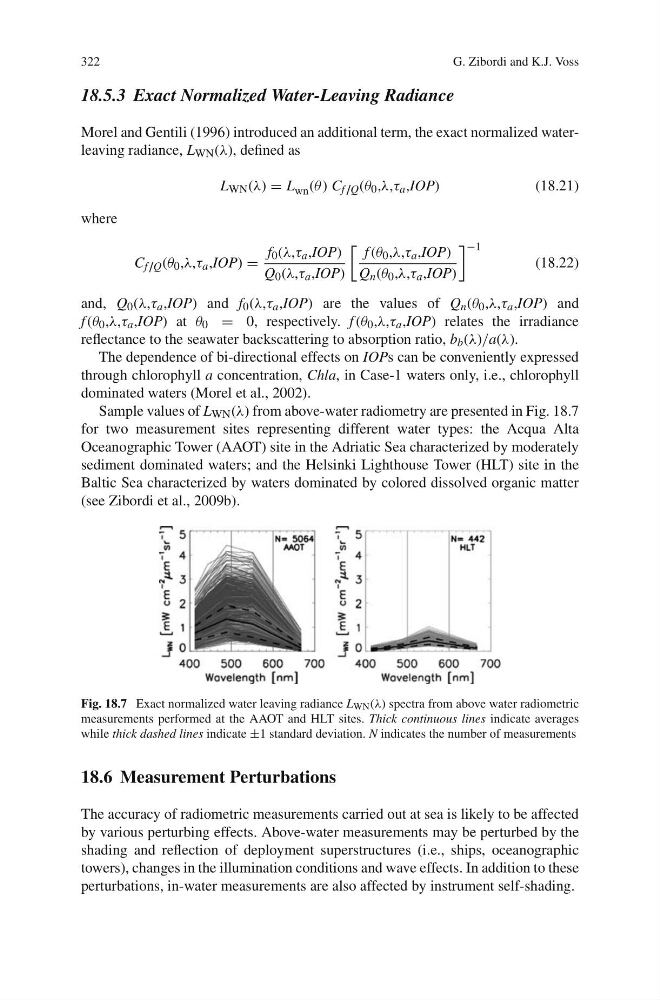
Sample values of L WN (λ) from above-water radiometry are presented in Fig. 18.7
for two measurement sites representing different water types: the Acqua Alta
Oceanographic Tower (AAOT) site in the Adriatic Sea characterized by moderately
sediment dominated waters; and the Helsinki Lighthouse Tower (HLT) site in the
Baltic Sea characterized by waters dominated by colored dissolved organic matter
(see Zibordi et al., 2009b).
Fig. 18.7 Exact normalized water leaving radiance L WN (λ) spectra from above water radiometric
measurements performed at the AAOT and HLT sites. Thick continuous lines indicate averages
while thick dashed lines indicate ±1 standard deviation. N indicates the number of measurements
18.6 Measurement Perturbations
The accuracy of radiometric measurements carried out at sea is likely to be affected
by various perturbing effects. Above-water measurements may be perturbed by the
shading and reflection of deployment superstructures (i.e., ships, oceanographic
towers), changes in the illumination conditions and wave effects. In addition to these
perturbations, in-water measurements are also affected by instrument self-shading.
G. Zibordi and K.J. Voss
18.5.3 Exact Normalized Water-Leaving Radiance
Morel and Gentili (1996) introduced an additional term, the exact normalized waterleaving radiance, L WN (λ), defined as
L WN (λ) = L wn (θ ) C f / Q (θ 0 ,λ,τ a ,IOP)
(18.21)
where
C f / Q (θ 0 ,λ,τ a ,IOP) =
f 0 (λ,τ a ,IOP)
Q 0 (λ,τ a ,IOP)
f (θ 0 ,λ,τ a ,IOP)
Q n (θ 0 ,λ,τ a ,IOP)
−1
(18.22)
and, Q 0 (λ,τ a ,IOP) and f 0 (λ,τ a ,IOP) are the values of Q n (θ 0 ,λ,τ a ,IOP) and
f (θ 0 ,λ,τ a ,IOP) at θ 0 = 0, respectively. f (θ 0 ,λ,τ a ,IOP) relates the irradiance
reflectance to the seawater backscattering to absorption ratio, b b (λ)/a(λ).
The dependence of bi-directional effects on IOPs can be conveniently expressed
through chlorophyll a concentration, Chla, in Case-1 waters only, i.e., chlorophyll
dominated waters (Morel et al., 2002).
Sample values of L WN (λ) from above-water radiometry are presented in Fig. 18.7
for two measurement sites representing different water types: the Acqua Alta
Oceanographic Tower (AAOT) site in the Adriatic Sea characterized by moderately
sediment dominated waters; and the Helsinki Lighthouse Tower (HLT) site in the
Baltic Sea characterized by waters dominated by colored dissolved organic matter
(see Zibordi et al., 2009b).
Fig. 18.7 Exact normalized water leaving radiance L WN (λ) spectra from above water radiometric
measurements performed at the AAOT and HLT sites. Thick continuous lines indicate averages
while thick dashed lines indicate ±1 standard deviation. N indicates the number of measurements
18.6 Measurement Perturbations
The accuracy of radiometric measurements carried out at sea is likely to be affected
by various perturbing effects. Above-water measurements may be perturbed by the
shading and reflection of deployment superstructures (i.e., ships, oceanographic
towers), changes in the illumination conditions and wave effects. In addition to these
perturbations, in-water measurements are also affected by instrument self-shading.