

18 Field Radiometry and Ocean Color Remote Sensing
321
18.5.2 Products from Above-Water Measurements
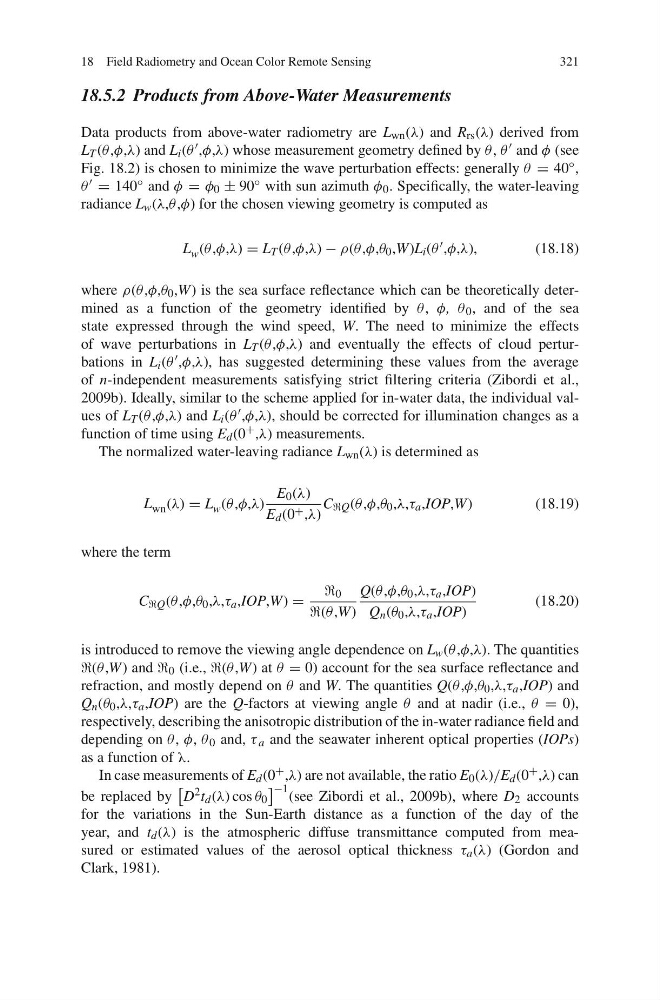
Data products from above-water radiometry are L wn (λ) and R rs (λ) derived from
L T (θ ,φ,λ) and L i (θ ,φ,λ) whose measurement geometry defined by θ, θ and φ (see
Fig. 18.2) is chosen to minimize the wave perturbation effects: generally θ = 40 ◦ ,
θ = 140 ◦ and φ = φ 0 ± 90 ◦ with sun azimuth φ 0 . Specifically, the water-leaving
radiance L w (λ,θ ,φ) for the chosen viewing geometry is computed as
L w (θ ,φ,λ) = L T (θ ,φ,λ) − ρ(θ ,φ,θ 0 ,W)L i (θ ,φ,λ),
(18.18)
where ρ(θ ,φ,θ 0 ,W) is the sea surface reflectance which can be theoretically determined as a function of the geometry identified by θ , φ, θ 0 , and of the sea
state expressed through the wind speed, W. The need to minimize the effects
of wave perturbations in L T (θ ,φ,λ) and eventually the effects of cloud perturbations in L i (θ ,φ,λ), has suggested determining these values from the average
of n-independent measurements satisfying strict filtering criteria (Zibordi et al.,
2009b). Ideally, similar to the scheme applied for in-water data, the individual values of L T (θ ,φ,λ) and L i (θ ,φ,λ), should be corrected for illumination changes as a
function of time using E d (0 + ,λ) measurements.
The normalized water-leaving radiance L wn (λ) is determined as
L wn (λ) = L w (θ ,φ,λ)
E 0 (λ)
E d (0 + ,λ)
C Q (θ ,φ,θ 0 ,λ,τ a ,IOP,W)
(18.19)
where the term
C Q (θ ,φ,θ 0 ,λ,τ a ,IOP,W) =
0
(θ ,W)
Q(θ,φ,θ 0 ,λ,τ a ,IOP)
Q n (θ 0 ,λ,τ a ,IOP)
(18.20)
is introduced to remove the viewing angle dependence on L w (θ ,φ,λ). The quantities
(θ ,W) and 0 (i.e., (θ ,W) at θ = 0) account for the sea surface reflectance and
refraction, and mostly depend on θ and W. The quantities Q(θ ,φ,θ 0 ,λ,τ a ,IOP) and
Q n (θ 0 ,λ,τ a ,IOP) are the Q-factors at viewing angle θ and at nadir (i.e., θ = 0),
respectively, describing the anisotropic distribution of the in-water radiance field and
depending on θ , φ, θ 0 and, τ a and the seawater inherent optical properties (IOPs)
as a function of λ.
In case measurements of E d (0 + ,λ) are not available, the ratio E 0 (λ)/E d (0 + ,λ) can
be replaced by
D 2 t d (λ) cos θ 0
−1 (see Zibordi et al., 2009b), where D 2 accounts
for the variations in the Sun-Earth distance as a function of the day of the
year, and t d (λ) is the atmospheric diffuse transmittance computed from measured or estimated values of the aerosol optical thickness τ a (λ) (Gordon and
Clark, 1981).
321
18.5.2 Products from Above-Water Measurements
Data products from above-water radiometry are L wn (λ) and R rs (λ) derived from
L T (θ ,φ,λ) and L i (θ ,φ,λ) whose measurement geometry defined by θ, θ and φ (see
Fig. 18.2) is chosen to minimize the wave perturbation effects: generally θ = 40 ◦ ,
θ = 140 ◦ and φ = φ 0 ± 90 ◦ with sun azimuth φ 0 . Specifically, the water-leaving
radiance L w (λ,θ ,φ) for the chosen viewing geometry is computed as
L w (θ ,φ,λ) = L T (θ ,φ,λ) − ρ(θ ,φ,θ 0 ,W)L i (θ ,φ,λ),
(18.18)
where ρ(θ ,φ,θ 0 ,W) is the sea surface reflectance which can be theoretically determined as a function of the geometry identified by θ , φ, θ 0 , and of the sea
state expressed through the wind speed, W. The need to minimize the effects
of wave perturbations in L T (θ ,φ,λ) and eventually the effects of cloud perturbations in L i (θ ,φ,λ), has suggested determining these values from the average
of n-independent measurements satisfying strict filtering criteria (Zibordi et al.,
2009b). Ideally, similar to the scheme applied for in-water data, the individual values of L T (θ ,φ,λ) and L i (θ ,φ,λ), should be corrected for illumination changes as a
function of time using E d (0 + ,λ) measurements.
The normalized water-leaving radiance L wn (λ) is determined as
L wn (λ) = L w (θ ,φ,λ)
E 0 (λ)
E d (0 + ,λ)
C Q (θ ,φ,θ 0 ,λ,τ a ,IOP,W)
(18.19)
where the term
C Q (θ ,φ,θ 0 ,λ,τ a ,IOP,W) =
0
(θ ,W)
Q(θ,φ,θ 0 ,λ,τ a ,IOP)
Q n (θ 0 ,λ,τ a ,IOP)
(18.20)
is introduced to remove the viewing angle dependence on L w (θ ,φ,λ). The quantities
(θ ,W) and 0 (i.e., (θ ,W) at θ = 0) account for the sea surface reflectance and
refraction, and mostly depend on θ and W. The quantities Q(θ ,φ,θ 0 ,λ,τ a ,IOP) and
Q n (θ 0 ,λ,τ a ,IOP) are the Q-factors at viewing angle θ and at nadir (i.e., θ = 0),
respectively, describing the anisotropic distribution of the in-water radiance field and
depending on θ , φ, θ 0 and, τ a and the seawater inherent optical properties (IOPs)
as a function of λ.
In case measurements of E d (0 + ,λ) are not available, the ratio E 0 (λ)/E d (0 + ,λ) can
be replaced by
D 2 t d (λ) cos θ 0
−1 (see Zibordi et al., 2009b), where D 2 accounts
for the variations in the Sun-Earth distance as a function of the day of the
year, and t d (λ) is the atmospheric diffuse transmittance computed from measured or estimated values of the aerosol optical thickness τ a (λ) (Gordon and
Clark, 1981).