

314
G. Zibordi and K.J. Voss
18.4 Calibration of Optical Radiometers
Absolute calibration and careful characterization of measuring instruments are crucial for determining physical quantities which are independent of the particular
instrument used in the data collection.
18.4.1 Radiometric Calibration
Absolute calibration of radiometers requires defining the mathematical transformation that relates the sensor output to the appropriate radiometric quantity. By
applying the concept of measurement equation (Wyatt, 1978) to yield the sensor
output for a specific source configuration and by assuming that the radiometer has
ideal spectral performance and linear response in the operational range, the conversion from relative to physical units (called calibration) of the radiometric quantity
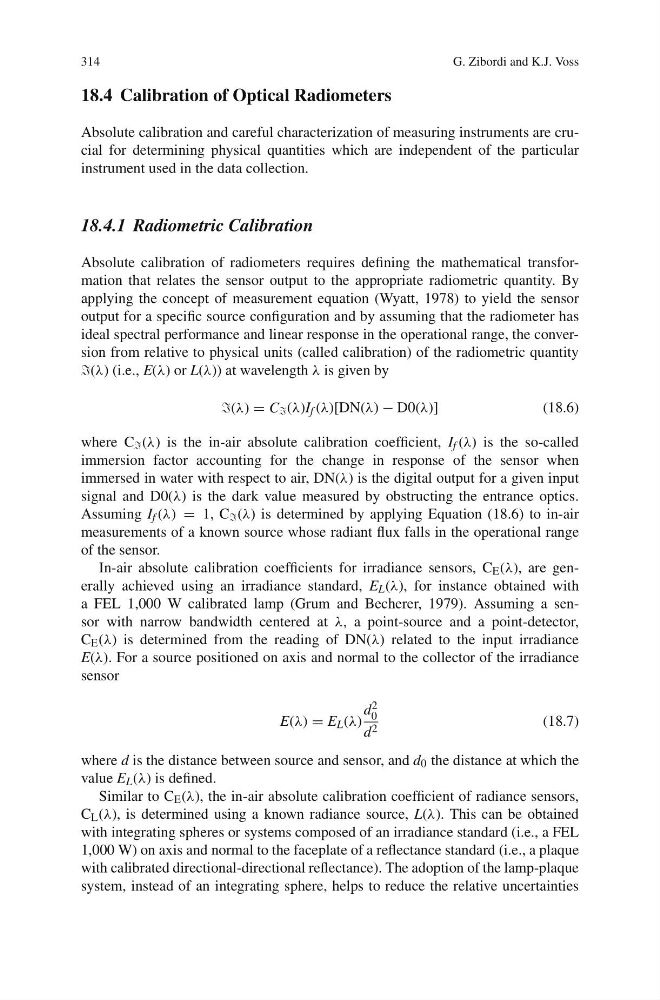
(λ) (i.e., E(λ) or L(λ)) at wavelength λ is given by
(λ) = C (λ)I f (λ)[DN(λ) − D0(λ)]
(18.6)
where C (λ) is the in-air absolute calibration coefficient, I f (λ) is the so-called
immersion factor accounting for the change in response of the sensor when
immersed in water with respect to air, DN(λ) is the digital output for a given input
signal and D0(λ) is the dark value measured by obstructing the entrance optics.
Assuming I f (λ) = 1, C (λ) is determined by applying Equation (18.6) to in-air
measurements of a known source whose radiant flux falls in the operational range
of the sensor.
In-air absolute calibration coefficients for irradiance sensors, C E (λ), are generally achieved using an irradiance standard, E L (λ), for instance obtained with
a FEL 1,000 W calibrated lamp (Grum and Becherer, 1979). Assuming a sensor with narrow bandwidth centered at λ, a point-source and a point-detector,
C E (λ) is determined from the reading of DN(λ) related to the input irradiance
E(λ). For a source positioned on axis and normal to the collector of the irradiance
sensor
E(λ) = E L (λ)
d 2
0
d 2
(18.7)
where d is the distance between source and sensor, and d 0 the distance at which the
value E L (λ) is defined.
Similar to C E (λ), the in-air absolute calibration coefficient of radiance sensors,
C L (λ), is determined using a known radiance source, L(λ). This can be obtained
with integrating spheres or systems composed of an irradiance standard (i.e., a FEL
1,000 W) on axis and normal to the faceplate of a reflectance standard (i.e., a plaque
with calibrated directional-directional reflectance). The adoption of the lamp-plaque
system, instead of an integrating sphere, helps to reduce the relative uncertainties
G. Zibordi and K.J. Voss
18.4 Calibration of Optical Radiometers
Absolute calibration and careful characterization of measuring instruments are crucial for determining physical quantities which are independent of the particular
instrument used in the data collection.
18.4.1 Radiometric Calibration
Absolute calibration of radiometers requires defining the mathematical transformation that relates the sensor output to the appropriate radiometric quantity. By
applying the concept of measurement equation (Wyatt, 1978) to yield the sensor
output for a specific source configuration and by assuming that the radiometer has
ideal spectral performance and linear response in the operational range, the conversion from relative to physical units (called calibration) of the radiometric quantity
(λ) (i.e., E(λ) or L(λ)) at wavelength λ is given by
(λ) = C (λ)I f (λ)[DN(λ) − D0(λ)]
(18.6)
where C (λ) is the in-air absolute calibration coefficient, I f (λ) is the so-called
immersion factor accounting for the change in response of the sensor when
immersed in water with respect to air, DN(λ) is the digital output for a given input
signal and D0(λ) is the dark value measured by obstructing the entrance optics.
Assuming I f (λ) = 1, C (λ) is determined by applying Equation (18.6) to in-air
measurements of a known source whose radiant flux falls in the operational range
of the sensor.
In-air absolute calibration coefficients for irradiance sensors, C E (λ), are generally achieved using an irradiance standard, E L (λ), for instance obtained with
a FEL 1,000 W calibrated lamp (Grum and Becherer, 1979). Assuming a sensor with narrow bandwidth centered at λ, a point-source and a point-detector,
C E (λ) is determined from the reading of DN(λ) related to the input irradiance
E(λ). For a source positioned on axis and normal to the collector of the irradiance
sensor
E(λ) = E L (λ)
d 2
0
d 2
(18.7)
where d is the distance between source and sensor, and d 0 the distance at which the
value E L (λ) is defined.
Similar to C E (λ), the in-air absolute calibration coefficient of radiance sensors,
C L (λ), is determined using a known radiance source, L(λ). This can be obtained
with integrating spheres or systems composed of an irradiance standard (i.e., a FEL
1,000 W) on axis and normal to the faceplate of a reflectance standard (i.e., a plaque
with calibrated directional-directional reflectance). The adoption of the lamp-plaque
system, instead of an integrating sphere, helps to reduce the relative uncertainties