

14 The Validation of Sea Surface Temperature Retrievals
237
brightness temperatures. Low-level flights provide a measurement of the skin SST,
but here the source of uncertainty is in the effects of the atmosphere beneath the
aircraft. The major drawback of using aircraft for surface temperature validation is
cost.
14.4.2 SST Validation Using Buoys
While accurate infrared radiometric measurements of skin SST provide the most
physically appropriate data for the validation of satellite-derived skin SSTs, they are
relatively small in number compared to those provided by the network of drifting
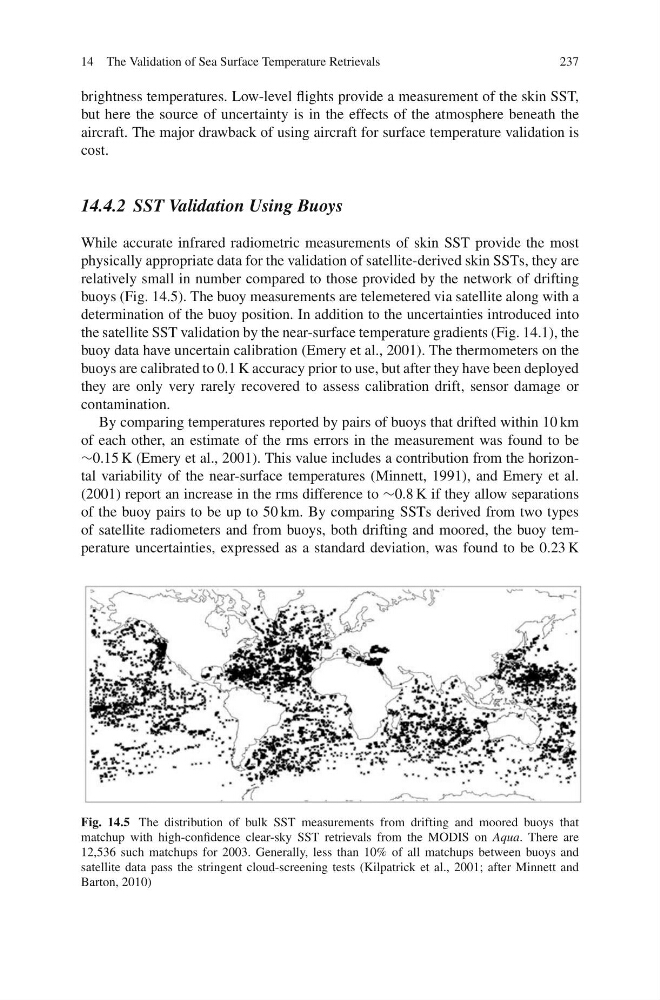
buoys (Fig. 14.5). The buoy measurements are telemetered via satellite along with a
determination of the buoy position. In addition to the uncertainties introduced into
the satellite SST validation by the near-surface temperature gradients (Fig. 14.1), the
buoy data have uncertain calibration (Emery et al., 2001). The thermometers on the
buoys are calibrated to 0.1 K accuracy prior to use, but after they have been deployed
they are only very rarely recovered to assess calibration drift, sensor damage or
contamination.
By comparing temperatures reported by pairs of buoys that drifted within 10 km
of each other, an estimate of the rms errors in the measurement was found to be
∼0.15 K (Emery et al., 2001). This value includes a contribution from the horizontal variability of the near-surface temperatures (Minnett, 1991), and Emery et al.
(2001) report an increase in the rms difference to ∼0.8 K if they allow separations
of the buoy pairs to be up to 50 km. By comparing SSTs derived from two types
of satellite radiometers and from buoys, both drifting and moored, the buoy temperature uncertainties, expressed as a standard deviation, was found to be 0.23 K
Fig. 14.5 The distribution of bulk SST measurements from drifting and moored buoys that
matchup with high-confidence clear-sky SST retrievals from the MODIS on Aqua. There are
12,536 such matchups for 2003. Generally, less than 10% of all matchups between buoys and
satellite data pass the stringent cloud-screening tests (Kilpatrick et al., 2001; after Minnett and
Barton, 2010)
237
brightness temperatures. Low-level flights provide a measurement of the skin SST,
but here the source of uncertainty is in the effects of the atmosphere beneath the
aircraft. The major drawback of using aircraft for surface temperature validation is
cost.
14.4.2 SST Validation Using Buoys
While accurate infrared radiometric measurements of skin SST provide the most
physically appropriate data for the validation of satellite-derived skin SSTs, they are
relatively small in number compared to those provided by the network of drifting
buoys (Fig. 14.5). The buoy measurements are telemetered via satellite along with a
determination of the buoy position. In addition to the uncertainties introduced into
the satellite SST validation by the near-surface temperature gradients (Fig. 14.1), the
buoy data have uncertain calibration (Emery et al., 2001). The thermometers on the
buoys are calibrated to 0.1 K accuracy prior to use, but after they have been deployed
they are only very rarely recovered to assess calibration drift, sensor damage or
contamination.
By comparing temperatures reported by pairs of buoys that drifted within 10 km
of each other, an estimate of the rms errors in the measurement was found to be
∼0.15 K (Emery et al., 2001). This value includes a contribution from the horizontal variability of the near-surface temperatures (Minnett, 1991), and Emery et al.
(2001) report an increase in the rms difference to ∼0.8 K if they allow separations
of the buoy pairs to be up to 50 km. By comparing SSTs derived from two types
of satellite radiometers and from buoys, both drifting and moored, the buoy temperature uncertainties, expressed as a standard deviation, was found to be 0.23 K
Fig. 14.5 The distribution of bulk SST measurements from drifting and moored buoys that
matchup with high-confidence clear-sky SST retrievals from the MODIS on Aqua. There are
12,536 such matchups for 2003. Generally, less than 10% of all matchups between buoys and
satellite data pass the stringent cloud-screening tests (Kilpatrick et al., 2001; after Minnett and
Barton, 2010)