

234
P.J. Minnett
the ship, the radiometers are mounted at heights of a few meters to a few tens of
meters above the sea surface, and even for those mounted at height the effects of the
atmosphere below are negligible or easily corrected to good accuracy (Minnett et al.,
2001; Smith et al., 1996). The radiometers on the ships, as those on aircraft, must
be calibrated throughout the field deployment using internal calibration targets; and
the calibration procedure should be checked using laboratory facilities before and
after each deployment.
The ship-based instruments are of two types: filter radiometers where the bandpass (the relative spectral response) of the instrument is determined by an optical
filter, and hyperspectral interferometers which measure a broad spectral range, a
section of which is selected for the skin SST measurement. The filter radiometers
developed for the validation of satellite-derived SSTs include the Infrared Scanning
Autonomous Radiometer (ISAR; Donlon et al., 2008), the Calibrated InfraRed
in-situ Measurement System (CIRIMS; Branch et al., 2008; Jessup and Branch,
2008), and the Scanning Infrared Sea Surface Temperature Radiometer (SISTeR;
described in Barton et al., 2004). These are autonomous instruments that can be
installed on ships to operate for weeks or months at a time with little or no operator
intervention. For example, ISARs have been mounted on the M/V Val de Loire and
M/V Pride of Bilbao for validation of SST in European waters (Corlett et al., 2006),
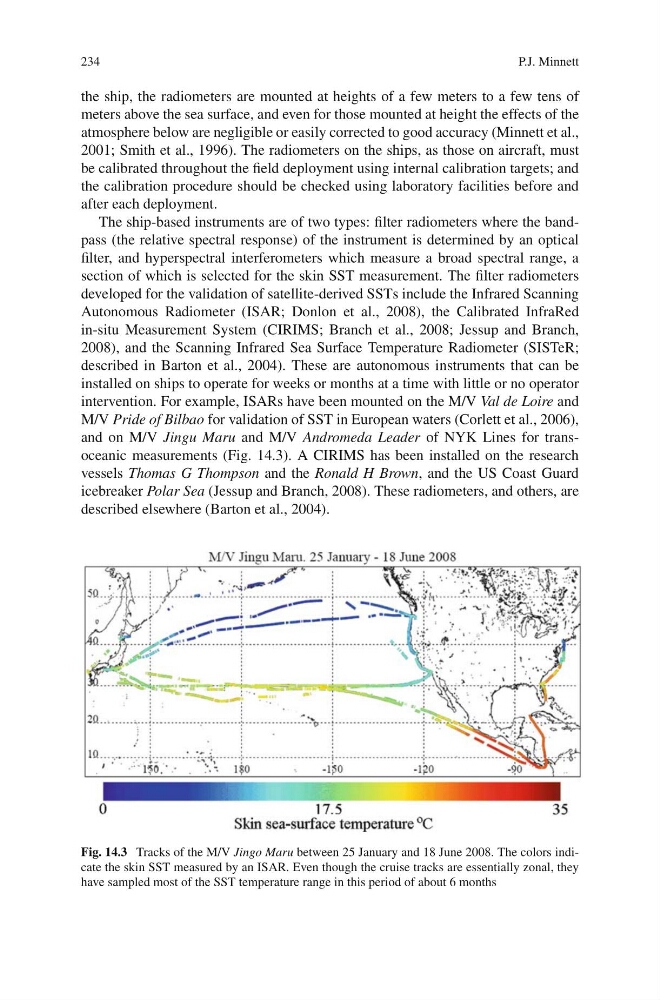
and on M/V Jingu Maru and M/V Andromeda Leader of NYK Lines for transoceanic measurements (Fig. 14.3). A CIRIMS has been installed on the research
vessels Thomas G Thompson and the Ronald H Brown, and the US Coast Guard
icebreaker Polar Sea (Jessup and Branch, 2008). These radiometers, and others, are
described elsewhere (Barton et al., 2004).
Fig. 14.3 Tracks of the M/V Jingo Maru between 25 January and 18 June 2008. The colors indicate the skin SST measured by an ISAR. Even though the cruise tracks are essentially zonal, they
have sampled most of the SST temperature range in this period of about 6 months
P.J. Minnett
the ship, the radiometers are mounted at heights of a few meters to a few tens of
meters above the sea surface, and even for those mounted at height the effects of the
atmosphere below are negligible or easily corrected to good accuracy (Minnett et al.,
2001; Smith et al., 1996). The radiometers on the ships, as those on aircraft, must
be calibrated throughout the field deployment using internal calibration targets; and
the calibration procedure should be checked using laboratory facilities before and
after each deployment.
The ship-based instruments are of two types: filter radiometers where the bandpass (the relative spectral response) of the instrument is determined by an optical
filter, and hyperspectral interferometers which measure a broad spectral range, a
section of which is selected for the skin SST measurement. The filter radiometers
developed for the validation of satellite-derived SSTs include the Infrared Scanning
Autonomous Radiometer (ISAR; Donlon et al., 2008), the Calibrated InfraRed
in-situ Measurement System (CIRIMS; Branch et al., 2008; Jessup and Branch,
2008), and the Scanning Infrared Sea Surface Temperature Radiometer (SISTeR;
described in Barton et al., 2004). These are autonomous instruments that can be
installed on ships to operate for weeks or months at a time with little or no operator
intervention. For example, ISARs have been mounted on the M/V Val de Loire and
M/V Pride of Bilbao for validation of SST in European waters (Corlett et al., 2006),
and on M/V Jingu Maru and M/V Andromeda Leader of NYK Lines for transoceanic measurements (Fig. 14.3). A CIRIMS has been installed on the research
vessels Thomas G Thompson and the Ronald H Brown, and the US Coast Guard
icebreaker Polar Sea (Jessup and Branch, 2008). These radiometers, and others, are
described elsewhere (Barton et al., 2004).
Fig. 14.3 Tracks of the M/V Jingo Maru between 25 January and 18 June 2008. The colors indicate the skin SST measured by an ISAR. Even though the cruise tracks are essentially zonal, they
have sampled most of the SST temperature range in this period of about 6 months