

14 The Validation of Sea Surface Temperature Retrievals
233
14.4.1 SST Validation Using Radiometers
The validation of SSTs with infrared radiometers can be done using instruments
mounted on ships (e.g. Kearns et al., 2000; Noyes et al., 2006) fixed platforms
(McMillan et al., 2003) and aircraft (Smith et al., 1994). Aircraft have the advantage
that they can be flown to areas free of clouds at the time of the satellite overpasses, but suffer from a serious disadvantage of being costly. Mounting radiometers
on ships for long-term deployment is feasible, and the cruises of the ships, especially on transoceanic voyages, provide the opportunity of sampling a wide range
of conditions. Cloud cover is an issue that leads to up to about 90% of possible
overpasses being unsuitable for satellite SST validation (Kilpatrick et al., 2001),
but the remaining ∼10% can make a significant contribution. Radiometers mounted
on fixed platforms require the advection of weather systems to provide a range of
atmospheric conditions. We focus on the approach of ship-based measurements in
the following discussion.
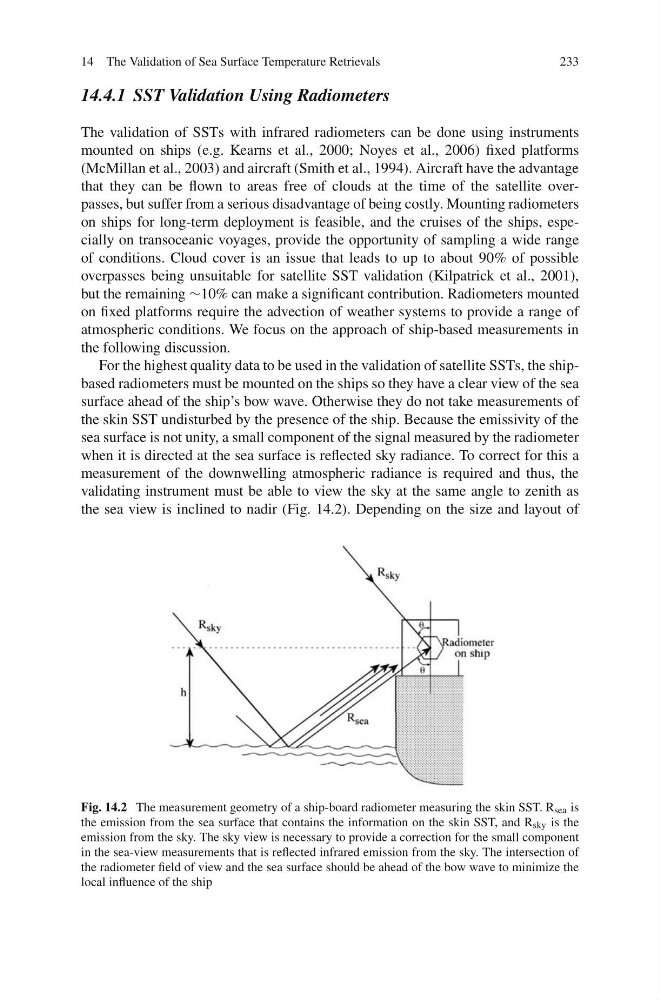
For the highest quality data to be used in the validation of satellite SSTs, the shipbased radiometers must be mounted on the ships so they have a clear view of the sea
surface ahead of the ship’s bow wave. Otherwise they do not take measurements of
the skin SST undisturbed by the presence of the ship. Because the emissivity of the
sea surface is not unity, a small component of the signal measured by the radiometer
when it is directed at the sea surface is reflected sky radiance. To correct for this a
measurement of the downwelling atmospheric radiance is required and thus, the
validating instrument must be able to view the sky at the same angle to zenith as
the sea view is inclined to nadir (Fig. 14.2). Depending on the size and layout of
Fig. 14.2 The measurement geometry of a ship-board radiometer measuring the skin SST. R sea is
the emission from the sea surface that contains the information on the skin SST, and R sky is the
emission from the sky. The sky view is necessary to provide a correction for the small component
in the sea-view measurements that is reflected infrared emission from the sky. The intersection of
the radiometer field of view and the sea surface should be ahead of the bow wave to minimize the
local influence of the ship
233
14.4.1 SST Validation Using Radiometers
The validation of SSTs with infrared radiometers can be done using instruments
mounted on ships (e.g. Kearns et al., 2000; Noyes et al., 2006) fixed platforms
(McMillan et al., 2003) and aircraft (Smith et al., 1994). Aircraft have the advantage
that they can be flown to areas free of clouds at the time of the satellite overpasses, but suffer from a serious disadvantage of being costly. Mounting radiometers
on ships for long-term deployment is feasible, and the cruises of the ships, especially on transoceanic voyages, provide the opportunity of sampling a wide range
of conditions. Cloud cover is an issue that leads to up to about 90% of possible
overpasses being unsuitable for satellite SST validation (Kilpatrick et al., 2001),
but the remaining ∼10% can make a significant contribution. Radiometers mounted
on fixed platforms require the advection of weather systems to provide a range of
atmospheric conditions. We focus on the approach of ship-based measurements in
the following discussion.
For the highest quality data to be used in the validation of satellite SSTs, the shipbased radiometers must be mounted on the ships so they have a clear view of the sea
surface ahead of the ship’s bow wave. Otherwise they do not take measurements of
the skin SST undisturbed by the presence of the ship. Because the emissivity of the
sea surface is not unity, a small component of the signal measured by the radiometer
when it is directed at the sea surface is reflected sky radiance. To correct for this a
measurement of the downwelling atmospheric radiance is required and thus, the
validating instrument must be able to view the sky at the same angle to zenith as
the sea view is inclined to nadir (Fig. 14.2). Depending on the size and layout of
Fig. 14.2 The measurement geometry of a ship-board radiometer measuring the skin SST. R sea is
the emission from the sea surface that contains the information on the skin SST, and R sky is the
emission from the sky. The sky view is necessary to provide a correction for the small component
in the sea-view measurements that is reflected infrared emission from the sky. The intersection of
the radiometer field of view and the sea surface should be ahead of the bow wave to minimize the
local influence of the ship