

9 Determining Ocean Circulation and Sea Level from Satellite Altimetry
153
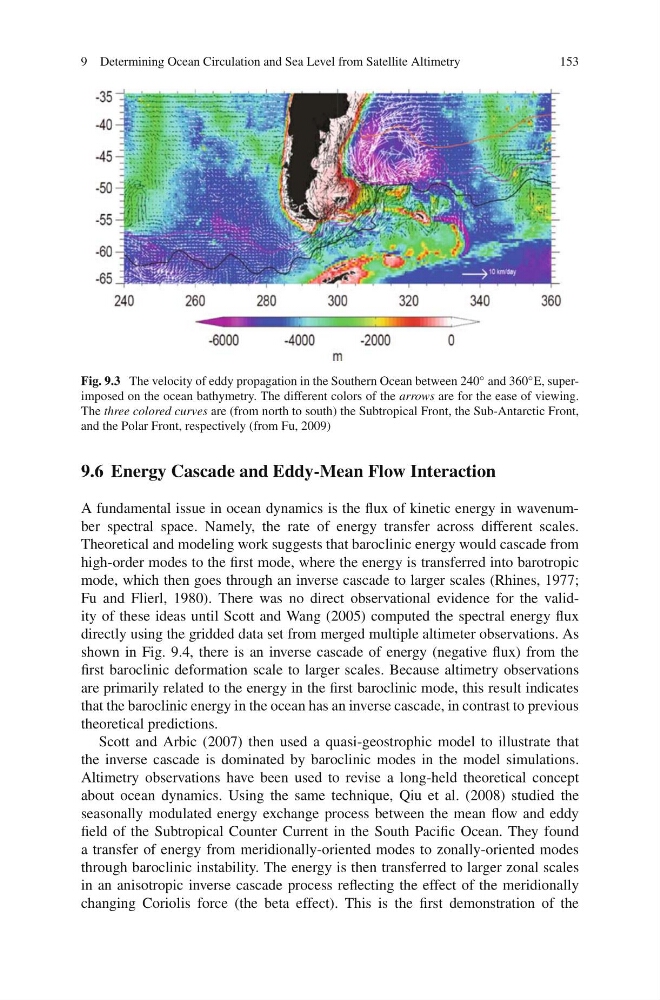
Fig. 9.3 The velocity of eddy propagation in the Southern Ocean between 240 ◦ and 360 ◦ E, superimposed on the ocean bathymetry. The different colors of the arrows are for the ease of viewing.
The three colored curves are (from north to south) the Subtropical Front, the Sub-Antarctic Front,
and the Polar Front, respectively (from Fu, 2009)
9.6 Energy Cascade and Eddy-Mean Flow Interaction
A fundamental issue in ocean dynamics is the flux of kinetic energy in wavenumber spectral space. Namely, the rate of energy transfer across different scales.
Theoretical and modeling work suggests that baroclinic energy would cascade from
high-order modes to the first mode, where the energy is transferred into barotropic
mode, which then goes through an inverse cascade to larger scales (Rhines, 1977;
Fu and Flierl, 1980). There was no direct observational evidence for the validity of these ideas until Scott and Wang (2005) computed the spectral energy flux
directly using the gridded data set from merged multiple altimeter observations. As
shown in Fig. 9.4, there is an inverse cascade of energy (negative flux) from the
first baroclinic deformation scale to larger scales. Because altimetry observations
are primarily related to the energy in the first baroclinic mode, this result indicates
that the baroclinic energy in the ocean has an inverse cascade, in contrast to previous
theoretical predictions.
Scott and Arbic (2007) then used a quasi-geostrophic model to illustrate that
the inverse cascade is dominated by baroclinic modes in the model simulations.
Altimetry observations have been used to revise a long-held theoretical concept
about ocean dynamics. Using the same technique, Qiu et al. (2008) studied the
seasonally modulated energy exchange process between the mean flow and eddy
field of the Subtropical Counter Current in the South Pacific Ocean. They found
a transfer of energy from meridionally-oriented modes to zonally-oriented modes
through baroclinic instability. The energy is then transferred to larger zonal scales
in an anisotropic inverse cascade process reflecting the effect of the meridionally
changing Coriolis force (the beta effect). This is the first demonstration of the
153
Fig. 9.3 The velocity of eddy propagation in the Southern Ocean between 240 ◦ and 360 ◦ E, superimposed on the ocean bathymetry. The different colors of the arrows are for the ease of viewing.
The three colored curves are (from north to south) the Subtropical Front, the Sub-Antarctic Front,
and the Polar Front, respectively (from Fu, 2009)
9.6 Energy Cascade and Eddy-Mean Flow Interaction
A fundamental issue in ocean dynamics is the flux of kinetic energy in wavenumber spectral space. Namely, the rate of energy transfer across different scales.
Theoretical and modeling work suggests that baroclinic energy would cascade from
high-order modes to the first mode, where the energy is transferred into barotropic
mode, which then goes through an inverse cascade to larger scales (Rhines, 1977;
Fu and Flierl, 1980). There was no direct observational evidence for the validity of these ideas until Scott and Wang (2005) computed the spectral energy flux
directly using the gridded data set from merged multiple altimeter observations. As
shown in Fig. 9.4, there is an inverse cascade of energy (negative flux) from the
first baroclinic deformation scale to larger scales. Because altimetry observations
are primarily related to the energy in the first baroclinic mode, this result indicates
that the baroclinic energy in the ocean has an inverse cascade, in contrast to previous
theoretical predictions.
Scott and Arbic (2007) then used a quasi-geostrophic model to illustrate that
the inverse cascade is dominated by baroclinic modes in the model simulations.
Altimetry observations have been used to revise a long-held theoretical concept
about ocean dynamics. Using the same technique, Qiu et al. (2008) studied the
seasonally modulated energy exchange process between the mean flow and eddy
field of the Subtropical Counter Current in the South Pacific Ocean. They found
a transfer of energy from meridionally-oriented modes to zonally-oriented modes
through baroclinic instability. The energy is then transferred to larger zonal scales
in an anisotropic inverse cascade process reflecting the effect of the meridionally
changing Coriolis force (the beta effect). This is the first demonstration of the