

144
M. Vespe et al.
a a
b
c
b
c
a
b
c
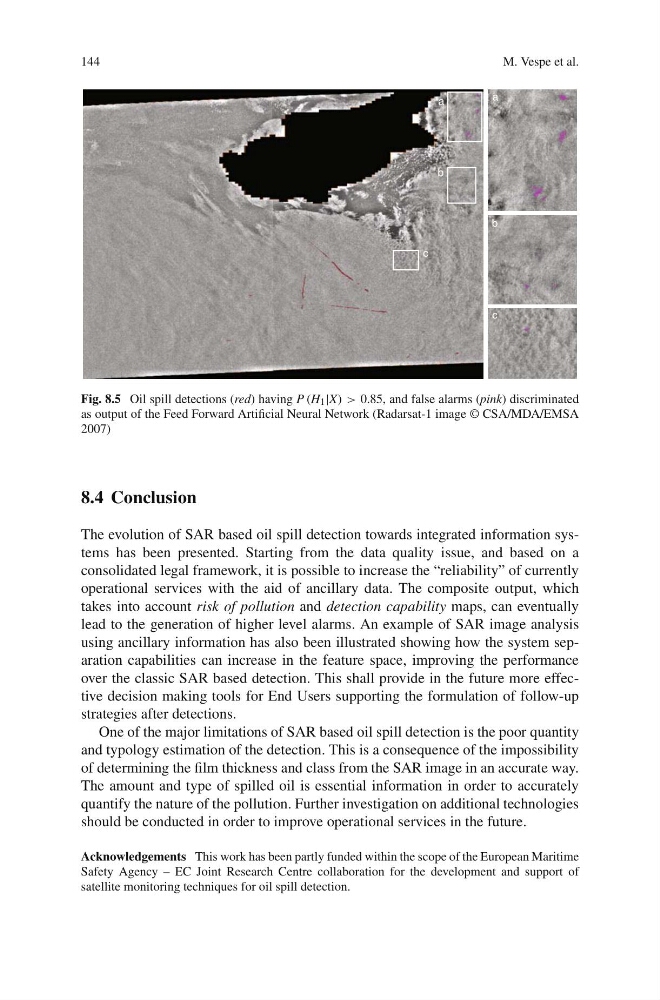
Fig. 8.5 Oil spill detections (red) having P (H 1 |X) > 0.85, and false alarms (pink) discriminated
as output of the Feed Forward Artificial Neural Network (Radarsat-1 image © CSA/MDA/EMSA
2007)
8.4 Conclusion
The evolution of SAR based oil spill detection towards integrated information systems has been presented. Starting from the data quality issue, and based on a
consolidated legal framework, it is possible to increase the “reliability” of currently
operational services with the aid of ancillary data. The composite output, which
takes into account risk of pollution and detection capability maps, can eventually
lead to the generation of higher level alarms. An example of SAR image analysis
using ancillary information has also been illustrated showing how the system separation capabilities can increase in the feature space, improving the performance
over the classic SAR based detection. This shall provide in the future more effective decision making tools for End Users supporting the formulation of follow-up
strategies after detections.
One of the major limitations of SAR based oil spill detection is the poor quantity
and typology estimation of the detection. This is a consequence of the impossibility
of determining the film thickness and class from the SAR image in an accurate way.
The amount and type of spilled oil is essential information in order to accurately
quantify the nature of the pollution. Further investigation on additional technologies
should be conducted in order to improve operational services in the future.
Acknowledgements This work has been partly funded within the scope of the European Maritime
Safety Agency – EC Joint Research Centre collaboration for the development and support of
satellite monitoring techniques for oil spill detection.
M. Vespe et al.
a a
b
c
b
c
a
b
c
Fig. 8.5 Oil spill detections (red) having P (H 1 |X) > 0.85, and false alarms (pink) discriminated
as output of the Feed Forward Artificial Neural Network (Radarsat-1 image © CSA/MDA/EMSA
2007)
8.4 Conclusion
The evolution of SAR based oil spill detection towards integrated information systems has been presented. Starting from the data quality issue, and based on a
consolidated legal framework, it is possible to increase the “reliability” of currently
operational services with the aid of ancillary data. The composite output, which
takes into account risk of pollution and detection capability maps, can eventually
lead to the generation of higher level alarms. An example of SAR image analysis
using ancillary information has also been illustrated showing how the system separation capabilities can increase in the feature space, improving the performance
over the classic SAR based detection. This shall provide in the future more effective decision making tools for End Users supporting the formulation of follow-up
strategies after detections.
One of the major limitations of SAR based oil spill detection is the poor quantity
and typology estimation of the detection. This is a consequence of the impossibility
of determining the film thickness and class from the SAR image in an accurate way.
The amount and type of spilled oil is essential information in order to accurately
quantify the nature of the pollution. Further investigation on additional technologies
should be conducted in order to improve operational services in the future.
Acknowledgements This work has been partly funded within the scope of the European Maritime
Safety Agency – EC Joint Research Centre collaboration for the development and support of
satellite monitoring techniques for oil spill detection.