

6 Scatterometer’s Unique Capability in Measuring Ocean Surface Stress
101
of the cold eddy, and vice versa for the warm eddy. QuikSCAT should observe the
vorticity distribution, if there is no ocean current (e.g. O’Neill et al., 2003), but its
observations do not show such crosswind relation (Fig. 6.4e). Positive vorticity is
collocated (in-phase) with warm water and negative vorticity is collocated with cold
water. The vorticity of the observed U N is opposite to the vorticity of the surface
current measured by drifters (Fig. 6.4f), confirming scatterometers measure the vector difference between wind and current, as associated with stress. Liu et al. (2007)
found similar results over the Agulhas Extension.
The stability effect on the difference between wind and stress, in the form of the
difference between U N and U, is governed by ψ u , as
δU = U N − U = 2.5U ∗ ψ u
(6.6)
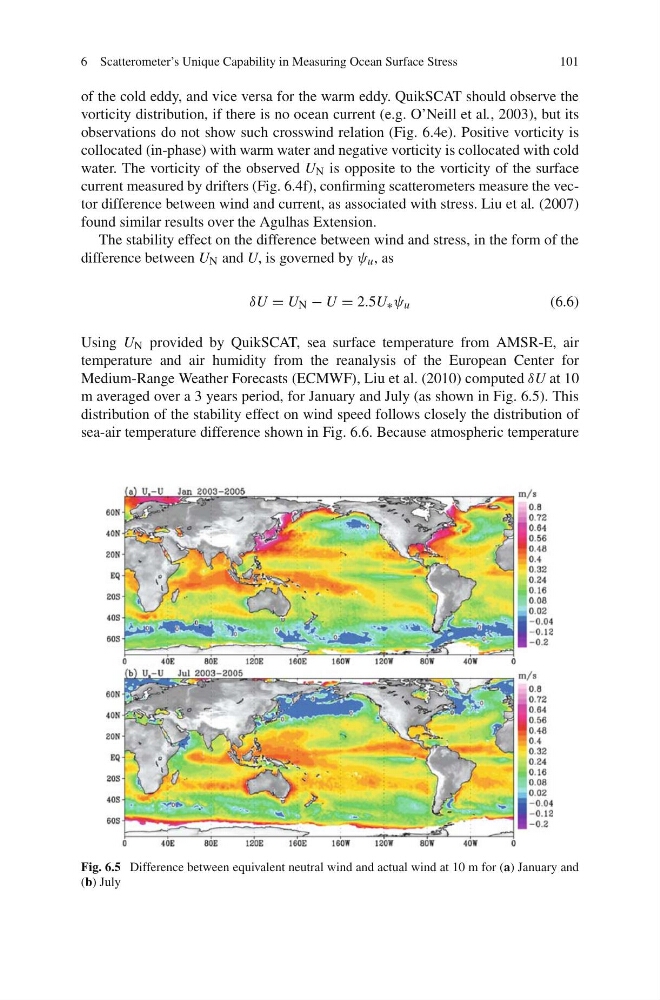
Using U N provided by QuikSCAT, sea surface temperature from AMSR-E, air
temperature and air humidity from the reanalysis of the European Center for
Medium-Range Weather Forecasts (ECMWF), Liu et al. (2010) computed δU at 10
m averaged over a 3 years period, for January and July (as shown in Fig. 6.5). This
distribution of the stability effect on wind speed follows closely the distribution of
sea-air temperature difference shown in Fig. 6.6. Because atmospheric temperature
Fig. 6.5 Difference between equivalent neutral wind and actual wind at 10 m for (a) January and
(b) July
101
of the cold eddy, and vice versa for the warm eddy. QuikSCAT should observe the
vorticity distribution, if there is no ocean current (e.g. O’Neill et al., 2003), but its
observations do not show such crosswind relation (Fig. 6.4e). Positive vorticity is
collocated (in-phase) with warm water and negative vorticity is collocated with cold
water. The vorticity of the observed U N is opposite to the vorticity of the surface
current measured by drifters (Fig. 6.4f), confirming scatterometers measure the vector difference between wind and current, as associated with stress. Liu et al. (2007)
found similar results over the Agulhas Extension.
The stability effect on the difference between wind and stress, in the form of the
difference between U N and U, is governed by ψ u , as
δU = U N − U = 2.5U ∗ ψ u
(6.6)
Using U N provided by QuikSCAT, sea surface temperature from AMSR-E, air
temperature and air humidity from the reanalysis of the European Center for
Medium-Range Weather Forecasts (ECMWF), Liu et al. (2010) computed δU at 10
m averaged over a 3 years period, for January and July (as shown in Fig. 6.5). This
distribution of the stability effect on wind speed follows closely the distribution of
sea-air temperature difference shown in Fig. 6.6. Because atmospheric temperature
Fig. 6.5 Difference between equivalent neutral wind and actual wind at 10 m for (a) January and
(b) July