

6 Scatterometer’s Unique Capability in Measuring Ocean Surface Stress
99
to understanding the transition from random turbulence to organized convection in
the atmosphere.
The difference between winds and stress over oceanfronts is well documented
by Liu et al. (2007) for the Agulhas Extension and by Liu and Xie (2008) for
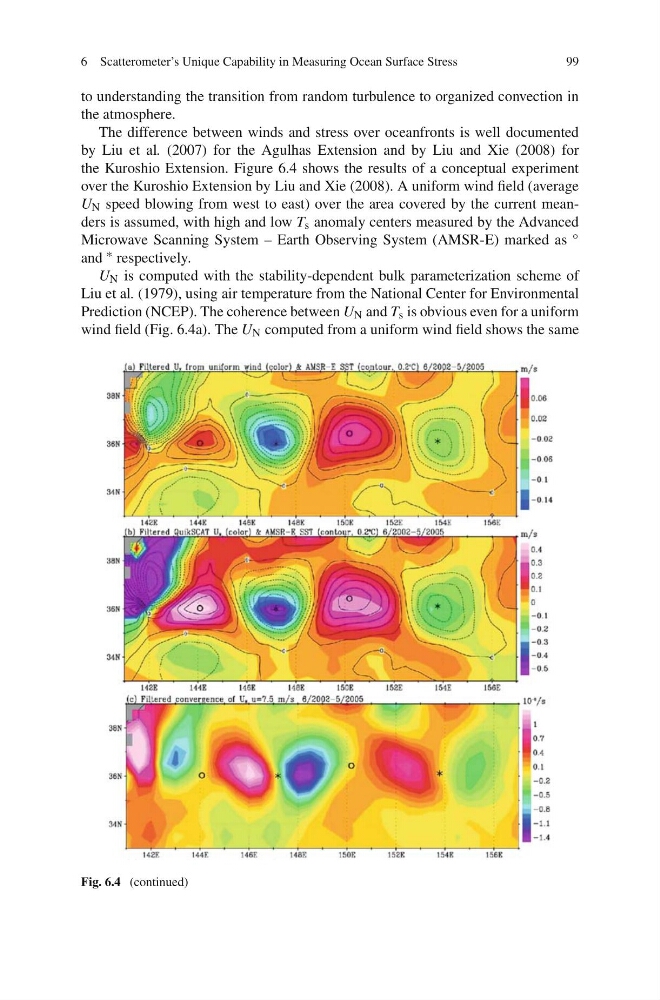
the Kuroshio Extension. Figure 6.4 shows the results of a conceptual experiment
over the Kuroshio Extension by Liu and Xie (2008). A uniform wind field (average
U N speed blowing from west to east) over the area covered by the current meanders is assumed, with high and low T s anomaly centers measured by the Advanced
Microwave Scanning System – Earth Observing System (AMSR-E) marked as ◦
and ∗ respectively.
U N is computed with the stability-dependent bulk parameterization scheme of
Liu et al. (1979), using air temperature from the National Center for Environmental
Prediction (NCEP). The coherence between U N and T s is obvious even for a uniform
wind field (Fig. 6.4a). The U N computed from a uniform wind field shows the same
Fig. 6.4 (continued)
99
to understanding the transition from random turbulence to organized convection in
the atmosphere.
The difference between winds and stress over oceanfronts is well documented
by Liu et al. (2007) for the Agulhas Extension and by Liu and Xie (2008) for
the Kuroshio Extension. Figure 6.4 shows the results of a conceptual experiment
over the Kuroshio Extension by Liu and Xie (2008). A uniform wind field (average
U N speed blowing from west to east) over the area covered by the current meanders is assumed, with high and low T s anomaly centers measured by the Advanced
Microwave Scanning System – Earth Observing System (AMSR-E) marked as ◦
and ∗ respectively.
U N is computed with the stability-dependent bulk parameterization scheme of
Liu et al. (1979), using air temperature from the National Center for Environmental
Prediction (NCEP). The coherence between U N and T s is obvious even for a uniform
wind field (Fig. 6.4a). The U N computed from a uniform wind field shows the same
Fig. 6.4 (continued)