

bottom will largely be predicted from a postglacial rebound model verified at only a few
oceanic points.
Modelling of the present-day rate of change of gravity based on the ICE-3G model of
Laurentide deglaciation (Tushingham and Peltier, 1991) predicts a relative rate of change of
gravity of about 1.75 ~Gallyr over a distance of 1000 km in eastern North America and a
similar relative rate of change over about twice that distance in the mid-continent (Figure
3). The model calculations employed an
Earth model with a Maxwell rheology,
the density and elastic parameter
structure of 1066B, an upper-mantle
viscosity of 10 21 Pa·s, a lower-mantle
viscosity of 2 x 10 21 Pa·s, and a
lithosphere thickness of 120 km.
Indications are that a more recent model
of global deglaciation history, ICE-4G
(Peltier, 1994), predicts higher rates,
particularly on the western side of
Hudson Bay.
An example of the potential of
absolute gravity measurements to verify
global postglacial rebound models is
provided by results from Churchill,
Canada. Measurements begun in 1987
(Tushingham et al., 1991) by the
Geological Survey of Canada (GSC)
have been continued since 1992 by the
NOAA Geosciences Laboratory (Figure
4). The data as a whole are consistent
with a steady decrease in gravity at a
rate of -1.3 ± 0.6 ~Gallyr and a
standard deviation of fit of 4.5 ~Gal.
The values measured in 1990 suffered
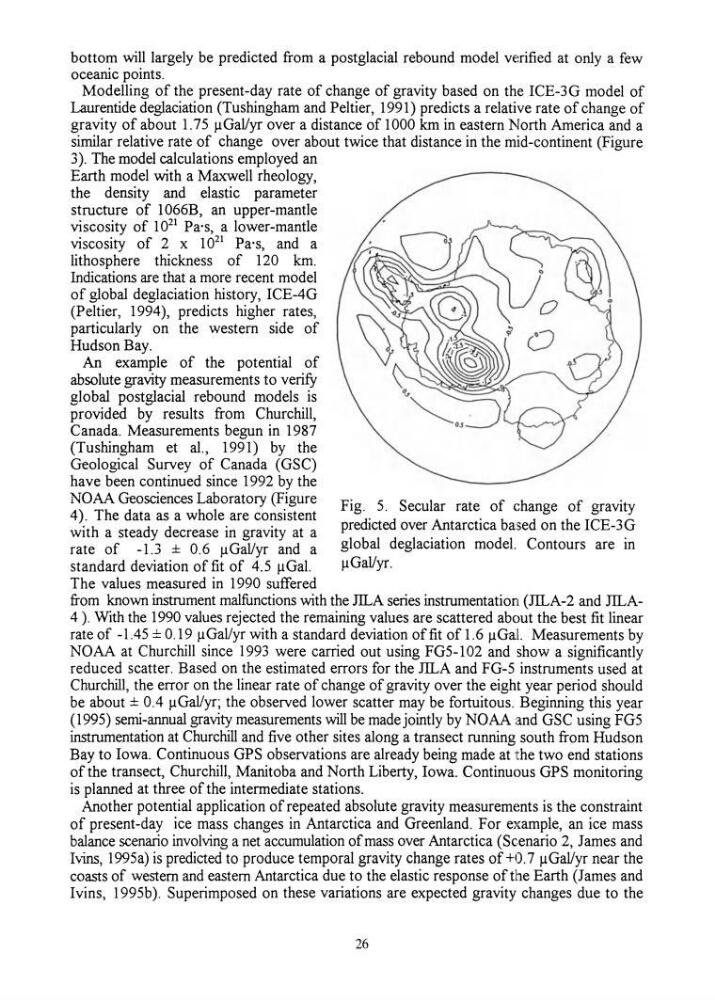
Fig. 5. Secular rate of change of gravity
predicted over Antarctica based on the ICE-3G
global deglaciation model. Contours are in
~Gallyr.
from known instrument malfunctions with the JILA series instrumentation (JIT.,A-2 and JIT.,A4 ). With the 1990 values rejected the remaining values are scattered about the best fit linear
rate of -1.45 ± 0.19 ~Gallyr with a standard deviation offit of 1.6 ~GaI. Measurements by
NOAA at Churchill since 1993 were carried out using FG5-102 and show a significantly
reduced scatter. Based on the estimated errors for the JIT.,A and FG-5 instruments used at
Churchill, the error on the linear rate of change of gravity over the eight year period should
be about ± 0.4 ~GaIlyr; the observed lower scatter may be fortuitous. Beginning this year
(1995) semi-annual gravity measurements will be made jointly by NOAA and GSC using FG5
instrumentation at Churchill and five other sites along a transect running south from Hudson
Bay to Iowa. Continuous GPS observations are already being made at the two end stations
of the transect, Churchill, Manitoba and North Liberty, Iowa. Continuous GPS monitoring
is planned at three of the intermediate stations.
Another potential application of repeated absolute gravity measurements is the constraint
of present-day ice mass changes in Antarctica and Greenland. For example, an ice mass
balance scenario involving a net accumulation of mass over Antarctica (Scenario 2, James and
Ivins, 1995a) is predicted to produce temporal gravity change rates of+0.7 ~GaIlyr near the
coasts of western and eastern Antarctica due to the elastic response of the Earth (James and
Ivins, 1995b). Superimposed on these variations are expected gravity changes due to the
26
oceanic points.
Modelling of the present-day rate of change of gravity based on the ICE-3G model of
Laurentide deglaciation (Tushingham and Peltier, 1991) predicts a relative rate of change of
gravity of about 1.75 ~Gallyr over a distance of 1000 km in eastern North America and a
similar relative rate of change over about twice that distance in the mid-continent (Figure
3). The model calculations employed an
Earth model with a Maxwell rheology,
the density and elastic parameter
structure of 1066B, an upper-mantle
viscosity of 10 21 Pa·s, a lower-mantle
viscosity of 2 x 10 21 Pa·s, and a
lithosphere thickness of 120 km.
Indications are that a more recent model
of global deglaciation history, ICE-4G
(Peltier, 1994), predicts higher rates,
particularly on the western side of
Hudson Bay.
An example of the potential of
absolute gravity measurements to verify
global postglacial rebound models is
provided by results from Churchill,
Canada. Measurements begun in 1987
(Tushingham et al., 1991) by the
Geological Survey of Canada (GSC)
have been continued since 1992 by the
NOAA Geosciences Laboratory (Figure
4). The data as a whole are consistent
with a steady decrease in gravity at a
rate of -1.3 ± 0.6 ~Gallyr and a
standard deviation of fit of 4.5 ~Gal.
The values measured in 1990 suffered
Fig. 5. Secular rate of change of gravity
predicted over Antarctica based on the ICE-3G
global deglaciation model. Contours are in
~Gallyr.
from known instrument malfunctions with the JILA series instrumentation (JIT.,A-2 and JIT.,A4 ). With the 1990 values rejected the remaining values are scattered about the best fit linear
rate of -1.45 ± 0.19 ~Gallyr with a standard deviation offit of 1.6 ~GaI. Measurements by
NOAA at Churchill since 1993 were carried out using FG5-102 and show a significantly
reduced scatter. Based on the estimated errors for the JIT.,A and FG-5 instruments used at
Churchill, the error on the linear rate of change of gravity over the eight year period should
be about ± 0.4 ~GaIlyr; the observed lower scatter may be fortuitous. Beginning this year
(1995) semi-annual gravity measurements will be made jointly by NOAA and GSC using FG5
instrumentation at Churchill and five other sites along a transect running south from Hudson
Bay to Iowa. Continuous GPS observations are already being made at the two end stations
of the transect, Churchill, Manitoba and North Liberty, Iowa. Continuous GPS monitoring
is planned at three of the intermediate stations.
Another potential application of repeated absolute gravity measurements is the constraint
of present-day ice mass changes in Antarctica and Greenland. For example, an ice mass
balance scenario involving a net accumulation of mass over Antarctica (Scenario 2, James and
Ivins, 1995a) is predicted to produce temporal gravity change rates of+0.7 ~GaIlyr near the
coasts of western and eastern Antarctica due to the elastic response of the Earth (James and
Ivins, 1995b). Superimposed on these variations are expected gravity changes due to the
26