

4J.! 0.0
O.J
O.S
I.:
mIWa
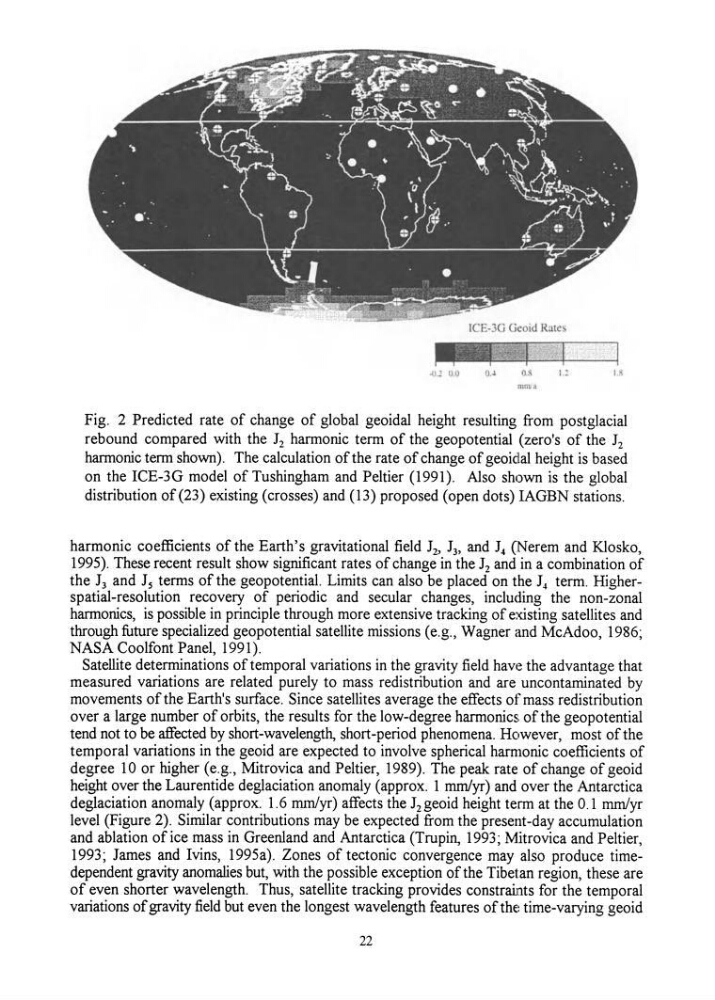
Fig. 2 Predicted rate of change of global geoidal height resulting from postglacial
rebound compared with the 12 harmonic term of the geopotential (zero's of the 12
harmonic term shown). The calculation of the rate of change of geoiclal height is based
on the ICE-3G model of Tushingham and Peltier (1991). Also shown is the global
distribution of (23) existing (crosses) and (13) proposed ( open dots) IAGBN stations.
harmonic coefficients of the Earth's gravitational field 12> 1 3 , and 14 (Nerem and Klosko,
1995). These recent result show significant rates of change in the 12 and in a combination of
the 13 and Is terms of the geopotential. Limits can also be placed on the J~ term. Higherspatial-resolution recovery of periodic and secular changes, including the non-zonal
harmonics, is possible in principle through more extensive tracking of existing satellites and
through future specialized geopotential satellite missions (e.g., Wagner and McAdoo, 1986;
NASA Coolfont Panel, 1991).
Satellite determinations of temporal variations in the gravity field have the advantage that
measured variations are related purely to mass redistribution and are uncontaminated by
movements of the Earth's surface. Since satellites average the effects of mass redistribution
over a large number of orbits, the results for the low-degree harmonics of the geopotential
tend not to be affected by short-wavelength, short-period phenomena. However, most of the
temporal variations in the geoid are expected to involve spherical harmonic coefficients of
degree 10 or higher (e.g., Mitrovica and Peltier, 1989). The peak rate of change of geoid
height over the Laurentide deglaciation anomaly (approx. 1 mm/yr) and over the Antarctica
deglaciation anomaly (approx. 1.6 mm/yr) affects the J 2 geoid height term at the 0.1 mm/yr
level (Figure 2). Similar contributions may be expected from the present-day accumulation
and ablation of ice mass in Greenland and Antarctica (Trupin, 1993; Mitrovica and Peltier,
1993; James and Ivins, 1995a). Zones of tectonic convergence may also produce timedependent gravity anomalies but, with the possible exception of the Tibetan region, these are
of even shorter wavelength. Thus, satellite tracking provides constraints for the temporal
variations of gravity field but even the longest wavelength features of the: time-varying geoid
22
O.J
O.S
I.:
mIWa
Fig. 2 Predicted rate of change of global geoidal height resulting from postglacial
rebound compared with the 12 harmonic term of the geopotential (zero's of the 12
harmonic term shown). The calculation of the rate of change of geoiclal height is based
on the ICE-3G model of Tushingham and Peltier (1991). Also shown is the global
distribution of (23) existing (crosses) and (13) proposed ( open dots) IAGBN stations.
harmonic coefficients of the Earth's gravitational field 12> 1 3 , and 14 (Nerem and Klosko,
1995). These recent result show significant rates of change in the 12 and in a combination of
the 13 and Is terms of the geopotential. Limits can also be placed on the J~ term. Higherspatial-resolution recovery of periodic and secular changes, including the non-zonal
harmonics, is possible in principle through more extensive tracking of existing satellites and
through future specialized geopotential satellite missions (e.g., Wagner and McAdoo, 1986;
NASA Coolfont Panel, 1991).
Satellite determinations of temporal variations in the gravity field have the advantage that
measured variations are related purely to mass redistribution and are uncontaminated by
movements of the Earth's surface. Since satellites average the effects of mass redistribution
over a large number of orbits, the results for the low-degree harmonics of the geopotential
tend not to be affected by short-wavelength, short-period phenomena. However, most of the
temporal variations in the geoid are expected to involve spherical harmonic coefficients of
degree 10 or higher (e.g., Mitrovica and Peltier, 1989). The peak rate of change of geoid
height over the Laurentide deglaciation anomaly (approx. 1 mm/yr) and over the Antarctica
deglaciation anomaly (approx. 1.6 mm/yr) affects the J 2 geoid height term at the 0.1 mm/yr
level (Figure 2). Similar contributions may be expected from the present-day accumulation
and ablation of ice mass in Greenland and Antarctica (Trupin, 1993; Mitrovica and Peltier,
1993; James and Ivins, 1995a). Zones of tectonic convergence may also produce timedependent gravity anomalies but, with the possible exception of the Tibetan region, these are
of even shorter wavelength. Thus, satellite tracking provides constraints for the temporal
variations of gravity field but even the longest wavelength features of the: time-varying geoid
22