

en .....
Q)
- Q) E
o
Q)
CO
()
en
Seasonal
rGround Water
Semi·Annuai
Period (seconds)
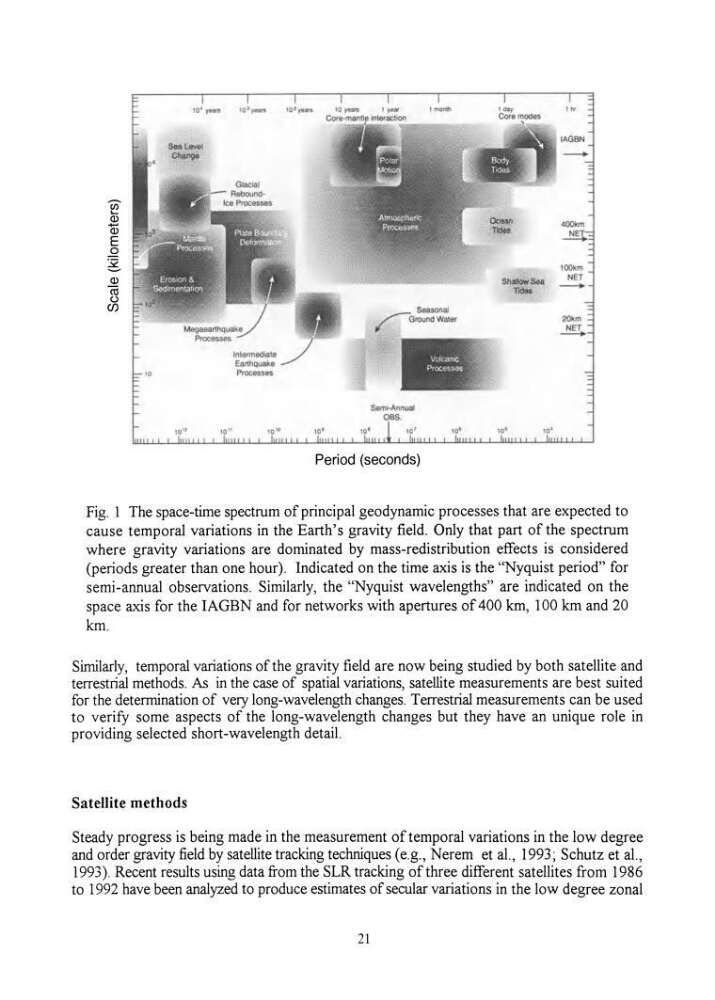
Fig. 1 The space-time spectrum of principal geodynamic processes that are expected to
cause temporal variations in the Earth's gravity field. Only that part of the spectrum
where gravity variations are dominated by mass-redistribution effects is considered
(periods greater than one hour) . Indicated on the time axis is the ''Nyquist period" for
semi-annual observations. Similarly, the "Nyquist wavelengths" are indicated on the
space axis for the IAGBN and for networks with apertures of 400 krn, 100 krn and 20
krn.
Similarly, temporal variations of the gravity field are now being studied by both satellite and
terrestrial methods. As in the case of spatial variations, satellite measurements are best suited
for the determination of very long-wavelength changes. Terrestrial measurements can be used
to verify some aspects of the long-wavelength changes but they have an unique role in
providing selected short-wavelength detail.
Satellite methods
Steady progress is being made in the measurement of temporal variations in the low degree
and order gravity field by satellite tracking techniques (e.g., Nerem et al., 1993; Schutz et al.,
1993). Recent results using data from the SLR tracking of three different satellites from 1986
to 1992 have been analyzed to produce estimates of secular variations in the low degree zonal
21
Q)
- Q) E
o
Q)
CO
()
en
Seasonal
rGround Water
Semi·Annuai
Period (seconds)
Fig. 1 The space-time spectrum of principal geodynamic processes that are expected to
cause temporal variations in the Earth's gravity field. Only that part of the spectrum
where gravity variations are dominated by mass-redistribution effects is considered
(periods greater than one hour) . Indicated on the time axis is the ''Nyquist period" for
semi-annual observations. Similarly, the "Nyquist wavelengths" are indicated on the
space axis for the IAGBN and for networks with apertures of 400 krn, 100 krn and 20
krn.
Similarly, temporal variations of the gravity field are now being studied by both satellite and
terrestrial methods. As in the case of spatial variations, satellite measurements are best suited
for the determination of very long-wavelength changes. Terrestrial measurements can be used
to verify some aspects of the long-wavelength changes but they have an unique role in
providing selected short-wavelength detail.
Satellite methods
Steady progress is being made in the measurement of temporal variations in the low degree
and order gravity field by satellite tracking techniques (e.g., Nerem et al., 1993; Schutz et al.,
1993). Recent results using data from the SLR tracking of three different satellites from 1986
to 1992 have been analyzed to produce estimates of secular variations in the low degree zonal
21