

The gra\ity field was derived from the height anomalies using FFT techniques
(Forsberg and Solheim, 1988). In the frequency domain a weak noise filtering was
applied at wavelengths shorter than 15 krn. Finally, the OSU91A gravity field
complete to degree and order 360 was restored, in order to obtain the free air gravity
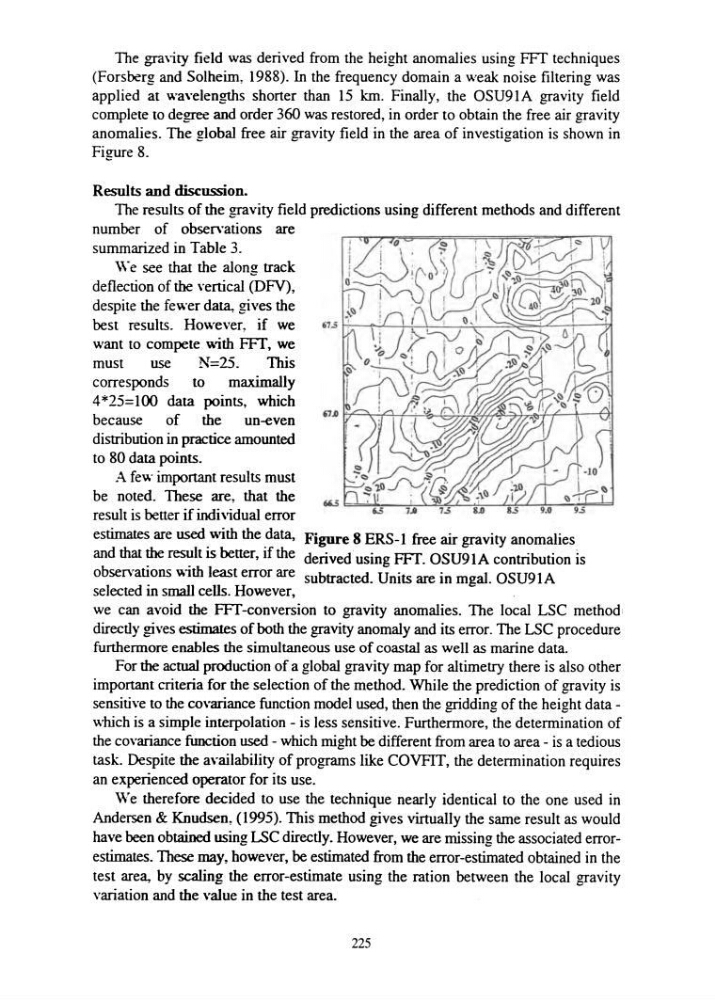
anomalies. The global free air gravity field in the area of investigation is shown in
Figure 8.
Results and discussion.
The results of the gravity field predictions using different methods and different
number of observations are
summarized in Table 3.
\\. e see that the along track
deflection of the vertical (DFV),
despite the fewer data, gives the
best results. However, if we
67.5 h-:-~...;.L--+~\--~~-~"C'~L-:-t--"""7I
want to compete with FFT, we
must
use
N=25.
This
corresponds
to
maximally
4*25=100 data points, which
because
of the
un-even
distribution in practice amounted
to 80 data points.
A few important results must
be noted. These are, that the
result is bener if individual error
estimates are used with the data,
and that the result is bener, if the
observations with least error are
selected in small cells. However,
Figure 8 ERS-l free air gravity anomalies
derived using FFf. OSU91A contribution is
subtracted. Units are in mgal. OSU91A
we can avoid the FFT-conversion to gravity anomalies. The local LSC method I
directly gives estimates of both the gravity anomaly and its error. The LSC procedure
furthermore enables the simultaneous use of coastal as well as marine data.
For the actual production of a global gravity map for altimetry there is also other
important criteria for the selection of the method. While the prediction of gravity is
sensitive to the covariance function model used, then the gridding of the height data -
which is a simple interpolation - is less sensitive. Furthermore, the determination of
the covariance fi.mction used - which might be different from area to area - is a tedious
task. Despite the availability of programs like COVFIT, the determination requires
an experienced operator for its use.
\Ve therefore decided to use the technique nearly identical to the one used in
Andersen & Knudsen, (1995). This method gives virtually the same result as would
have been obtained using LSC directly. However, we are missing the associated errorestimates. These may, however, be estimated from the error-estimated obtained in the
test area, by scaling the error-estimate using the ration between the local gravity
variation and the value in the test area.
225
(Forsberg and Solheim, 1988). In the frequency domain a weak noise filtering was
applied at wavelengths shorter than 15 krn. Finally, the OSU91A gravity field
complete to degree and order 360 was restored, in order to obtain the free air gravity
anomalies. The global free air gravity field in the area of investigation is shown in
Figure 8.
Results and discussion.
The results of the gravity field predictions using different methods and different
number of observations are
summarized in Table 3.
\\. e see that the along track
deflection of the vertical (DFV),
despite the fewer data, gives the
best results. However, if we
67.5 h-:-~...;.L--+~\--~~-~"C'~L-:-t--"""7I
want to compete with FFT, we
must
use
N=25.
This
corresponds
to
maximally
4*25=100 data points, which
because
of the
un-even
distribution in practice amounted
to 80 data points.
A few important results must
be noted. These are, that the
result is bener if individual error
estimates are used with the data,
and that the result is bener, if the
observations with least error are
selected in small cells. However,
Figure 8 ERS-l free air gravity anomalies
derived using FFf. OSU91A contribution is
subtracted. Units are in mgal. OSU91A
we can avoid the FFT-conversion to gravity anomalies. The local LSC method I
directly gives estimates of both the gravity anomaly and its error. The LSC procedure
furthermore enables the simultaneous use of coastal as well as marine data.
For the actual production of a global gravity map for altimetry there is also other
important criteria for the selection of the method. While the prediction of gravity is
sensitive to the covariance function model used, then the gridding of the height data -
which is a simple interpolation - is less sensitive. Furthermore, the determination of
the covariance fi.mction used - which might be different from area to area - is a tedious
task. Despite the availability of programs like COVFIT, the determination requires
an experienced operator for its use.
\Ve therefore decided to use the technique nearly identical to the one used in
Andersen & Knudsen, (1995). This method gives virtually the same result as would
have been obtained using LSC directly. However, we are missing the associated errorestimates. These may, however, be estimated from the error-estimated obtained in the
test area, by scaling the error-estimate using the ration between the local gravity
variation and the value in the test area.
225