

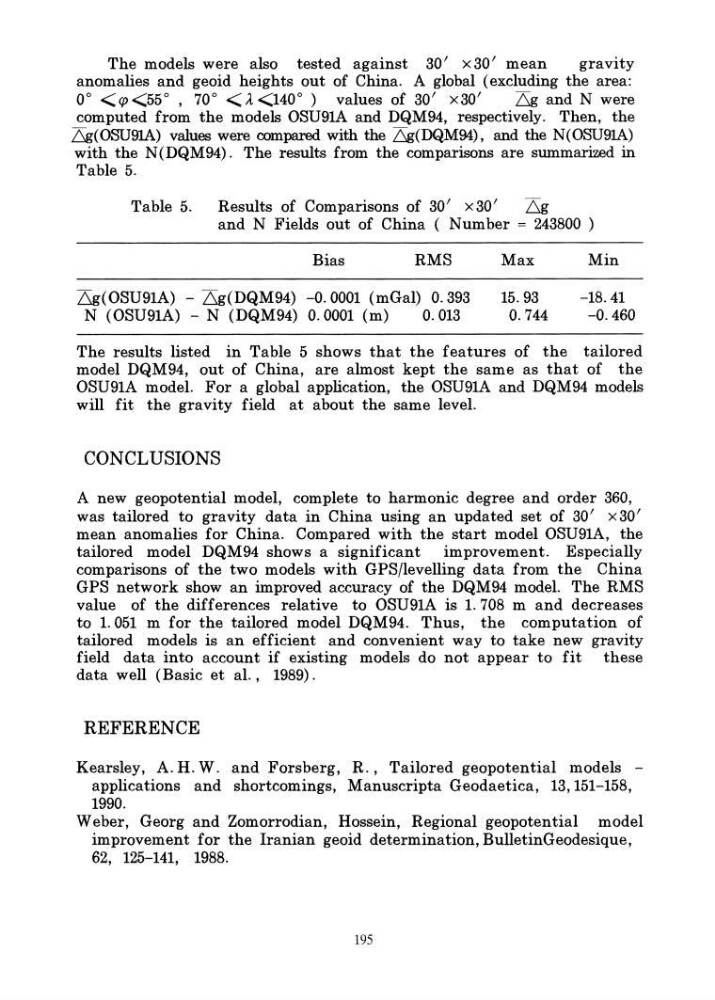
The models were also tested against 30' x30' mean
gravity
anomalies and geoid heights out of China. A global (excluding the area:
0
0
<<7><55
0
,
70
0
<"l <140
0
)
values of 30' x30'
6g and N were
computed from the models OSU91A and DQM94, respectively. Then, the
6g( OSU91A) values were compared with the 6g(DQM94), and the N (OSU91A)
with the N(DQM94). The results from the comparisons are summarized in
Table 5.
Table 5.
Results of Comparisons of 30' x 30'
.6.g
and N Fields out of China ( Number == 243800 )
Bias
RMS
6g(OSU91A) - .6.g(DQM94) -0.0001 (mGal) 0.393
N (OSU91A) - N (DQM94) 0.0001 (m)
0.013
Max
15.93
0.744
Min
-18.41
-0.460
The results listed in Table 5 shows that the features of the tailored
model DQM94, out of China, are almost kept the same as that of the
OSU91A model. For a global application, the OSU91A and DQM94 models
will fit the gravity field at about the same level.
CONCLUSIONS
A new geopotential model, complete to harmonic degree and order 360,
was tailored to gravity data in China using an updated set of 30' x30'
mean anomalies for China. Compared with the start model OSU91A, the
tailored model DQM94 shows a significant improvement. Especially
comparisons of the two models with G PS/levelling data from the China
GPS network show an improved accuracy of the DQM94 model. The RMS
value of the differences relative to OSU91A is 1. 708 m and decreases
to 1. 051 m for the tailored model DQM94. Thus, the computation of
tailored models is an efficient and convenient way to take new gravity
field data into account if existing models do not appear to fit these
data well (Basic et aI., 1989).
REFERENCE
Kearsley, A. H. W. and Forsberg, R., Tailored geopotential models -
applications and shortcomings, Manuscripta Geodaetica, 13,151-158,
1990.
Weber, Georg and Zomorrodian, Hossein, Regional geopotential model
improvement for the Iranian geoid determination, BulletinGeodesique,
62, 125-141, 1988.
195
gravity
anomalies and geoid heights out of China. A global (excluding the area:
0
0
<<7><55
0
,
70
0
<"l <140
0
)
values of 30' x30'
6g and N were
computed from the models OSU91A and DQM94, respectively. Then, the
6g( OSU91A) values were compared with the 6g(DQM94), and the N (OSU91A)
with the N(DQM94). The results from the comparisons are summarized in
Table 5.
Table 5.
Results of Comparisons of 30' x 30'
.6.g
and N Fields out of China ( Number == 243800 )
Bias
RMS
6g(OSU91A) - .6.g(DQM94) -0.0001 (mGal) 0.393
N (OSU91A) - N (DQM94) 0.0001 (m)
0.013
Max
15.93
0.744
Min
-18.41
-0.460
The results listed in Table 5 shows that the features of the tailored
model DQM94, out of China, are almost kept the same as that of the
OSU91A model. For a global application, the OSU91A and DQM94 models
will fit the gravity field at about the same level.
CONCLUSIONS
A new geopotential model, complete to harmonic degree and order 360,
was tailored to gravity data in China using an updated set of 30' x30'
mean anomalies for China. Compared with the start model OSU91A, the
tailored model DQM94 shows a significant improvement. Especially
comparisons of the two models with G PS/levelling data from the China
GPS network show an improved accuracy of the DQM94 model. The RMS
value of the differences relative to OSU91A is 1. 708 m and decreases
to 1. 051 m for the tailored model DQM94. Thus, the computation of
tailored models is an efficient and convenient way to take new gravity
field data into account if existing models do not appear to fit these
data well (Basic et aI., 1989).
REFERENCE
Kearsley, A. H. W. and Forsberg, R., Tailored geopotential models -
applications and shortcomings, Manuscripta Geodaetica, 13,151-158,
1990.
Weber, Georg and Zomorrodian, Hossein, Regional geopotential model
improvement for the Iranian geoid determination, BulletinGeodesique,
62, 125-141, 1988.
195