

estimated, for while they are very effective for improving orbit accuracies by correcting
forcing at this fundamental resonance period, these parameters completely remove any
shortcoming in the odd zonal harmonic geopotential modeling. If applied, these 1 cpr
parameters would eliminate any secular odd zonal recovery sensitivity. Ajisai, while not as
dense as either Starlette or Lageos-1, is also a passive, spherical satellite permitting good
orbit determination without the need for 1 cpr terms.
There are a number of effects perturbing these orbits which are not fully understood or
completely modeled at present. An atypical signal is present in the IAGEOS-1 orbit,
showing itself in the recovered J 3 time series during 1988-89 and again for 1991-92 and 1994
(see Nerem et al., (1993b); Gegout and Cazenave, (1993)). This has come to be known as
the "Lageos anomaly". Substantial effort has been made to understand the source of these
signals, with numerical evidence suggesting that the thermal atmospheric tide at SI giving rise
to a 560 day period, modulated by an annual term, as a contributing candidate. An analysis
of the Lageos, Starlette and Ajisai data have provided yearly values for SI and Sz
atmospheric tidal terms (Nerem et al., (1993)) and have been shown to model this orbital
behavior; this parameter adjustment approach was adopted for the analysis presented here.
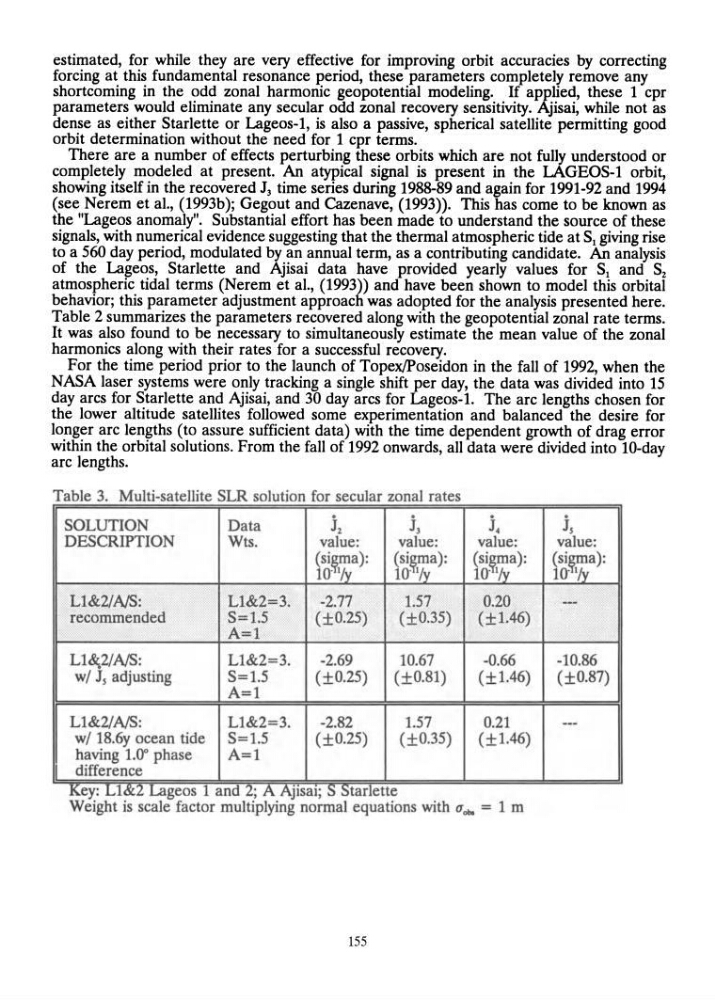
Table 2 summarizes the parameters recovered along with the geopotential zonal rate terms.
It was also found to be necessary to simultaneously estimate the mean value of the zonal
harmonics along with their rates for a successful recovery.
For the time period prior to the launch of Topex/Poseidon in the fall of 1992, when the
NASA laser systems were only tracking a single shift per day, the data was divided into 15
day arcs for Starlette and Ajisai, and 30 day arcs for Lageos-1. The arc lengths chosen for
the lower altitude satellites followed some experimentation and balanced the desire for
longer arc lengths (to assure sufficient data) with the time dependent growth of drag error
within the orbital solutions. From the fall of 1992 onwards, all data were divided into 10-day
arc lengths.
Table 3. Multi-satellite SLR solution for secular zonal rates
jz
.
j~
.
SOLUTION
Data
J 3
J s
DESCRIPTION
Wts.
value:
value:
value:
value:
(si~ma):
lO,l/y
(si~ma):
lO,l/y
(si~a):
10,1ty
(si~a):
lO,l/ y
Ll&2/A/S:
L1&2=3.
-2.77
1.57
0.20
--recommended
S=1.5
(±0.25)
(±0.35)
(±1,46)
,.,
A=l
L1~2/NS:
L1&2=3.
-2.69
10.67
-0.66
-10.86
w/ J s adjusting
S=l.5
(±0.25)
(±0.81)
(± 1.46)
(±0.87)
A=l
L1&2/NS:
Ll&2=3.
-2.82
1.57
0.21
--wi 18.6y ocean tide S=1.5
(±0.25)
(±0.35)
( +1.46)
having 1.0° phase
A=l
difference
Ke : L1&2 Lal eos 1 and 2' A Aiisai' S Starlette
y
g
, J ,
Weight is scale factor mUltiplying normal equations with 0"0li0 = 1 m
155
forcing at this fundamental resonance period, these parameters completely remove any
shortcoming in the odd zonal harmonic geopotential modeling. If applied, these 1 cpr
parameters would eliminate any secular odd zonal recovery sensitivity. Ajisai, while not as
dense as either Starlette or Lageos-1, is also a passive, spherical satellite permitting good
orbit determination without the need for 1 cpr terms.
There are a number of effects perturbing these orbits which are not fully understood or
completely modeled at present. An atypical signal is present in the IAGEOS-1 orbit,
showing itself in the recovered J 3 time series during 1988-89 and again for 1991-92 and 1994
(see Nerem et al., (1993b); Gegout and Cazenave, (1993)). This has come to be known as
the "Lageos anomaly". Substantial effort has been made to understand the source of these
signals, with numerical evidence suggesting that the thermal atmospheric tide at SI giving rise
to a 560 day period, modulated by an annual term, as a contributing candidate. An analysis
of the Lageos, Starlette and Ajisai data have provided yearly values for SI and Sz
atmospheric tidal terms (Nerem et al., (1993)) and have been shown to model this orbital
behavior; this parameter adjustment approach was adopted for the analysis presented here.
Table 2 summarizes the parameters recovered along with the geopotential zonal rate terms.
It was also found to be necessary to simultaneously estimate the mean value of the zonal
harmonics along with their rates for a successful recovery.
For the time period prior to the launch of Topex/Poseidon in the fall of 1992, when the
NASA laser systems were only tracking a single shift per day, the data was divided into 15
day arcs for Starlette and Ajisai, and 30 day arcs for Lageos-1. The arc lengths chosen for
the lower altitude satellites followed some experimentation and balanced the desire for
longer arc lengths (to assure sufficient data) with the time dependent growth of drag error
within the orbital solutions. From the fall of 1992 onwards, all data were divided into 10-day
arc lengths.
Table 3. Multi-satellite SLR solution for secular zonal rates
jz
.
j~
.
SOLUTION
Data
J 3
J s
DESCRIPTION
Wts.
value:
value:
value:
value:
(si~ma):
lO,l/y
(si~ma):
lO,l/y
(si~a):
10,1ty
(si~a):
lO,l/ y
Ll&2/A/S:
L1&2=3.
-2.77
1.57
0.20
--recommended
S=1.5
(±0.25)
(±0.35)
(±1,46)
,.,
A=l
L1~2/NS:
L1&2=3.
-2.69
10.67
-0.66
-10.86
w/ J s adjusting
S=l.5
(±0.25)
(±0.81)
(± 1.46)
(±0.87)
A=l
L1&2/NS:
Ll&2=3.
-2.82
1.57
0.21
--wi 18.6y ocean tide S=1.5
(±0.25)
(±0.35)
( +1.46)
having 1.0° phase
A=l
difference
Ke : L1&2 Lal eos 1 and 2' A Aiisai' S Starlette
y
g
, J ,
Weight is scale factor mUltiplying normal equations with 0"0li0 = 1 m
155