

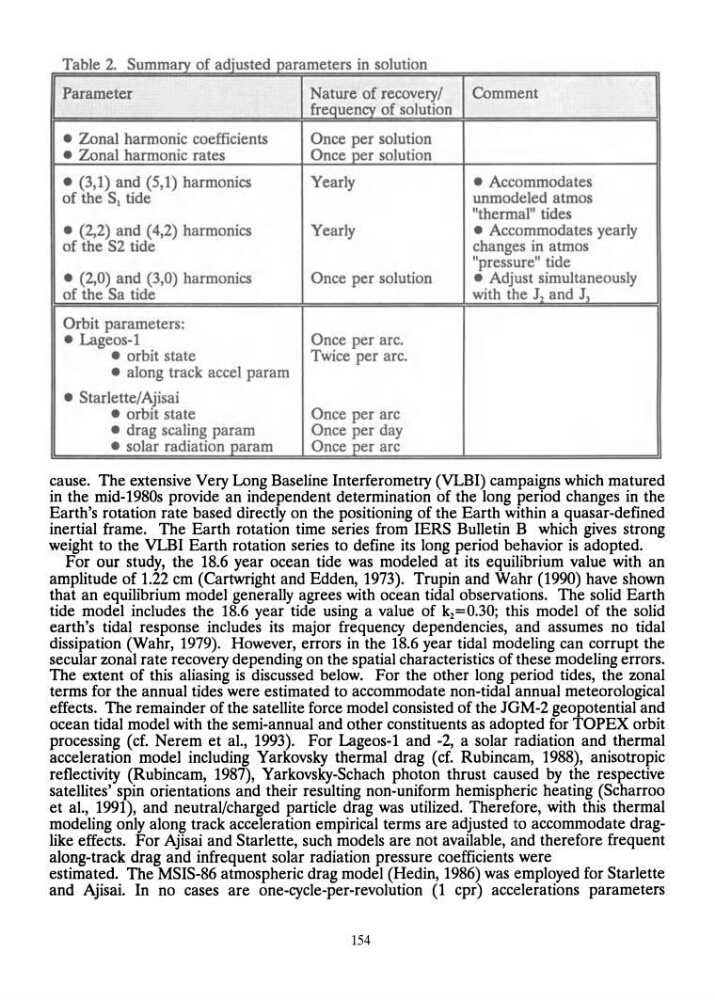
Table 2 Summary of adjusted parameters In solution
Parameter
• Zonal harmonic coefficients
• Zonal harmonic rates
• (3,1) and (5,1) harmonics
of the Sl tide
• (2,2) and (4,2) harmonics
of the S2 tide
• (2,0) and (3,0) harmonics
of the Sa tide
Orbit parameters:
• Lageos-1
• orbit state
• along track accel param
• Starlette/Ajisai
• orbit state
• drag scaling param
• solar radiation param
Nature of recovery/
Comment
frequency_ of solution
Once per solution
Once per solution
Yearly
Yearly
Once per solution
Once per arc.
Twice per arc.
Once per arc
Once per day
Once per arc
• Accommodates
unmodeled atmos
"thermal" tides
• Accommodates yearly
changes in atmos
"pressure" tide
• Adjust simultaneously
with the J 2 and J 3
cause. The extensive Very Long Baseline Interferometry (VLBI) campaigns which matured
in the mid-1980s provide an independent determination of the long period changes in the
Earth's rotation rate based directly on the positioning of the Earth within a quasar-defined
inertial frame. The Earth rotation time series from IERS Bulletin B which gives strong
weight to the VLBI Earth rotation series to define its long period behavior is adopted.
For our study, the 18.6 year ocean tide was modeled at its equilibrium value with an
amplitude of 1.22 cm (Cartwright and Edden, 1973). Trupin and Wahr (1990) have shown
that an equilibrium model generally agrees with ocean tidal observations. The solid Earth
tide model includes the 18.6 year tide using a value of k 2 =0.30; this model of the solid
earth's tidal response includes its major frequency dependencies, and assumes no tidal
dissipation (Wahr, 1979). However, errors in the 18.6 year tidal modeling can corrupt the
secular zonal rate recovery depending on the spatial characteristics of these modeling errors.
The extent of this aliasing is discussed below. For the other long period tides, the zonal
terms for the annual tides were estimated to accommodate non-tidal annual meteorological
effects. The remainder of the satellite force model consisted of the JGM-2 geopotential and
ocean tidal model with the semi-annual and other constituents as adopted for TOPEX orbit
processing (cf. Nerem et aI., 1993). For Lageos-1 and -2, a solar radiation and thermal
acceleration model including Yarkovsky thermal drag (cf. Rubincam, 1988), anisotropic
reflectivity (Rubin cam, 1987), Yarkovsky-Schach photon thrust caused by the respective
satellites' spin orientations and their resulting non-uniform hemispheric heating (Scharroo
et aI., 1991), and neutral/charged particle drag was utilized. Therefore, with this thermal
modeling only along track acceleration empirical terms are adjusted to accommodate draglike effects. For Ajisai and Starlette, such models are not available, and therefore frequent
along-track drag and infrequent solar radiation pressure coefficients were
estimated. The MSIS-86 atmospheric drag model (Hedin, 1986) was employed for Starlette
and Ajisai. In no cases are one-cycle-per-revolution (1 cpr) accelerations parameters
154
Parameter
• Zonal harmonic coefficients
• Zonal harmonic rates
• (3,1) and (5,1) harmonics
of the Sl tide
• (2,2) and (4,2) harmonics
of the S2 tide
• (2,0) and (3,0) harmonics
of the Sa tide
Orbit parameters:
• Lageos-1
• orbit state
• along track accel param
• Starlette/Ajisai
• orbit state
• drag scaling param
• solar radiation param
Nature of recovery/
Comment
frequency_ of solution
Once per solution
Once per solution
Yearly
Yearly
Once per solution
Once per arc.
Twice per arc.
Once per arc
Once per day
Once per arc
• Accommodates
unmodeled atmos
"thermal" tides
• Accommodates yearly
changes in atmos
"pressure" tide
• Adjust simultaneously
with the J 2 and J 3
cause. The extensive Very Long Baseline Interferometry (VLBI) campaigns which matured
in the mid-1980s provide an independent determination of the long period changes in the
Earth's rotation rate based directly on the positioning of the Earth within a quasar-defined
inertial frame. The Earth rotation time series from IERS Bulletin B which gives strong
weight to the VLBI Earth rotation series to define its long period behavior is adopted.
For our study, the 18.6 year ocean tide was modeled at its equilibrium value with an
amplitude of 1.22 cm (Cartwright and Edden, 1973). Trupin and Wahr (1990) have shown
that an equilibrium model generally agrees with ocean tidal observations. The solid Earth
tide model includes the 18.6 year tide using a value of k 2 =0.30; this model of the solid
earth's tidal response includes its major frequency dependencies, and assumes no tidal
dissipation (Wahr, 1979). However, errors in the 18.6 year tidal modeling can corrupt the
secular zonal rate recovery depending on the spatial characteristics of these modeling errors.
The extent of this aliasing is discussed below. For the other long period tides, the zonal
terms for the annual tides were estimated to accommodate non-tidal annual meteorological
effects. The remainder of the satellite force model consisted of the JGM-2 geopotential and
ocean tidal model with the semi-annual and other constituents as adopted for TOPEX orbit
processing (cf. Nerem et aI., 1993). For Lageos-1 and -2, a solar radiation and thermal
acceleration model including Yarkovsky thermal drag (cf. Rubincam, 1988), anisotropic
reflectivity (Rubin cam, 1987), Yarkovsky-Schach photon thrust caused by the respective
satellites' spin orientations and their resulting non-uniform hemispheric heating (Scharroo
et aI., 1991), and neutral/charged particle drag was utilized. Therefore, with this thermal
modeling only along track acceleration empirical terms are adjusted to accommodate draglike effects. For Ajisai and Starlette, such models are not available, and therefore frequent
along-track drag and infrequent solar radiation pressure coefficients were
estimated. The MSIS-86 atmospheric drag model (Hedin, 1986) was employed for Starlette
and Ajisai. In no cases are one-cycle-per-revolution (1 cpr) accelerations parameters
154