

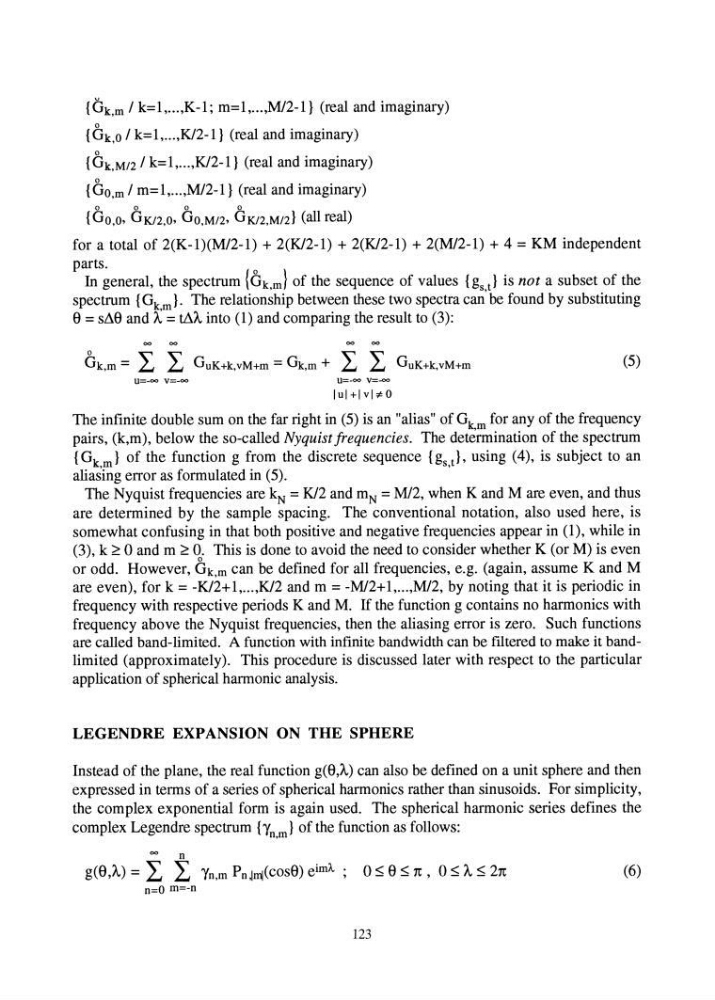
{Gk,m! k=I, ... ,K-l; m=I, ... ,Ml2-1} (real and imaginary)
o
{Gk,O ! k=I, ... ,Kl2-1} (real and imaginary)
o
{G k ,M/2! k=I, ... ,Kl2-1} (real and imaginary)
o
{GO,m! m=I, ... ,Ml2-1} (real and imaginary)
o
0
0
0
{Go,o, G Kl2,0, G O,MI2, G Kl2,MI2} (all real)
for a total of 2(K-l)(MI2-l) + 2(Kl2-1) + 2(Kl2-1) + 2(Ml2-1) + 4 = KM independent
parts.
In general, the spectrum {Ok,m} of the sequence of values {gs,t} is not a subset of the
spectrum {Gk,m}. The relationship between these two spectra can be found by substituting
S = sAS and X = tAl.. into (1) and comparing the result to (3):
00
00
Ok,m = L L GuK+k,vM+m = Gk,m + L L GuK+k,vM+m
(5)
U=-OO v=-oo
u=-oo v=lul+lvl;tO
The infinite double sum on the far right in (5) is an "alias" of Gk,m for any of the frequency
pairs, (k,m), below the so-called Nyquist frequencies. The determination of the spectrum
{Gk,m} of the function g from the discrete sequence {gs,t}, using (4), is subject to an
aliasing error as formulated in (5).
The Nyquist frequencies are kN = Kl2 and mN = Ml2, when K and M are even, and thus
are determined by the sample spacing. The conventional notation, also used here, is
somewhat confusing in that both positive and negative frequencies appear in (1), while in
(3), k ~ 0 and m ~ O. This is done to avoid the need to consider whether K (or M) is even
o
or odd. However, Gk,m can be defined for all frequencies, e.g. (again, assume K and M
are even), for k = -Kl2+ 1, ... ,Kl2 and m = -M/2+ 1, ... ,M!2, by noting that it is periodic in
frequency with respective periods K and M. If the function g contains no harmonics with
frequency above the Nyquist frequencies, then the aliasing error is zero. Such functions
are called band-limited. A function with infinite bandwidth can be fIltered to make it bandlimited (approximately). This procedure is discussed later with respect to the particular
application of spherical harmonic analysis.
LEGENDRE EXPANSION ON THE SPHERE
Instead of the plane, the real function g(S,A.) can also be defined on a unit sphere and then
expressed in terms of a series of spherical harmonics rather than sinusoids. For simplicity,
the complex exponential form is again used. The spherical harmonic series defines the
complex Legendre spectrum {'Yn,m} of the function as follows:
n
g(S,A.) = L L 'Yn,m PnJmI(cosS) e imA ; 0::;; S ::;; 7t, 0::;; A. ::;; 27t
(6)
n=O m=-n
123
o
{Gk,O ! k=I, ... ,Kl2-1} (real and imaginary)
o
{G k ,M/2! k=I, ... ,Kl2-1} (real and imaginary)
o
{GO,m! m=I, ... ,Ml2-1} (real and imaginary)
o
0
0
0
{Go,o, G Kl2,0, G O,MI2, G Kl2,MI2} (all real)
for a total of 2(K-l)(MI2-l) + 2(Kl2-1) + 2(Kl2-1) + 2(Ml2-1) + 4 = KM independent
parts.
In general, the spectrum {Ok,m} of the sequence of values {gs,t} is not a subset of the
spectrum {Gk,m}. The relationship between these two spectra can be found by substituting
S = sAS and X = tAl.. into (1) and comparing the result to (3):
00
00
Ok,m = L L GuK+k,vM+m = Gk,m + L L GuK+k,vM+m
(5)
U=-OO v=-oo
u=-oo v=lul+lvl;tO
The infinite double sum on the far right in (5) is an "alias" of Gk,m for any of the frequency
pairs, (k,m), below the so-called Nyquist frequencies. The determination of the spectrum
{Gk,m} of the function g from the discrete sequence {gs,t}, using (4), is subject to an
aliasing error as formulated in (5).
The Nyquist frequencies are kN = Kl2 and mN = Ml2, when K and M are even, and thus
are determined by the sample spacing. The conventional notation, also used here, is
somewhat confusing in that both positive and negative frequencies appear in (1), while in
(3), k ~ 0 and m ~ O. This is done to avoid the need to consider whether K (or M) is even
o
or odd. However, Gk,m can be defined for all frequencies, e.g. (again, assume K and M
are even), for k = -Kl2+ 1, ... ,Kl2 and m = -M/2+ 1, ... ,M!2, by noting that it is periodic in
frequency with respective periods K and M. If the function g contains no harmonics with
frequency above the Nyquist frequencies, then the aliasing error is zero. Such functions
are called band-limited. A function with infinite bandwidth can be fIltered to make it bandlimited (approximately). This procedure is discussed later with respect to the particular
application of spherical harmonic analysis.
LEGENDRE EXPANSION ON THE SPHERE
Instead of the plane, the real function g(S,A.) can also be defined on a unit sphere and then
expressed in terms of a series of spherical harmonics rather than sinusoids. For simplicity,
the complex exponential form is again used. The spherical harmonic series defines the
complex Legendre spectrum {'Yn,m} of the function as follows:
n
g(S,A.) = L L 'Yn,m PnJmI(cosS) e imA ; 0::;; S ::;; 7t, 0::;; A. ::;; 27t
(6)
n=O m=-n
123