

operators reduce the effects of aliasing. Throughout, the errors in measuring the function
on the sphere are not considered.
FOURIER EXPANSION ON THE PLANE
Consider the spherical coordinates (e,A), co-latitude and longitude, defined on the plane;
and let g(e,A) be a real, periodic function defined on this plane, with periods 7t and 27t in e
and A, respectively. Assuming it is a reasonably well-behaved function (e.g., piecewise
continuous), g may be represented as an infinite series of sinusoidal functions that
converges to g almost everywhere (except possibly at the discontinuities):
00
00
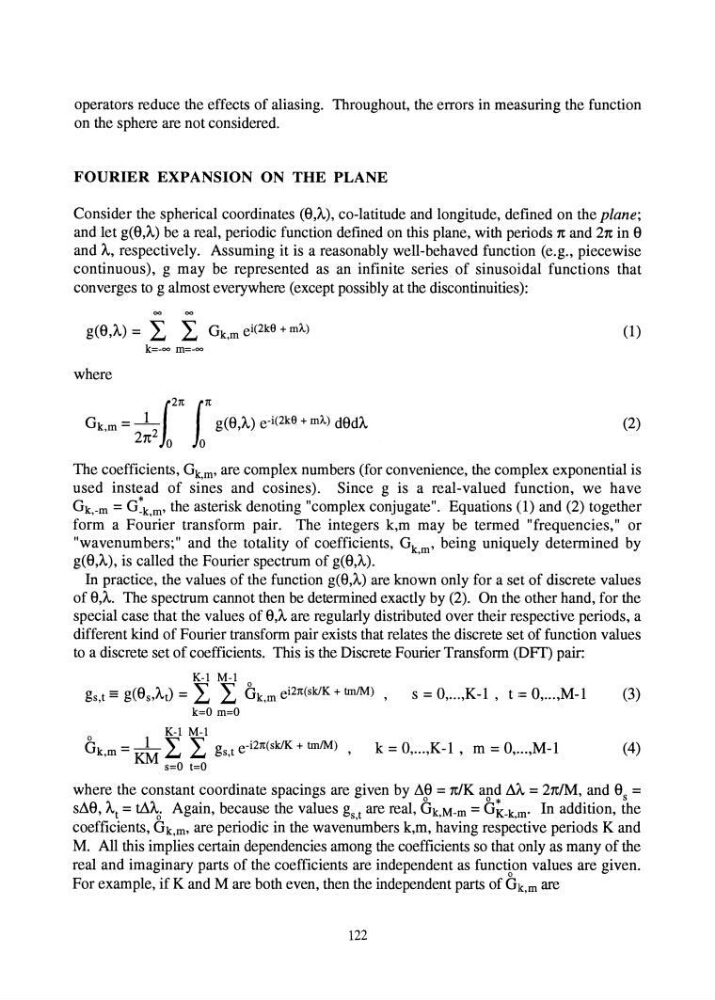
g(e,A) = L L Gk,rn e i (2k9 + rnA.)
(1)
k=-oo rn=-oo
where
Gk,rn = ~i27t i7t g(e,A) e-i(2k9 + rnA.) dedI..
27t 0
0
(2)
The coefficients, Gk,rn, are complex numbers (for convenience, the complex exponential is
used instead of sines and cosines). Since g is a real-valued function, we have
Gk,-rn = G:k,rn, the asterisk denoting "complex conjugate". Equations (1) and (2) together
form a Fourier transform pair. The integers k,m may be termed "frequencies," or
"wavenumbers;" and the totality of coefficients, Gk,rn' being uniquely determined by
g(e,A), is called the Fourier spectrum of g(e,A).
In practice, the values of the function gee,A) are known only for a set of discrete values
of e,A. The spectrum cannot then be determined exactly by (2). On the other hand, for the
special case that the values of e,A are regularly distributed over their respective periods, a
different kind of Fourier transform pair exists that relates the discrete set of function values
to a discrete set of coefficients. This is the Discrete Fourier Transform (OFT) pair:
K-l M-l
gs,t == g(es,At) = L L Gk,rn e i27t (sklK + tm/M), S = O, ... ,K-1 , t:: O, ... ,M-1 (3)
k=O rn=O
K-l M-l
Gk,rn = ~ L L gs,t e- i27t (sk/K + tm/M), k = O, ... ,K-1, m = O, ... ,M-1
(4)
s=O t=O
where the constant coordinate spacings are given by i\e = 7t/K and i\A = 27t1M, and e s =
si\e, At = ti\\ Again, because the values gs,t are real, Gk,M-rn = G~-k,rn. In addition, the
coefficients, Gk,rn, are periodic in the wavenumbers k,m, having respective periods K and
M. All this implies certain dependencies among the coefficients so that only as many of the
real and imaginary parts of the coefficients are independent as function values are given.
o
For example, if K and M are both even, then the independent parts of Gk,rn are
122
on the sphere are not considered.
FOURIER EXPANSION ON THE PLANE
Consider the spherical coordinates (e,A), co-latitude and longitude, defined on the plane;
and let g(e,A) be a real, periodic function defined on this plane, with periods 7t and 27t in e
and A, respectively. Assuming it is a reasonably well-behaved function (e.g., piecewise
continuous), g may be represented as an infinite series of sinusoidal functions that
converges to g almost everywhere (except possibly at the discontinuities):
00
00
g(e,A) = L L Gk,rn e i (2k9 + rnA.)
(1)
k=-oo rn=-oo
where
Gk,rn = ~i27t i7t g(e,A) e-i(2k9 + rnA.) dedI..
27t 0
0
(2)
The coefficients, Gk,rn, are complex numbers (for convenience, the complex exponential is
used instead of sines and cosines). Since g is a real-valued function, we have
Gk,-rn = G:k,rn, the asterisk denoting "complex conjugate". Equations (1) and (2) together
form a Fourier transform pair. The integers k,m may be termed "frequencies," or
"wavenumbers;" and the totality of coefficients, Gk,rn' being uniquely determined by
g(e,A), is called the Fourier spectrum of g(e,A).
In practice, the values of the function gee,A) are known only for a set of discrete values
of e,A. The spectrum cannot then be determined exactly by (2). On the other hand, for the
special case that the values of e,A are regularly distributed over their respective periods, a
different kind of Fourier transform pair exists that relates the discrete set of function values
to a discrete set of coefficients. This is the Discrete Fourier Transform (OFT) pair:
K-l M-l
gs,t == g(es,At) = L L Gk,rn e i27t (sklK + tm/M), S = O, ... ,K-1 , t:: O, ... ,M-1 (3)
k=O rn=O
K-l M-l
Gk,rn = ~ L L gs,t e- i27t (sk/K + tm/M), k = O, ... ,K-1, m = O, ... ,M-1
(4)
s=O t=O
where the constant coordinate spacings are given by i\e = 7t/K and i\A = 27t1M, and e s =
si\e, At = ti\\ Again, because the values gs,t are real, Gk,M-rn = G~-k,rn. In addition, the
coefficients, Gk,rn, are periodic in the wavenumbers k,m, having respective periods K and
M. All this implies certain dependencies among the coefficients so that only as many of the
real and imaginary parts of the coefficients are independent as function values are given.
o
For example, if K and M are both even, then the independent parts of Gk,rn are
122