

attenuation at satellite altitudes, only the coefficients up to degree 70 were used in the tests.
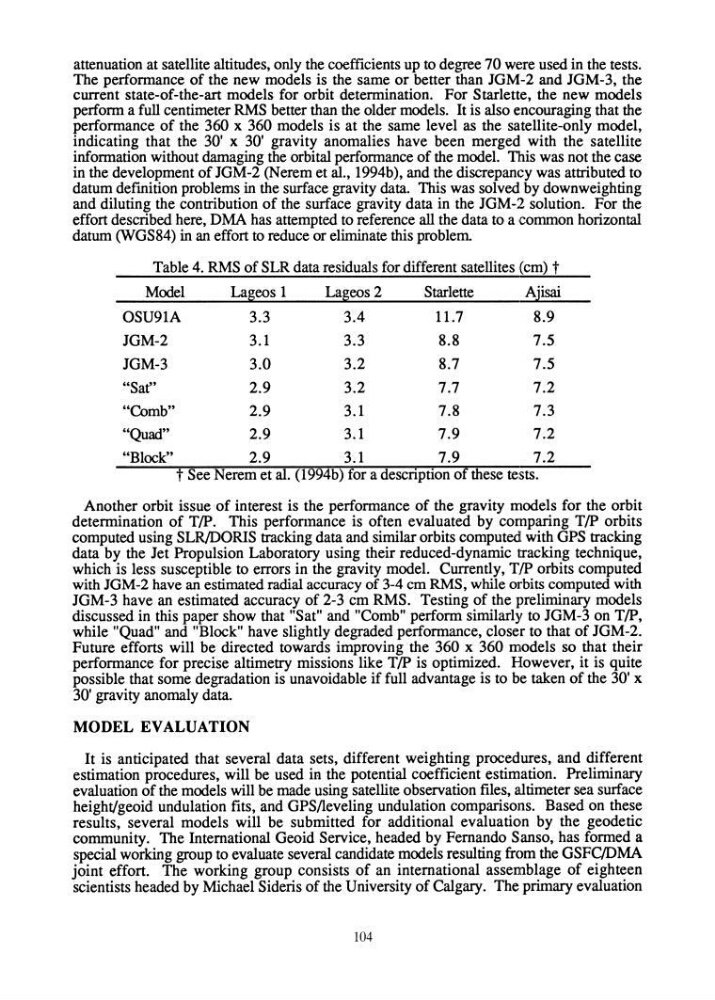
The perfonnance of the new models is the same or better than IGM-2 and IGM-3, the
current state-of-the-art models for orbit determination. For Starlette, the new models
perform a full centimeter RMS better than the older models. It is also encouraging that the
perfonnance of the 360 x 360 models is at the same level as the satellite-only model,
indicating that the 30' x 30' gravity anomalies have been merged with the satellite
information without damaging the orbital performance of the model. This was not the case
in the development of IGM-2 (Nerem et al., 1994b), and the discrepancy was attributed to
datum defmition problems in the surface gravity data. This was solved by downweighting
and diluting the contribution of the surface gravity data in the IGM-2 solution. For the
effort described here, DMA has attempted to reference all the data to a common horizontal
datum (WGS84) in an effort to reduce or eliminate this problem.
Table 4. RMS of SLR data residuals for different satellites (cm) t
Model
Lageos 1
Lageos2
Starlette
Ajisai
OSU91A
3.3
3.4
11.7
8.9
IGM-2
3.1
3.3
8.8
7.5
IGM-3
3.0
3.2
8.7
7.5
"Sat"
2.9
3.2
7.7
7.2
"Comb"
2.9
3.1
7.8
7.3
"Quad."
2.9
3.1
7.9
7.2
"Block"
2.9
3.1
7.9
7.2
t See Nerem et al. (l994b) for a description of these tests.
Another orbit issue of interest is the performance of the gravity models for the orbit
determination of TIP. This performance is often evaluated by comparing TIP orbits
computed using SLRlDORIS tracking data and similar orbits computed with GPS tracking
data by the let Propulsion Laboratory using their reduced-dynamic tracking technique,
which is less susceptible to errors in the gravity model. Currently, T.IP orbits computed
with IGM-2 have an estimated radial accuracy of 3-4 em RMS, while orbits computed with
IGM-3 have an estimated accuracy of 2-3 cm RMS. Testing of the preliminary models
discussed in this paper show that "Sat" and "Comb" perform similarly to JGM-3 on TIP,
while "Quad" and "Block" have slightly degraded performance, closer to that of JGM-2.
Future efforts will be directed towards improving the 360 x 360 models so that their
performance for precise altimetry missions like TIP is optimized. However, it is quite
possible that some degradation is unavoidable if full advantage is to be taken of the 30' x
30' gravity anomaly data.
MODEL EVALUATION
It is anticipated that several data sets, different weighting procedures, and different
estimation procedures, will be used in the potential coefficient estimation. Preliminary
evaluation of the models will be made using satellite observation files, altimeter sea surface
height/geoid undulation fits, and GPS/leveling undulation comparisons. Based on these
results, several models will be submitted for additional evaluation by the geodetic
community. The International Geoid Service, headed by Fernando Sanso, has formed a
special working group to evaluate several candidate models resulting from the GSFClDMA
joint effort. The working group consists of an international assemblage of eighteen
scientists headed by Michael Sideris of the University of Calgary. The primary evaluation
104
The perfonnance of the new models is the same or better than IGM-2 and IGM-3, the
current state-of-the-art models for orbit determination. For Starlette, the new models
perform a full centimeter RMS better than the older models. It is also encouraging that the
perfonnance of the 360 x 360 models is at the same level as the satellite-only model,
indicating that the 30' x 30' gravity anomalies have been merged with the satellite
information without damaging the orbital performance of the model. This was not the case
in the development of IGM-2 (Nerem et al., 1994b), and the discrepancy was attributed to
datum defmition problems in the surface gravity data. This was solved by downweighting
and diluting the contribution of the surface gravity data in the IGM-2 solution. For the
effort described here, DMA has attempted to reference all the data to a common horizontal
datum (WGS84) in an effort to reduce or eliminate this problem.
Table 4. RMS of SLR data residuals for different satellites (cm) t
Model
Lageos 1
Lageos2
Starlette
Ajisai
OSU91A
3.3
3.4
11.7
8.9
IGM-2
3.1
3.3
8.8
7.5
IGM-3
3.0
3.2
8.7
7.5
"Sat"
2.9
3.2
7.7
7.2
"Comb"
2.9
3.1
7.8
7.3
"Quad."
2.9
3.1
7.9
7.2
"Block"
2.9
3.1
7.9
7.2
t See Nerem et al. (l994b) for a description of these tests.
Another orbit issue of interest is the performance of the gravity models for the orbit
determination of TIP. This performance is often evaluated by comparing TIP orbits
computed using SLRlDORIS tracking data and similar orbits computed with GPS tracking
data by the let Propulsion Laboratory using their reduced-dynamic tracking technique,
which is less susceptible to errors in the gravity model. Currently, T.IP orbits computed
with IGM-2 have an estimated radial accuracy of 3-4 em RMS, while orbits computed with
IGM-3 have an estimated accuracy of 2-3 cm RMS. Testing of the preliminary models
discussed in this paper show that "Sat" and "Comb" perform similarly to JGM-3 on TIP,
while "Quad" and "Block" have slightly degraded performance, closer to that of JGM-2.
Future efforts will be directed towards improving the 360 x 360 models so that their
performance for precise altimetry missions like TIP is optimized. However, it is quite
possible that some degradation is unavoidable if full advantage is to be taken of the 30' x
30' gravity anomaly data.
MODEL EVALUATION
It is anticipated that several data sets, different weighting procedures, and different
estimation procedures, will be used in the potential coefficient estimation. Preliminary
evaluation of the models will be made using satellite observation files, altimeter sea surface
height/geoid undulation fits, and GPS/leveling undulation comparisons. Based on these
results, several models will be submitted for additional evaluation by the geodetic
community. The International Geoid Service, headed by Fernando Sanso, has formed a
special working group to evaluate several candidate models resulting from the GSFClDMA
joint effort. The working group consists of an international assemblage of eighteen
scientists headed by Michael Sideris of the University of Calgary. The primary evaluation
104