

340
19 Correlation of Significant Voyaging Activity with Rare Extreme Climate Events
As we have suggested, a problem inherent in establishing a chronology from
generational data is finding an optimal means of characterizing the transition from
one generation to the next. In illustration of this problem, at the time of the eclipse
of 1383, Uenuku’s son Paikea had already achieved chiefly status, although Uenuku
had probably held the reins of power for a generation at this stage and was to hold
them for another. If we have Paikea’s generation represented as achieving maturity
in 1383 (as evidenced by Paikea’s involvement in the land-based punitive war party
against Tawheta in Tahiti, some short time before the eclipse) we would need to retrospectively date Uenuku’s access to chiefly status to 1358 in a chronology with a
25.5 year generation length. Access to chiefly status, or to a navigator’s command of
a waka, seems to be a more realistic way of determining the gaps between generations – a generation length – than guessed dates for births and deaths. Using climate
data, which suggests the most likely times for ocean voyaging, throws emphasis
onto the times of maximum adult activity in each generation rather than onto the
timing for transmission of tribal mana from a dying chief to his son. Our climate
and generational data reach their natural interface in times of action.
Although Hoaki and Taukata do not appear on the main Rarotongan line, the
importance of establishing an estimate for Hoaki and Taukata’s voyage to New
Zealand and so for the bringing of the kumara to New Zealand has led us in
Table 19.1 to show their generational if not genetic relationship to Kahukura through
their sister Kanioro, one of two women claimed to be the mother of Kahukura.
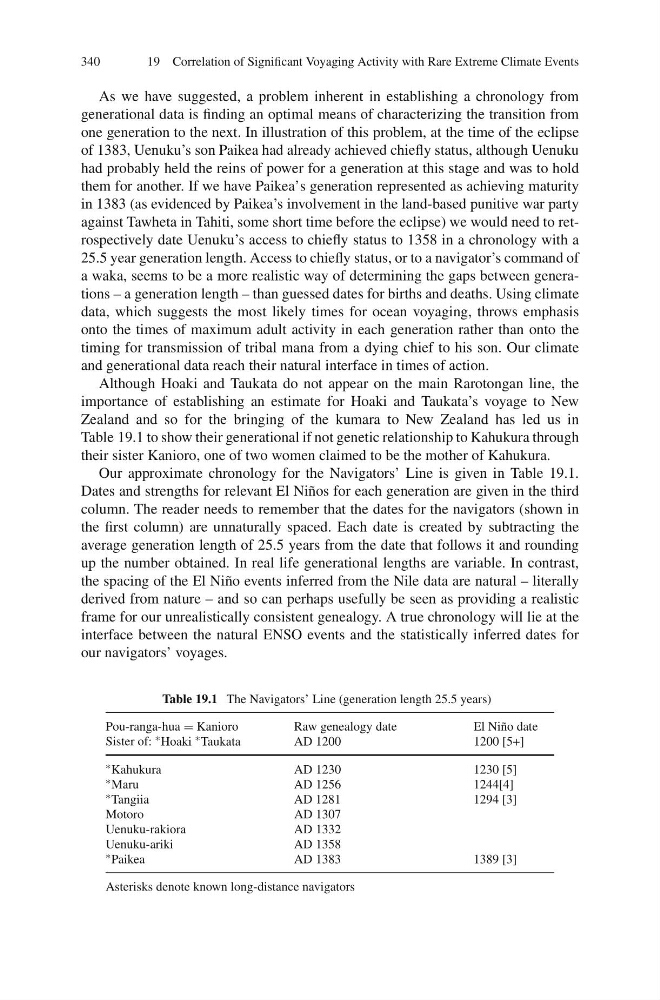
Our approximate chronology for the Navigators’ Line is given in Table 19.1.
Dates and strengths for relevant El Niños for each generation are given in the third
column. The reader needs to remember that the dates for the navigators (shown in
the first column) are unnaturally spaced. Each date is created by subtracting the
average generation length of 25.5 years from the date that follows it and rounding
up the number obtained. In real life generational lengths are variable. In contrast,
the spacing of the El Niño events inferred from the Nile data are natural – literally
derived from nature – and so can perhaps usefully be seen as providing a realistic
frame for our unrealistically consistent genealogy. A true chronology will lie at the
interface between the natural ENSO events and the statistically inferred dates for
our navigators’ voyages.
Table 19.1 The Navigators’ Line (generation length 25.5 years)
Pou-ranga-hua = Kanioro
Sister of: ∗ Hoaki ∗ Taukata
Raw genealogy date
AD 1200
El Niño date
1200 [5+]
∗ Kahukura
AD 1230
1230 [5]
∗ Maru
AD 1256
1244[4]
∗ Tangiia
AD 1281
1294 [3]
Motoro
AD 1307
Uenuku-rakiora
AD 1332
Uenuku-ariki
AD 1358
∗ Paikea
AD 1383
1389 [3]
Asterisks denote known long-distance navigators
19 Correlation of Significant Voyaging Activity with Rare Extreme Climate Events
As we have suggested, a problem inherent in establishing a chronology from
generational data is finding an optimal means of characterizing the transition from
one generation to the next. In illustration of this problem, at the time of the eclipse
of 1383, Uenuku’s son Paikea had already achieved chiefly status, although Uenuku
had probably held the reins of power for a generation at this stage and was to hold
them for another. If we have Paikea’s generation represented as achieving maturity
in 1383 (as evidenced by Paikea’s involvement in the land-based punitive war party
against Tawheta in Tahiti, some short time before the eclipse) we would need to retrospectively date Uenuku’s access to chiefly status to 1358 in a chronology with a
25.5 year generation length. Access to chiefly status, or to a navigator’s command of
a waka, seems to be a more realistic way of determining the gaps between generations – a generation length – than guessed dates for births and deaths. Using climate
data, which suggests the most likely times for ocean voyaging, throws emphasis
onto the times of maximum adult activity in each generation rather than onto the
timing for transmission of tribal mana from a dying chief to his son. Our climate
and generational data reach their natural interface in times of action.
Although Hoaki and Taukata do not appear on the main Rarotongan line, the
importance of establishing an estimate for Hoaki and Taukata’s voyage to New
Zealand and so for the bringing of the kumara to New Zealand has led us in
Table 19.1 to show their generational if not genetic relationship to Kahukura through
their sister Kanioro, one of two women claimed to be the mother of Kahukura.
Our approximate chronology for the Navigators’ Line is given in Table 19.1.
Dates and strengths for relevant El Niños for each generation are given in the third
column. The reader needs to remember that the dates for the navigators (shown in
the first column) are unnaturally spaced. Each date is created by subtracting the
average generation length of 25.5 years from the date that follows it and rounding
up the number obtained. In real life generational lengths are variable. In contrast,
the spacing of the El Niño events inferred from the Nile data are natural – literally
derived from nature – and so can perhaps usefully be seen as providing a realistic
frame for our unrealistically consistent genealogy. A true chronology will lie at the
interface between the natural ENSO events and the statistically inferred dates for
our navigators’ voyages.
Table 19.1 The Navigators’ Line (generation length 25.5 years)
Pou-ranga-hua = Kanioro
Sister of: ∗ Hoaki ∗ Taukata
Raw genealogy date
AD 1200
El Niño date
1200 [5+]
∗ Kahukura
AD 1230
1230 [5]
∗ Maru
AD 1256
1244[4]
∗ Tangiia
AD 1281
1294 [3]
Motoro
AD 1307
Uenuku-rakiora
AD 1332
Uenuku-ariki
AD 1358
∗ Paikea
AD 1383
1389 [3]
Asterisks denote known long-distance navigators