

11.3 Time as the Fundamental Variable
189
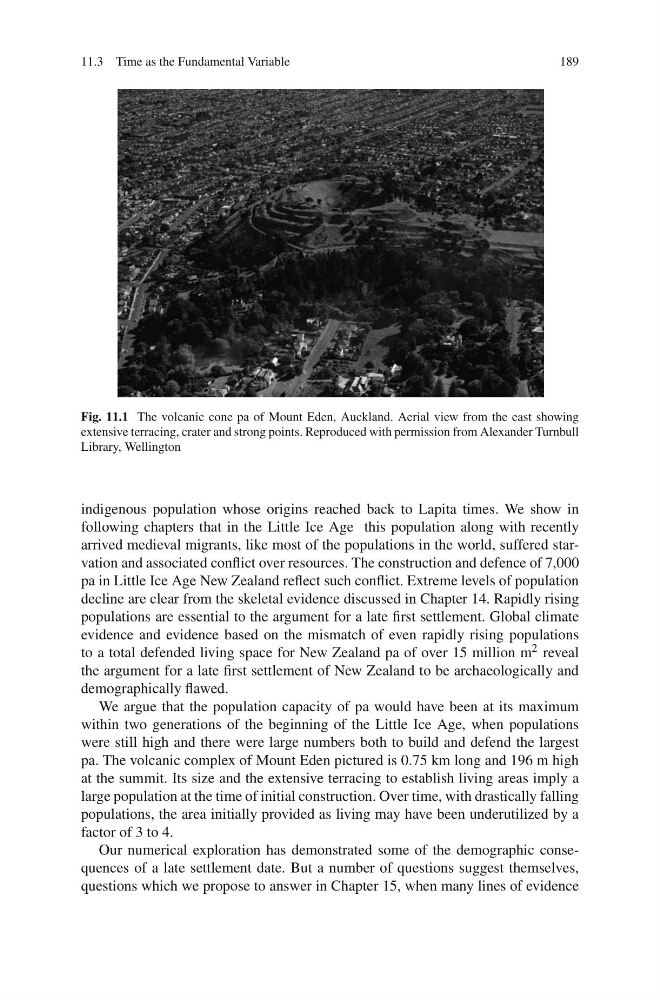
Fig. 11.1 The volcanic cone pa of Mount Eden, Auckland. Aerial view from the east showing
extensive terracing, crater and strong points. Reproduced with permission from Alexander Turnbull
Library, Wellington
indigenous population whose origins reached back to Lapita times. We show in
following chapters that in the Little Ice Age this population along with recently
arrived medieval migrants, like most of the populations in the world, suffered starvation and associated conflict over resources. The construction and defence of 7,000
pa in Little Ice Age New Zealand reflect such conflict. Extreme levels of population
decline are clear from the skeletal evidence discussed in Chapter 14. Rapidly rising
populations are essential to the argument for a late first settlement. Global climate
evidence and evidence based on the mismatch of even rapidly rising populations
to a total defended living space for New Zealand pa of over 15 million m 2 reveal
the argument for a late first settlement of New Zealand to be archaeologically and
demographically flawed.
We argue that the population capacity of pa would have been at its maximum
within two generations of the beginning of the Little Ice Age, when populations
were still high and there were large numbers both to build and defend the largest
pa. The volcanic complex of Mount Eden pictured is 0.75 km long and 196 m high
at the summit. Its size and the extensive terracing to establish living areas imply a
large population at the time of initial construction. Over time, with drastically falling
populations, the area initially provided as living may have been underutilized by a
factor of 3 to 4.
Our numerical exploration has demonstrated some of the demographic consequences of a late settlement date. But a number of questions suggest themselves,
questions which we propose to answer in Chapter 15, when many lines of evidence
189
Fig. 11.1 The volcanic cone pa of Mount Eden, Auckland. Aerial view from the east showing
extensive terracing, crater and strong points. Reproduced with permission from Alexander Turnbull
Library, Wellington
indigenous population whose origins reached back to Lapita times. We show in
following chapters that in the Little Ice Age this population along with recently
arrived medieval migrants, like most of the populations in the world, suffered starvation and associated conflict over resources. The construction and defence of 7,000
pa in Little Ice Age New Zealand reflect such conflict. Extreme levels of population
decline are clear from the skeletal evidence discussed in Chapter 14. Rapidly rising
populations are essential to the argument for a late first settlement. Global climate
evidence and evidence based on the mismatch of even rapidly rising populations
to a total defended living space for New Zealand pa of over 15 million m 2 reveal
the argument for a late first settlement of New Zealand to be archaeologically and
demographically flawed.
We argue that the population capacity of pa would have been at its maximum
within two generations of the beginning of the Little Ice Age, when populations
were still high and there were large numbers both to build and defend the largest
pa. The volcanic complex of Mount Eden pictured is 0.75 km long and 196 m high
at the summit. Its size and the extensive terracing to establish living areas imply a
large population at the time of initial construction. Over time, with drastically falling
populations, the area initially provided as living may have been underutilized by a
factor of 3 to 4.
Our numerical exploration has demonstrated some of the demographic consequences of a late settlement date. But a number of questions suggest themselves,
questions which we propose to answer in Chapter 15, when many lines of evidence