

188
11 Challenging a Late First Settlement Date for New Zealand
Table 11.1 A demographic reductio ad absurdum
AD
World growth
rate
Population
Hawaii
growth rate
Population
Uniform
growth
Population
1200
−0.01
300
0.93
300
1.056
300
1340
0.08
296
0.32
1,096
1.056
1,306
1500
0.15
336
−0.01
1,825
1.056
7,020
1600
0.07
391
−0.14
1,810
1.056
20,079
1650
0.43
404
−0.55
1,687
1.056
33,958
1700
0.26
501
0.35
1,281
1.056
57,430
1750
0.39
571
0.08
1,525
1.056
97,127
1770
617
1,550
119,847
1801
696
1,589
166,000
populations to pa capacity, shows rather that they were entering a country with a significant population and a long demographic history. A long time was needed for the
development of populations by AD 1445 which were able to match pa with a total
area of over 23 million m 2 (computed from just 90% of pa over 2,100 m 2 in size).
The paucity of native food plants and the fact that the fruit and nut trees that
Polynesians relied on in the tropics could not grow in New Zealand meant that the
horticulture introduced by the medieval migrants was mostly restricted to the four
tropical vegetables they brought with them, the kumara, yam, taro and gourd, all of
which had to be acclimatized to New Zealand. The descent of the Little Ice Age in
about AD 1400 would have drastically reduced the harvests of all of these tropical
plants.
If the medieval Eastern Polynesian migrants had arrived in a pristine uninhabited
land, why would they, as a tiny population 200 years after first settlement, have
begun to undertake the construction and defence of pa? And why did these pa require
such extreme protection? Elsdon Best mentions pa with palisades 9 m high and
ditches 7 m deep [14].
There is a striking disparity between the likely size of a population in
New Zealand 600 years after a first settlement supposedly taking place in AD
1200 and the population capacity suggested by 7,000 Maori pa. Though, as we
have commented, many pa were small, there were undoubtedly pa that protected and were protected by thousands. The photograph of the pa on One
Tree Hill, Fig. 11.1, is one such example. Clearly if the population observed
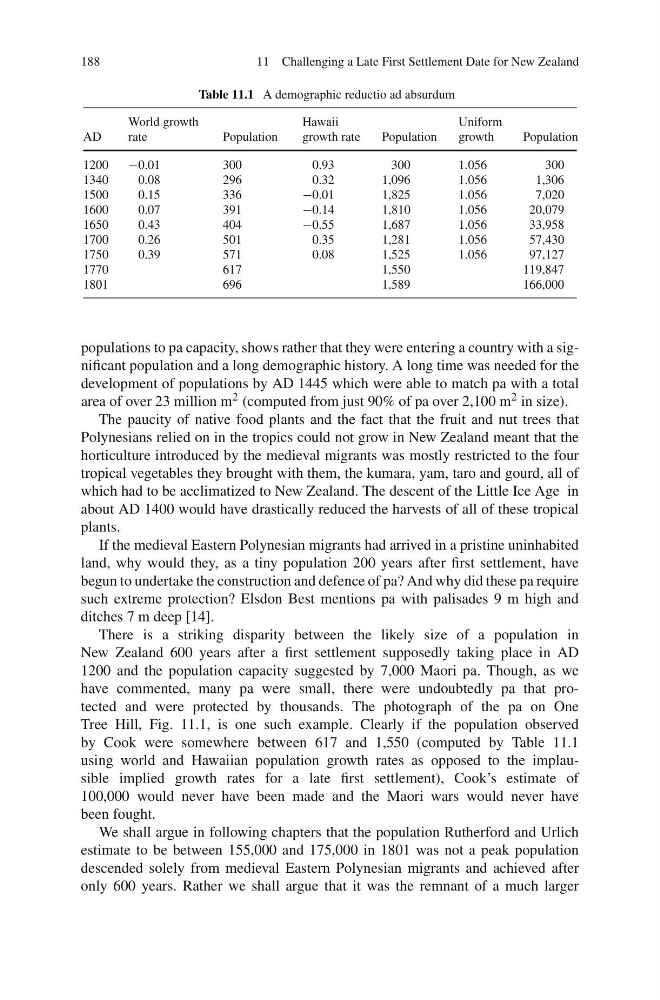
by Cook were somewhere between 617 and 1,550 (computed by Table 11.1
using world and Hawaiian population growth rates as opposed to the implausible implied growth rates for a late first settlement), Cook’s estimate of
100,000 would never have been made and the Maori wars would never have
been fought.
We shall argue in following chapters that the population Rutherford and Urlich
estimate to be between 155,000 and 175,000 in 1801 was not a peak population
descended solely from medieval Eastern Polynesian migrants and achieved after
only 600 years. Rather we shall argue that it was the remnant of a much larger
11 Challenging a Late First Settlement Date for New Zealand
Table 11.1 A demographic reductio ad absurdum
AD
World growth
rate
Population
Hawaii
growth rate
Population
Uniform
growth
Population
1200
−0.01
300
0.93
300
1.056
300
1340
0.08
296
0.32
1,096
1.056
1,306
1500
0.15
336
−0.01
1,825
1.056
7,020
1600
0.07
391
−0.14
1,810
1.056
20,079
1650
0.43
404
−0.55
1,687
1.056
33,958
1700
0.26
501
0.35
1,281
1.056
57,430
1750
0.39
571
0.08
1,525
1.056
97,127
1770
617
1,550
119,847
1801
696
1,589
166,000
populations to pa capacity, shows rather that they were entering a country with a significant population and a long demographic history. A long time was needed for the
development of populations by AD 1445 which were able to match pa with a total
area of over 23 million m 2 (computed from just 90% of pa over 2,100 m 2 in size).
The paucity of native food plants and the fact that the fruit and nut trees that
Polynesians relied on in the tropics could not grow in New Zealand meant that the
horticulture introduced by the medieval migrants was mostly restricted to the four
tropical vegetables they brought with them, the kumara, yam, taro and gourd, all of
which had to be acclimatized to New Zealand. The descent of the Little Ice Age in
about AD 1400 would have drastically reduced the harvests of all of these tropical
plants.
If the medieval Eastern Polynesian migrants had arrived in a pristine uninhabited
land, why would they, as a tiny population 200 years after first settlement, have
begun to undertake the construction and defence of pa? And why did these pa require
such extreme protection? Elsdon Best mentions pa with palisades 9 m high and
ditches 7 m deep [14].
There is a striking disparity between the likely size of a population in
New Zealand 600 years after a first settlement supposedly taking place in AD
1200 and the population capacity suggested by 7,000 Maori pa. Though, as we
have commented, many pa were small, there were undoubtedly pa that protected and were protected by thousands. The photograph of the pa on One
Tree Hill, Fig. 11.1, is one such example. Clearly if the population observed
by Cook were somewhere between 617 and 1,550 (computed by Table 11.1
using world and Hawaiian population growth rates as opposed to the implausible implied growth rates for a late first settlement), Cook’s estimate of
100,000 would never have been made and the Maori wars would never have
been fought.
We shall argue in following chapters that the population Rutherford and Urlich
estimate to be between 155,000 and 175,000 in 1801 was not a peak population
descended solely from medieval Eastern Polynesian migrants and achieved after
only 600 years. Rather we shall argue that it was the remnant of a much larger