

Kleiber and Niessen: Late Pleistocene Paleoriver Channels on the Laptev Sea Shelf
663
18 ka B.P.) until the transgression reached the present-day 30 m-isobath approximately 10,000
years B.P. (Blanchon and Shaw, 1995). The uppermost bed which covers the filled paleorivers
and the stratified sediments of probably Pleistocene age equally, is interpreted as Holocene
deposits.
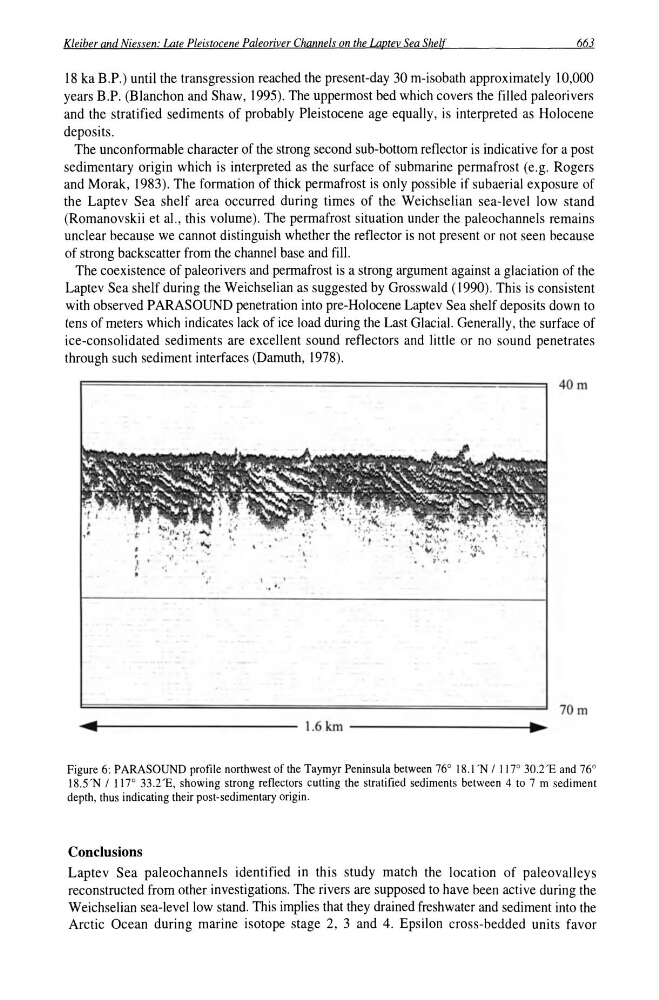
The unconformable character of the strong second sub-bottom reflector is indicative for a post
sedimentary origin which is interpreted as the surface of submarine permafrost (e.g. Rogers
and Morak, 1983). The formation of thick permafrost is only possible if subaerial exposure of
the Laptev Sea shelf area occurred during times of the Weichselian sea-level low stand
(Romanovskii et aI., this volume). The permafrost situation under the paleochannels remains
unclear because we cannot distinguish whether the reflector is not present or not seen because
of strong backscatter from the channel base and fill.
The coexistence of paleorivers and permafrost is a strong argument against a glaciation of the
Laptev Sea shelf during the Weichselian as suggested by Grosswald (1990). This is consistent
with observed PARASOUND penetration into pre-Holocene Laptev Sea shelf deposits down to
tens of meters which indicates lack of ice load during the Last Glacial. Generally, the surface of
ice-consolidated sediments are excellent sound reflectors and little or no sound penetrates
through such sediment interfaces (Damuth, 1978).
40m
.'
70 m
...
1.6km
Figure 6: PARASOUND profile northwest of the Taymyr Peninsula between 76° IS.I 'N / 117 0 30.2'E and 76°
IS.5'N / 117° 33.2'E, showing strong reflectors cutting the stratified sediments between 4 to 7 m sediment
depth, thus indicating their post-sedimentary origin.
Conclusions
Laptev Sea paleochannels identified in this study match the location of paleo valleys
reconstructed from other investigations. The rivers are supposed to have been active during the
Weichselian sea-level low stand. This implies that they drained freshwater and sediment into the
Arctic Ocean during marine isotope stage 2, 3 and 4. Epsilon cross-bedded units favor
663
18 ka B.P.) until the transgression reached the present-day 30 m-isobath approximately 10,000
years B.P. (Blanchon and Shaw, 1995). The uppermost bed which covers the filled paleorivers
and the stratified sediments of probably Pleistocene age equally, is interpreted as Holocene
deposits.
The unconformable character of the strong second sub-bottom reflector is indicative for a post
sedimentary origin which is interpreted as the surface of submarine permafrost (e.g. Rogers
and Morak, 1983). The formation of thick permafrost is only possible if subaerial exposure of
the Laptev Sea shelf area occurred during times of the Weichselian sea-level low stand
(Romanovskii et aI., this volume). The permafrost situation under the paleochannels remains
unclear because we cannot distinguish whether the reflector is not present or not seen because
of strong backscatter from the channel base and fill.
The coexistence of paleorivers and permafrost is a strong argument against a glaciation of the
Laptev Sea shelf during the Weichselian as suggested by Grosswald (1990). This is consistent
with observed PARASOUND penetration into pre-Holocene Laptev Sea shelf deposits down to
tens of meters which indicates lack of ice load during the Last Glacial. Generally, the surface of
ice-consolidated sediments are excellent sound reflectors and little or no sound penetrates
through such sediment interfaces (Damuth, 1978).
40m
.'
70 m
...
1.6km
Figure 6: PARASOUND profile northwest of the Taymyr Peninsula between 76° IS.I 'N / 117 0 30.2'E and 76°
IS.5'N / 117° 33.2'E, showing strong reflectors cutting the stratified sediments between 4 to 7 m sediment
depth, thus indicating their post-sedimentary origin.
Conclusions
Laptev Sea paleochannels identified in this study match the location of paleo valleys
reconstructed from other investigations. The rivers are supposed to have been active during the
Weichselian sea-level low stand. This implies that they drained freshwater and sediment into the
Arctic Ocean during marine isotope stage 2, 3 and 4. Epsilon cross-bedded units favor