

Kleiber and Niessen: Late Pleistocene Paleoriver Channels on the Laptev Sea Shelf
659
allows high vertical as well as a lateral spatial resolution. The sub-bottom penetration is up to
100 m with a vertical resolution of 5 to 30 cm (Grant and Schreiber, 1990; Rostek, 1991). In
this study the secondary frequency was set to 4 kHz.
Incising Pleistocene channels were identified using the following diagnostic criteria: (i), an
erosive, u-shaped sub-bottom morphology and (ii), an undeformed fill geometry. Channel
locations were mapped as doubtful when one of the criteria above was not clearly fulfilled.
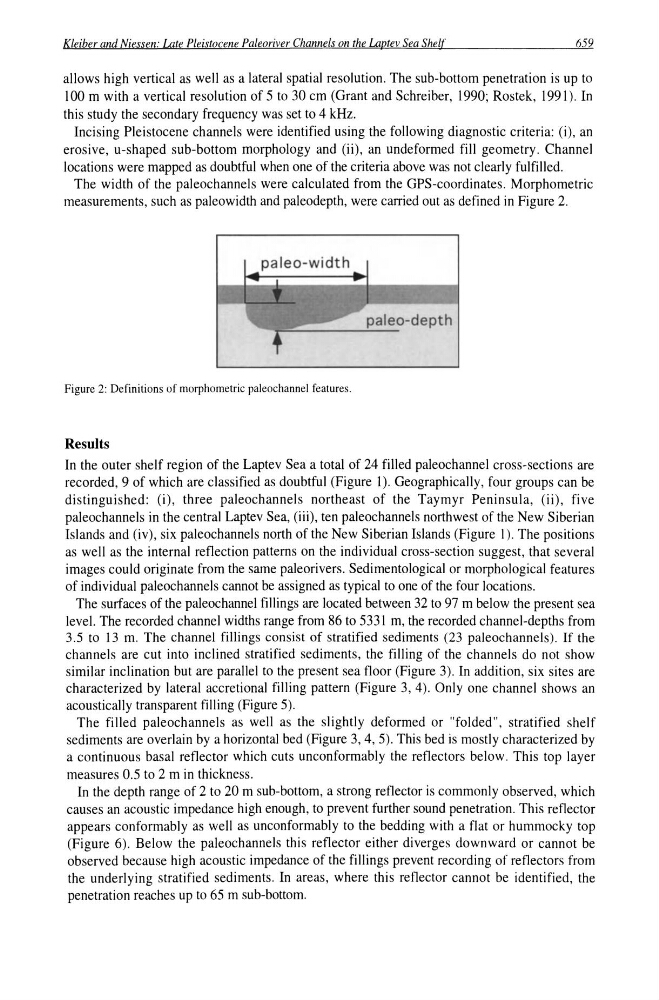
The width of the paleochannels were calculated from the GPS-coordinates. Morphometric
measurements, such as paleowidth and paleodepth, were carried out as defined in Figure 2 .
...:.:.~~~=-_.!:p~al~eo-depth
Figure 2: Definitions of morphometric paleochannel features.
Results
In the outer shelf region of the Laptev Sea a total of 24 filled paleochannel cross-sections are
recorded, 9 of which are classified as doubtful (Figure 1). Geographically, four groups can be
distinguished: (i), three paleochannels northeast of the Taymyr Peninsula, (ii), five
paleochannels in the central Laptev Sea, (iii), ten paleochannels northwest of the New Siberian
Islands and (iv), six paleochannels north of the New Siberian Islands (Figure I). The positions
as well as the internal reflection patterns on the individual cross-section suggest, that several
images could originate from the same paleorivers. Sedimentological or morphological features
of individual paleochannels cannot be assigned as typical to one of the four locations.
The surfaces of the paleochannel fillings are located between 32 to 97 m below the present sea
level. The recorded channel widths range from 86 to 5331 m, the recorded channel-depths from
3.5 to 13 m. The channel fillings consist of stratified sediments (23 paleochannels). If the
channels are cut into inclined stratified sediments, the filling of the channels do not show
similar inclination but are parallel to the present sea floor (Figure 3). In addition, six sites are
characterized by lateral accretional filling pattern (Figure 3,4). Only one channel shows an
acoustically transparent filling (Figure 5).
The filled paleochannels as well as the slightly deformed or "folded", stratified shelf
sediments are overlain by a horizontal bed (Figure 3, 4, 5). This bed is mostly characterized by
a continuous basal reflector which cuts unconformably the reflectors below. This top layer
measures 0.5 to 2 m in thickness.
In the depth range of 2 to 20 m sub-bottom, a strong reflector is commonly observed, which
causes an acoustic impedance high enough, to prevent further sound penetration. This reflector
appears conformably as well as unconformably to the bedding with a flat or hummocky top
(Figure 6). Below the paleochannels this reflector either diverges downward or cannot be
observed because high acoustic impedance of the fillings prevent recording of reflectors from
the underlying stratified sediments. In areas, where this reflector cannot be identified, the
penetration reaches up to 65 m sub-bottom.
659
allows high vertical as well as a lateral spatial resolution. The sub-bottom penetration is up to
100 m with a vertical resolution of 5 to 30 cm (Grant and Schreiber, 1990; Rostek, 1991). In
this study the secondary frequency was set to 4 kHz.
Incising Pleistocene channels were identified using the following diagnostic criteria: (i), an
erosive, u-shaped sub-bottom morphology and (ii), an undeformed fill geometry. Channel
locations were mapped as doubtful when one of the criteria above was not clearly fulfilled.
The width of the paleochannels were calculated from the GPS-coordinates. Morphometric
measurements, such as paleowidth and paleodepth, were carried out as defined in Figure 2 .
...:.:.~~~=-_.!:p~al~eo-depth
Figure 2: Definitions of morphometric paleochannel features.
Results
In the outer shelf region of the Laptev Sea a total of 24 filled paleochannel cross-sections are
recorded, 9 of which are classified as doubtful (Figure 1). Geographically, four groups can be
distinguished: (i), three paleochannels northeast of the Taymyr Peninsula, (ii), five
paleochannels in the central Laptev Sea, (iii), ten paleochannels northwest of the New Siberian
Islands and (iv), six paleochannels north of the New Siberian Islands (Figure I). The positions
as well as the internal reflection patterns on the individual cross-section suggest, that several
images could originate from the same paleorivers. Sedimentological or morphological features
of individual paleochannels cannot be assigned as typical to one of the four locations.
The surfaces of the paleochannel fillings are located between 32 to 97 m below the present sea
level. The recorded channel widths range from 86 to 5331 m, the recorded channel-depths from
3.5 to 13 m. The channel fillings consist of stratified sediments (23 paleochannels). If the
channels are cut into inclined stratified sediments, the filling of the channels do not show
similar inclination but are parallel to the present sea floor (Figure 3). In addition, six sites are
characterized by lateral accretional filling pattern (Figure 3,4). Only one channel shows an
acoustically transparent filling (Figure 5).
The filled paleochannels as well as the slightly deformed or "folded", stratified shelf
sediments are overlain by a horizontal bed (Figure 3, 4, 5). This bed is mostly characterized by
a continuous basal reflector which cuts unconformably the reflectors below. This top layer
measures 0.5 to 2 m in thickness.
In the depth range of 2 to 20 m sub-bottom, a strong reflector is commonly observed, which
causes an acoustic impedance high enough, to prevent further sound penetration. This reflector
appears conformably as well as unconformably to the bedding with a flat or hummocky top
(Figure 6). Below the paleochannels this reflector either diverges downward or cannot be
observed because high acoustic impedance of the fillings prevent recording of reflectors from
the underlying stratified sediments. In areas, where this reflector cannot be identified, the
penetration reaches up to 65 m sub-bottom.