

Stein et al.: Late Ouaternary Organic Carbon and Biomarker Records from the Laptev Sea
637
organic matter (mainly from higher plants) has CIN ratios of >15 (e.g., Bordowskiy, 1965;
Scheffer and Schachtschabel, 1984; Hedges et aI., 1986).
For more precise informations about the marine and terrigenous proportions of the organiccarbon fraction in marine sediments and for paleoclimatic and paleoceanographic
reconstructions, specific biomarkers can be used. The distribution of n-alkanes, for example,
may allow an identification of contributions of land-derived vascular plant material
(characterized by long-chain C27, C29 and C31 n-alkanes) and of marine phytoplankton
(dominated by C17 and C 19 n-alkanes ) (e.g., Blumer et aI., 1971; Kollatukudy. 1976; Simoneit
et aI., 1977; Prahl and Muehlhausen, 1989). Other biomarkers used as a marine source
indicator are long-chain unsaturated alkenones (C37:2, C37:3, and C37:4) (c.g .. Marlowe et aI.,
1984; Brassell et aI., 1986; Prahl et aI., 1988, 1993) and short-chain fatty acids (16:0, 16: I,
18:0, 18:1) (e.g., Ackman et aI., 1968; Orcutt and Patterson, 1975; Mayzand et a!., 1989;
Kattner and Brockmann, 1990; Fahl and Stein, 1997a). Furthermore, the alkenones which are
synthezised by prymnesiophytes (Volkman et a!., 1980), provide an attractive geochemical tool
for reconstructions of surface-water paleotemperature in lower latitude areas characterized by
temperatures >lOoC (e.g., Marlowe et a!., 1984; Brassell et aI., 1986; Prahl and Wakeham,
1987; Prahl et aI., 1988, 1993; Sikes et a!., 1991; Rostek et aI., 1993; Rosell-Mele et a!., 1995;
Hinrichs et a!., 1997). Concerning the alkenones as paleotemperature indicator in high latitudes
with low temperatures « I O°C we are working, however, the interpretation of the data has
much more uncertainties (cf., Sikes and Volkman, 1993; Rosell-Mele et al.. 1995).
In the study area of the Laptev Sea it also has to be considered that the strong fluvial supply
may also provide freshwater organic matter which may cause difficulties in interpreting some of
the biomarker signals (Fahl and Stein, I 997b). Short-chain fatty acids, for example, can also be
synthezised by freshwater (lacustrine) phytoplankton (Ahlgren et aI., 1990, 1992; Leveille et
a!., 1997).
s
Polynya
Sea ·ice formation and
sediment transport
N
Om
- - - - -. . . . . - -
' LGM sea level
Surface currents
Contour currenls
(Atlantic water mass)
tOOOm
2000m
3000m
4000m
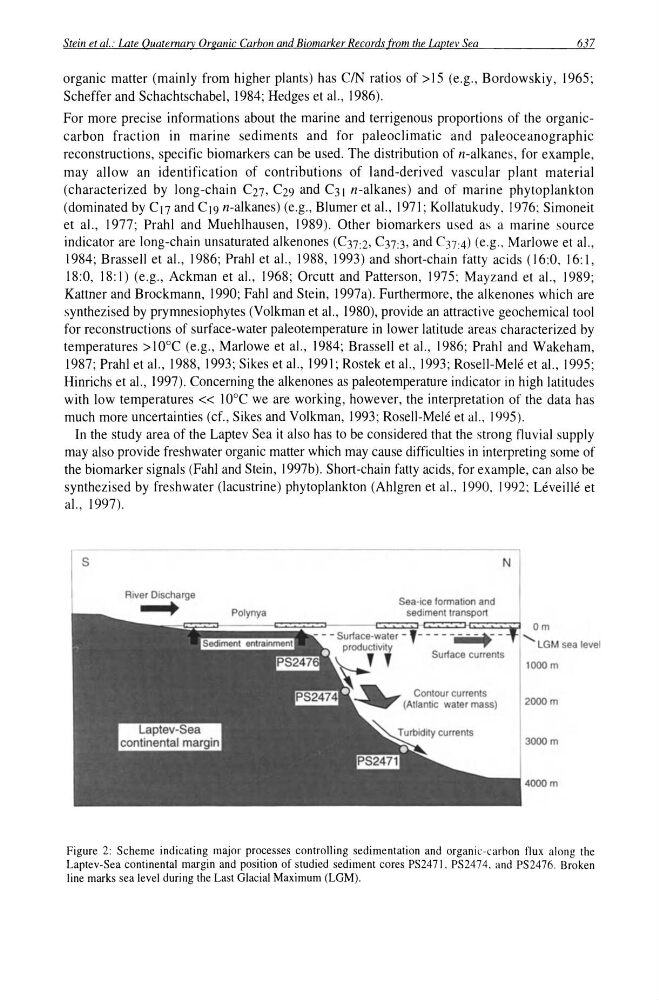
Figure 2: Scheme indicating major processes controlling sedimentation and organic-carbon nux along the
Laptev-Sea continental margin and position of studied sediment cores PS2471. PS2474. and PS2476. Broken
line marks sea level during the Last Glacial Maximum (LGM).
637
organic matter (mainly from higher plants) has CIN ratios of >15 (e.g., Bordowskiy, 1965;
Scheffer and Schachtschabel, 1984; Hedges et aI., 1986).
For more precise informations about the marine and terrigenous proportions of the organiccarbon fraction in marine sediments and for paleoclimatic and paleoceanographic
reconstructions, specific biomarkers can be used. The distribution of n-alkanes, for example,
may allow an identification of contributions of land-derived vascular plant material
(characterized by long-chain C27, C29 and C31 n-alkanes) and of marine phytoplankton
(dominated by C17 and C 19 n-alkanes ) (e.g., Blumer et aI., 1971; Kollatukudy. 1976; Simoneit
et aI., 1977; Prahl and Muehlhausen, 1989). Other biomarkers used as a marine source
indicator are long-chain unsaturated alkenones (C37:2, C37:3, and C37:4) (c.g .. Marlowe et aI.,
1984; Brassell et aI., 1986; Prahl et aI., 1988, 1993) and short-chain fatty acids (16:0, 16: I,
18:0, 18:1) (e.g., Ackman et aI., 1968; Orcutt and Patterson, 1975; Mayzand et a!., 1989;
Kattner and Brockmann, 1990; Fahl and Stein, 1997a). Furthermore, the alkenones which are
synthezised by prymnesiophytes (Volkman et a!., 1980), provide an attractive geochemical tool
for reconstructions of surface-water paleotemperature in lower latitude areas characterized by
temperatures >lOoC (e.g., Marlowe et a!., 1984; Brassell et aI., 1986; Prahl and Wakeham,
1987; Prahl et aI., 1988, 1993; Sikes et a!., 1991; Rostek et aI., 1993; Rosell-Mele et a!., 1995;
Hinrichs et a!., 1997). Concerning the alkenones as paleotemperature indicator in high latitudes
with low temperatures « I O°C we are working, however, the interpretation of the data has
much more uncertainties (cf., Sikes and Volkman, 1993; Rosell-Mele et al.. 1995).
In the study area of the Laptev Sea it also has to be considered that the strong fluvial supply
may also provide freshwater organic matter which may cause difficulties in interpreting some of
the biomarker signals (Fahl and Stein, I 997b). Short-chain fatty acids, for example, can also be
synthezised by freshwater (lacustrine) phytoplankton (Ahlgren et aI., 1990, 1992; Leveille et
a!., 1997).
s
Polynya
Sea ·ice formation and
sediment transport
N
Om
- - - - -. . . . . - -
' LGM sea level
Surface currents
Contour currenls
(Atlantic water mass)
tOOOm
2000m
3000m
4000m
Figure 2: Scheme indicating major processes controlling sedimentation and organic-carbon nux along the
Laptev-Sea continental margin and position of studied sediment cores PS2471. PS2474. and PS2476. Broken
line marks sea level during the Last Glacial Maximum (LGM).