

636
Land-Ocean Systems in the Siberian Arctic: Dynamics and History
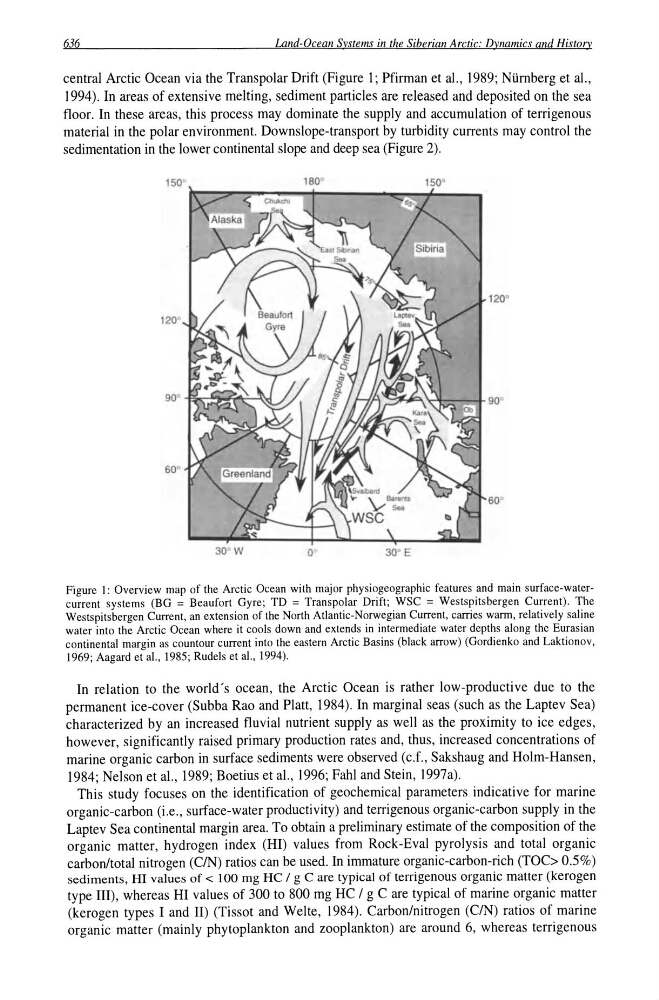
central Arctic Ocean via the Transpolar Drift (Figure I; Pfirman et aI., 1989; Niirnberg et a!.,
1994). In areas of extensive melting, sediment particles are released and deposited on the sea
floor. In these areas, this process may dominate the supply and accumulation of terrigenous
material in the polar environment. Downslope-transport by turbidity currents may control the
sedimentation in the lower continental slope and deep sea (Figure 2).
30' W
o
30' E
Figure 1: Overview map of the Arctic Ocean with major physiogeographic features and main surface-watercurrent systems (BG = Beaufort Gyre; TD = Transpolar Drift; WSC = Westspitsbergen Current). The
Westspitsbergen Current, an extension of the North Atlantic-Norwegian Current, carries warm, relatively saline
water into the Arctic Ocean where it cools down and extends in intermediate water depths along the Eurasian
continental margin as countour current into the eastern Arctic Basins (black arrow) (Gordienko and Laktionov,
1969; Aagard et ai., 1985; Rudels et ai., 1994).
In relation to the world's ocean, the Arctic Ocean is rather low-productive due to the
permanent ice-cover (Subba Rao and Platt, 1984). In marginal seas (such as the Laptev Sea)
characterized by an increased fluvial nutrient supply as well as the proximity to ice edges,
however, significantly raised primary production rates and, thus, increased concentrations of
marine organic carbon in surface sediments were observed (c.f., Sakshaug and Holm-Hansen,
1984; Nelson et a!., 1989; Boetius et a!., 1996; Fahl and Stein, 1997a).
This study focuses on the identification of geochemical parameters indicative for marine
organic-carbon (i.e., surface-water productivity) and terrigenous organic-carbon supply in the
Laptev Sea continental margin area. To obtain a preliminary estimate of the composition of the
organic matter, hydrogen index (HI) values from Rock-Eval pyrolysis and total organic
carbon/total nitrogen (CIN) ratios can be used. In immature organic-carbon-rich (TOC> 0.5%)
sediments, HI values of < 100 mg HC / g C are typical of terrigenous organic matter (kerogen
type III), whereas HI values of 300 to 800 mg HC / g C are typical of marine organic matter
(kerogen types I and II) (Tissot and Welte, 1984). Carbon/nitrogen (C/N) ratios of marine
organic matter (mainly phytoplankton and zooplankton) are around 6, whereas terrigenous
Land-Ocean Systems in the Siberian Arctic: Dynamics and History
central Arctic Ocean via the Transpolar Drift (Figure I; Pfirman et aI., 1989; Niirnberg et a!.,
1994). In areas of extensive melting, sediment particles are released and deposited on the sea
floor. In these areas, this process may dominate the supply and accumulation of terrigenous
material in the polar environment. Downslope-transport by turbidity currents may control the
sedimentation in the lower continental slope and deep sea (Figure 2).
30' W
o
30' E
Figure 1: Overview map of the Arctic Ocean with major physiogeographic features and main surface-watercurrent systems (BG = Beaufort Gyre; TD = Transpolar Drift; WSC = Westspitsbergen Current). The
Westspitsbergen Current, an extension of the North Atlantic-Norwegian Current, carries warm, relatively saline
water into the Arctic Ocean where it cools down and extends in intermediate water depths along the Eurasian
continental margin as countour current into the eastern Arctic Basins (black arrow) (Gordienko and Laktionov,
1969; Aagard et ai., 1985; Rudels et ai., 1994).
In relation to the world's ocean, the Arctic Ocean is rather low-productive due to the
permanent ice-cover (Subba Rao and Platt, 1984). In marginal seas (such as the Laptev Sea)
characterized by an increased fluvial nutrient supply as well as the proximity to ice edges,
however, significantly raised primary production rates and, thus, increased concentrations of
marine organic carbon in surface sediments were observed (c.f., Sakshaug and Holm-Hansen,
1984; Nelson et a!., 1989; Boetius et a!., 1996; Fahl and Stein, 1997a).
This study focuses on the identification of geochemical parameters indicative for marine
organic-carbon (i.e., surface-water productivity) and terrigenous organic-carbon supply in the
Laptev Sea continental margin area. To obtain a preliminary estimate of the composition of the
organic matter, hydrogen index (HI) values from Rock-Eval pyrolysis and total organic
carbon/total nitrogen (CIN) ratios can be used. In immature organic-carbon-rich (TOC> 0.5%)
sediments, HI values of < 100 mg HC / g C are typical of terrigenous organic matter (kerogen
type III), whereas HI values of 300 to 800 mg HC / g C are typical of marine organic matter
(kerogen types I and II) (Tissot and Welte, 1984). Carbon/nitrogen (C/N) ratios of marine
organic matter (mainly phytoplankton and zooplankton) are around 6, whereas terrigenous