

54
lO"
Barents
Sea
30'
Land-Ocean Systems in the Siberian Arctic: Dynamics and History
90'
120"
150"
ISO"
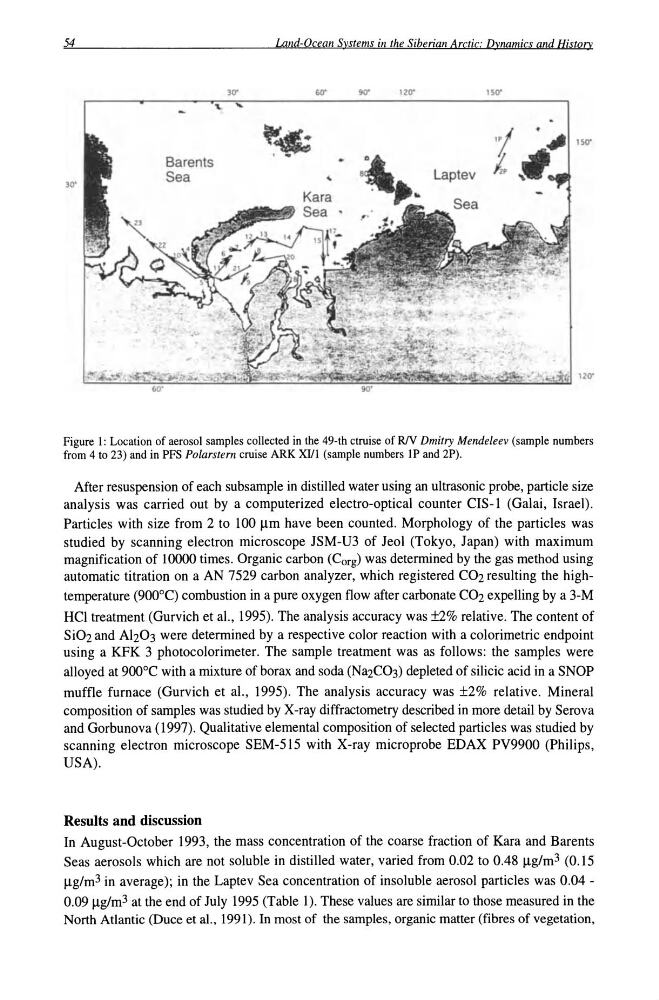
Figure I: Location of aerosol samples collected in the 49-th ctruise of RlV Dmitry Mendeleev (sample numbers
from 4 to 23) and in PFS Polarstern cruise ARK XIII (sample numbers IP and 2P).
After resuspension of each subs ample in distilled water using an ultrasonic probe, particle size
analysis was carried out by a computerized electro-optical counter CIS-I (Galai, Israel).
Particles with size from 2 to 100 11m have been counted. Morphology of the particles was
studied by scanning electron microscope JSM-U3 of Jeol (Tokyo, Japan) with maximum
magnification of 10000 times. Organic carbon (Corg) was determined by the gas method using
automatic titration on a AN 7529 carbon analyzer, which registered C02 resulting the hightemperature (900°C) combustion in a pure oxygen flow after carbonate C02 expelling by a 3-M
HCl treatment (Gurvich et aI., 1995). The analysis accuracy was ±2% relative. The content of
Si02 and Ah03 were determined by a respective color reaction with a colorimetric endpoint
using a KFK 3 photocolorimeter. The sample treatment was as follows: the samples were
alloyed at 900°C with a mixture of borax and soda (Na2C03) depleted of silicic acid in a SNOP
muffle furnace (Gurvich et aI., 1995). The analysis accuracy was ±2% relative. Mineral
composition of samples was studied by X-ray diffractometry described in more detail by Serova
and Gorbunova (1997). Qualitative elemental composition of selected particles was studied by
scanning electron microscope SEM-515 with X-ray microprobe EDAX PV9900 (Philips,
USA).
Results and discussion
In August-October 1993, the mass concentration of the coarse fraction of Kara and Barents
Seas aerosols which are not soluble in distilled water, varied from 0.02 to 0.48 Ilg/m 3 (0.15
Ilg/m3 in average); in the Laptev Sea concentration of insoluble aerosol particles was 0.04 -
0.09Ilg/m3 at the end of July 1995 (Table I). These values are similar to those measured in the
North Atlantic (Duce et a!., 1991). In most of the samples, organic matter (fibres of vegetation,
lO"
Barents
Sea
30'
Land-Ocean Systems in the Siberian Arctic: Dynamics and History
90'
120"
150"
ISO"
Figure I: Location of aerosol samples collected in the 49-th ctruise of RlV Dmitry Mendeleev (sample numbers
from 4 to 23) and in PFS Polarstern cruise ARK XIII (sample numbers IP and 2P).
After resuspension of each subs ample in distilled water using an ultrasonic probe, particle size
analysis was carried out by a computerized electro-optical counter CIS-I (Galai, Israel).
Particles with size from 2 to 100 11m have been counted. Morphology of the particles was
studied by scanning electron microscope JSM-U3 of Jeol (Tokyo, Japan) with maximum
magnification of 10000 times. Organic carbon (Corg) was determined by the gas method using
automatic titration on a AN 7529 carbon analyzer, which registered C02 resulting the hightemperature (900°C) combustion in a pure oxygen flow after carbonate C02 expelling by a 3-M
HCl treatment (Gurvich et aI., 1995). The analysis accuracy was ±2% relative. The content of
Si02 and Ah03 were determined by a respective color reaction with a colorimetric endpoint
using a KFK 3 photocolorimeter. The sample treatment was as follows: the samples were
alloyed at 900°C with a mixture of borax and soda (Na2C03) depleted of silicic acid in a SNOP
muffle furnace (Gurvich et aI., 1995). The analysis accuracy was ±2% relative. Mineral
composition of samples was studied by X-ray diffractometry described in more detail by Serova
and Gorbunova (1997). Qualitative elemental composition of selected particles was studied by
scanning electron microscope SEM-515 with X-ray microprobe EDAX PV9900 (Philips,
USA).
Results and discussion
In August-October 1993, the mass concentration of the coarse fraction of Kara and Barents
Seas aerosols which are not soluble in distilled water, varied from 0.02 to 0.48 Ilg/m 3 (0.15
Ilg/m3 in average); in the Laptev Sea concentration of insoluble aerosol particles was 0.04 -
0.09Ilg/m3 at the end of July 1995 (Table I). These values are similar to those measured in the
North Atlantic (Duce et a!., 1991). In most of the samples, organic matter (fibres of vegetation,